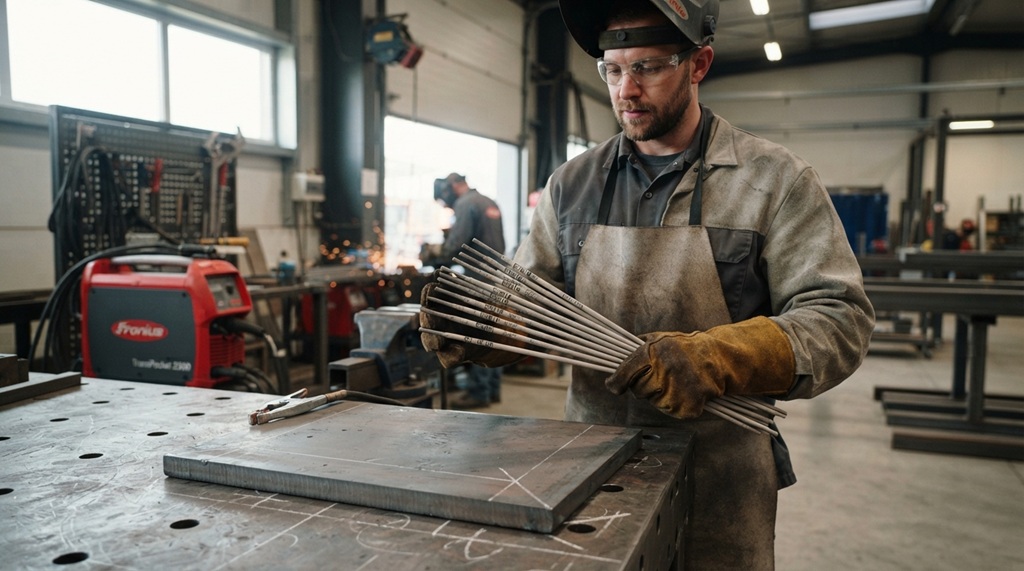

Pick a welding electrode by matching it to four things: your metal, your welding position, your machine, and the strength you need. For most steel jobs, E6013 works for light, clean work, and E7018 works for strong joints. E6010 and E6011 are best when the metal is rusty or dirty.
The wrong rod causes weak welds, tiny gas holes, and messy beads. It also wastes your time and money. However, choosing well takes only a few minutes.
First, this guide shows you how to read a rod label. Then it walks through each choice step by step, with real examples from common projects.
How to Read a Welding Rod Label
An electrode code tells you the rod’s strength, position, and coating. Once you know the code, every box makes sense.
Take E7018 as an example:
- E means arc welding electrode.
- 70 means the weld holds at least 70,000 psi.
- 1 means you can use the rod in all positions.
- 8 points to the coating type and the current it needs.
The third digit matters most for position. A “1” means flat, horizontal, vertical, and overhead. A “2” means flat and horizontal only. For instance, E7024 only works flat and horizontal.
The last digit shows the coating and the current type. Since brands differ a little, always check the box for exact settings.
Match the Rod to Your Base Metal
The rod must suit the metal you are joining. In short, the filler should match your metal’s type and strength.
Mild steel
Most beginners weld mild steel. The common rods are E6010, E6011, E6013, and E7018. The next section covers each one. For general repairs and shop projects, these rods are the usual starting point.
Stainless steel
Stainless needs a stainless rod. E308L is a common pick for 304 stainless. A mild steel rod weakens the joint and lets it rust. So, match the rod grade to the metal grade.
Cast iron and aluminum
Cast iron cracks easily. Because of this, welders use nickel rods for repairs and let the part cool slowly. Aluminum is possible with stick welding, but it is rare. Most welders choose TIG or MIG instead.
When in doubt, read the maker’s data sheet. It lists which metals each rod suits.
Compare the Most Common Steel Rods
Each rod has a clear job. Your choice depends on how clean the metal is and how strong the weld must be.
E6010 and E6011
These rods dig deep into the metal. As a result, they handle rust, paint, and dirt better than most rods. Pipe welders and farm repair crews rely on them.
E6010 needs a DC machine, while E6011 runs on AC or DC. So if your machine is AC only, choose E6011. Expect a forceful arc and a rough bead with both rods.
E6013
E6013 is the easy rod. You get a smooth arc, little spatter, and a neat bead. This rod suits thin to medium steel with a clean surface.
Because it runs on AC or DC, many home welders start here. It works well for gates, brackets, and light frames. However, it is not the best pick for heavy, load-bearing work.
E7018
E7018 makes strong, clean welds that resist cracks. Builders use it for steel beams, heavy equipment, and thick plate.
There is one catch, though. The coating soaks up water from the air. Damp rods cause gas holes and cracks. Therefore, keep E7018 in a sealed box or a rod oven, and follow the maker’s advice.
This rod runs on AC or DC. Still, it needs clean metal, so grind off rust and paint first.
E7024
E7024 has a thick coating with iron powder, so it lays down weld fast. Yet it only works flat and horizontal. Shops use it for long, straight welds on thick plate when speed matters.
Consider Position and Joint Type
Your position limits your choices, so check the third digit before you buy.
Flat welding is the easiest and works with nearly every rod. Vertical and overhead welds are harder. For those, pick an all-position rod such as E6010, E6011, E6013, or E7018. Skip E7024 here.
Joint type matters too. A thin lap joint on sheet metal calls for a gentle rod like E6013. In contrast, a deep groove on thick plate needs a rod that bites deep. For multi-pass welds on thick steel, E7018 is a standard choice.
For example, a welder building a trailer frame in the shop might use E7018 on the main joints. Later, the same welder fixing a gate outdoors could grab E6011 and weld through light rust.
Matching Your Electrode to Machine & Power Source
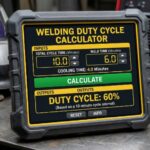
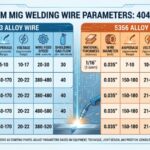
Your welding machine ultimately dictates which electrodes you can run, making a thorough compatibility check essential before buying supplies. Power sources output Alternating Current (AC), Direct Current (DC), or both; compact entry-level units often run AC-only, which easily strikes rods like E6011 and E6013 but lacks the circuitry needed to maintain an arc with E6010. Amperage capacity is equally critical, as each rod diameter requires a specific operating range a lightweight unit delivering 90 amps will struggle to penetrate a $5/32\text{“}$ rod on thick structural steel. Beyond raw output, factor in your machine’s duty cycle to prevent thermal overload during extended passes, and always pair your setup with properly rated fire resistant gear for safe metalwork to protect against extreme heat, radiant light, and spatter.
Match Rod Size to Metal Thickness
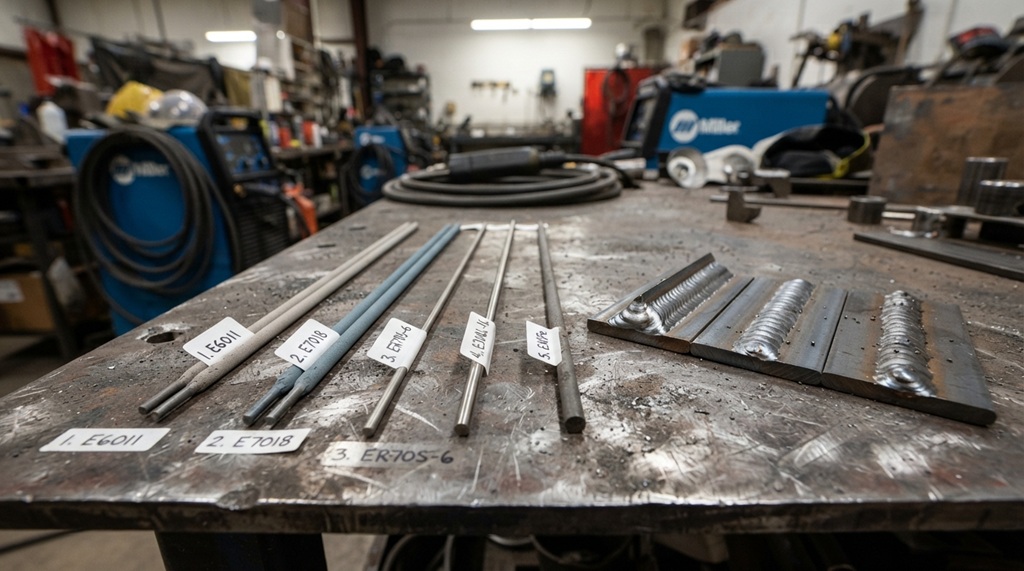
Rod size should match the thickness of your metal. A rod that is too thick burns through thin sheet. On the other hand, a rod that is too thin makes weak welds on heavy plate.
Common sizes are 3/32, 1/8, and 5/32 inch. Here is a simple guide:
- 3/32 inch: Thin metal and tight spots.
- 1/8 inch: General use on medium steel. It is the best size for most beginners.
- 5/32 inch: Thick steel and heavy repairs.
Start with the amp range on the box, then adjust. If the bead looks thin and spattery, you are probably running too hot. If the rod keeps sticking, add a few amps.
Avoid Common Electrode Mistakes
Most rod problems come from a few simple errors. Fixing them improves your welds right away.
First, many welders use damp rods. Rods like E7018 need dry storage. If a rod has sat out for a long time, dry it as the maker says or replace it.
Second, some welders skip cleaning the metal. Even tough rods work better on clean steel. A quick pass with a grinder or wire brush helps a lot.
Third, people often pick a rod by price alone. A cheap rod that does not suit the job costs more in the end. You pay for grinding out bad welds and starting over.
Finally, many beginners set the amps by guess. Instead, start in the middle of the range on the box. Then adjust in small steps until the arc sounds steady.
Frequently Asked Questions
What is the best welding electrode for beginners?
E6013 is the best choice for most beginners. It strikes easily and makes a neat bead. Moreover, it works on both AC and DC machines, so it suits most home welders.
Can I use E7018 on rusty metal?
You should clean the metal first. E7018 does not handle rust and paint well, and dirty metal can cause gas holes. If you cannot clean the surface, E6010 or E6011 is a better pick.
Why do I need to keep E7018 rods dry?
The coating on E7018 soaks up water from the air. That water can cause gas holes and cracks in the weld. For this reason, store the rods in a sealed box or a rod oven.
Can I weld two different metals with one electrode?
Sometimes, but it depends on the metals. Joining stainless steel to mild steel is a common case. It needs a special rod, often a high-alloy stainless type. Check the maker’s guide for your exact pairing.
What do the numbers on a welding rod mean?
The first two digits show strength in thousands of psi. Next, the third digit shows which positions the rod can handle. Finally, the last digit shows the coating type and the current it uses.
Conclusion
Choosing the right welding electrode comes down to four checks. Match the rod to your metal, your position, your machine, and your joint. Then match the rod size to your metal thickness.
As a simple rule, use E6013 for clean, light work. Use E6010 or E6011 for dirty metal. Choose E7018 when strength matters most. Before you strike an arc, read the rod box and set your amps in the listed range. A few minutes of prep will save you hours of rework.