

Every welder faces the same practical questions. How much gas am I using? How long will my cylinder last? Am I wasting gas by running the flow too high? Getting these answers right saves money, prevents weld defects, and keeps your shop running without surprise interruptions. This guide covers the welding gas flow rate calculator formula in plain language, walks through the key calculations for CFH and L/min, and shows you exactly how to estimate cylinder runtime for any process or tank size.
Why Gas Flow Rate Matters in Welding
Shielding gas protects your weld pool from contamination. It forms a barrier around the arc that blocks oxygen, nitrogen, and moisture from reaching the molten metal. Without proper shielding, welds develop porosity, cracks, and weak spots.
Flow rate is the volume of gas your torch delivers per unit of time. Too little flow leaves the weld pool exposed. Too much flow creates turbulence, which pulls ambient air into the weld zone and causes the same porosity problems you were trying to prevent. Additionally, running flow too high burns through your gas cylinders much faster than necessary.
Therefore, dialing in the right flow rate is not just a technical detail. It is a fundamental part of welding quality and cost control.
Understanding the Units: CFH vs L/min
In the United States, flow rate is most commonly measured in cubic feet per hour, written as CFH. In most other countries, liters per minute, written as L/min, is the standard. Both describe the same thing — the volume of gas moving through your torch per unit of time.
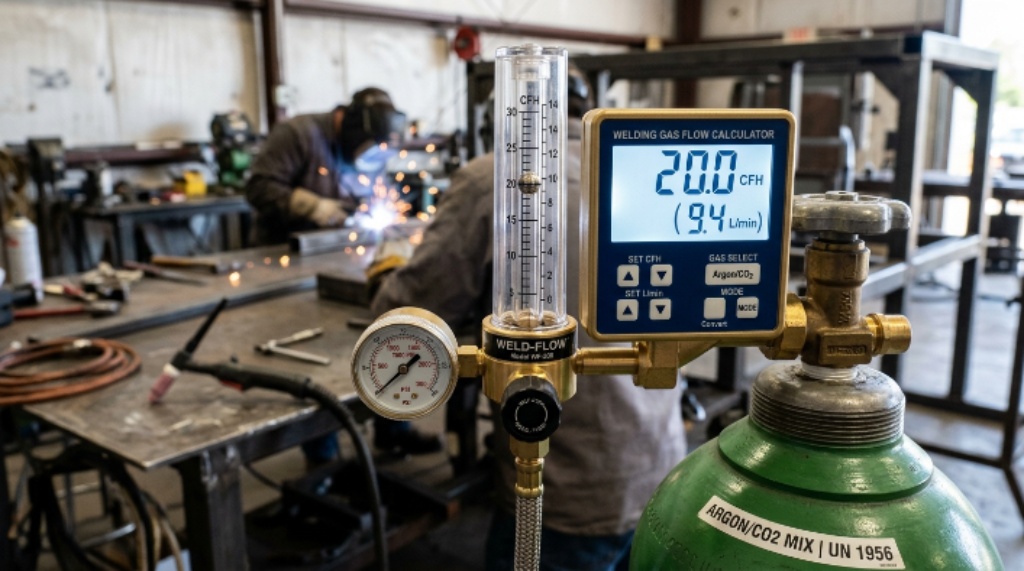
Converting between the two is straightforward. One CFH equals 0.472 L/min. Therefore, if you know your flow rate in one unit, you can find the other with simple multiplication or division.
| Conversion | Formula | Example |
| CFH to L/min | CFH × 0.472 | 20 CFH × 0.472 = 9.44 L/min |
| L/min to CFH | L/min ÷ 0.472 | 10 L/min ÷ 0.472 = 21.2 CFH |
This conversion comes up often when reading equipment specs from international manufacturers or comparing regulators designed for different markets.
The Core Gas Flow Rate Formula
The basic formula for calculating gas flow rate is simple. Flow rate equals volume divided by time.
When you know how much gas you consumed and how long you welded, you can work backwards to find your flow rate. For example, if you used 30 cubic feet of argon over 90 minutes of welding, you convert 90 minutes to 1.5 hours, then divide 30 by 1.5. The result is 20 CFH. That falls within the normal MIG welding range and confirms your regulator was set correctly.
| What You Know | What You Want | Calculation |
| Volume used + time welded | Flow rate (CFH) | Volume (CF) ÷ Time (hours) |
| Flow rate + time welded | Volume consumed (CF) | CFH × Hours |
| Cylinder capacity + flow rate | Runtime (hours) | Cylinder CF ÷ CFH |
These three versions of the same formula cover the most common questions welders ask about gas consumption.
How to Calculate Cylinder Runtime
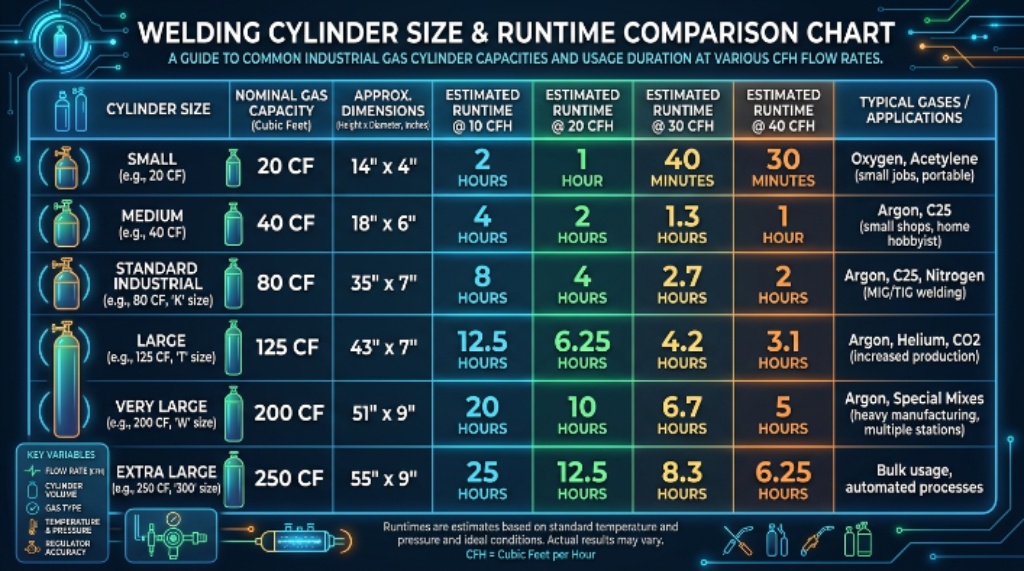
Knowing how long your cylinder will last before it runs empty is one of the most practical calculations in welding. The formula divides the total cylinder capacity in cubic feet by your flow rate in CFH.
For example, a 125 cubic foot cylinder running at 20 CFH gives 6.25 hours of continuous arc-on time. However, welding is rarely continuous. Most welders spend time fitting, tacking, grinding, and repositioning between passes. Therefore, real-world cylinder life is typically longer than the calculated number.
A duty cycle factor helps account for this. If you estimate you are actually welding about 40 percent of the time you have the machine running, multiply your calculated runtime by 2.5 to get a more realistic estimate.
| Cylinder Size (CF) | Flow Rate (CFH) | Continuous Runtime | At 40% Duty Cycle |
| 40 CF | 20 CFH | 2.0 hours | ~5.0 hours |
| 80 CF | 20 CFH | 4.0 hours | ~10.0 hours |
| 125 CF | 20 CFH | 6.25 hours | ~15.6 hours |
| 125 CF | 25 CFH | 5.0 hours | ~12.5 hours |
| 250 CF | 20 CFH | 12.5 hours | ~31.25 hours |
Keep in mind that you cannot use the last 50 to 100 PSI in your cylinder reliably. Pressure drops at the end of a tank can cause inconsistent flow. Therefore, treat your usable volume as roughly 85 to 90 percent of the nominal cylinder capacity for planning purposes.
Recommended Flow Rates by Welding Process
The right flow rate depends on your welding process, the gas type, your environment, and the nozzle size you are using. The table below gives practical starting points for the most common processes used by US welders.
| Welding Process | Gas Type | Recommended Flow Rate | Notes |
| MIG — mild steel, indoors | 75/25 Ar/CO2 (C25) | 15–22 CFH (7.1–10.4 L/min) | Standard starting point for most shops |
| MIG — stainless steel | 98/2 Ar/O2 or tri-mix | 20–30 CFH (9.4–14.2 L/min) | Higher flow for larger bead sizes |
| MIG — aluminum | 100% Argon | 25–35 CFH (11.8–16.5 L/min) | Argon-rich mixes need more flow |
| TIG — steel and stainless | 100% Argon | 15–20 CFH (7.1–9.4 L/min) | Adjust for cup size |
| TIG — aluminum | 100% Argon | 18–25 CFH (8.5–11.8 L/min) | Larger cups increase demand |
| Plasma cutting | Mixed or pure Argon | 35–50 CFH (16.5–23.6 L/min) | Higher volume process |
| Outdoor welding (light wind) | Any | Add 10–15 CFH | Wind disrupts shielding coverage |
A useful rule of thumb for nozzle sizing is approximately 1 CFH per 1/16 inch of nozzle opening. A 5/8-inch nozzle, for example, supports a flow rate of around 10 CFH as a starting baseline.
How to Calculate Total Gas Usage for a Job
Planning gas consumption before starting a project helps you avoid running out mid-job and lets you order the right cylinder size. The formula multiplies your flow rate by your estimated arc-on time.
For instance, if you plan to weld for a total of four arc-on hours at 25 CFH, you will consume 100 cubic feet of gas. An 80 cubic foot cylinder would not be enough. A 125 cubic foot cylinder covers the job with reserve.
However, arc-on time is not the same as total time at the machine. If your job takes eight clock hours but you estimate you are actively welding half that time, your arc-on time is four hours. This distinction matters a great deal for accurate planning.
Additionally, account for gas used during pre-flow and post-flow. TIG welding in particular uses several seconds of post-flow after each stop to protect the tungsten and cooling weld pool. On long TIG sessions with many starts and stops, this adds up.
Common Cylinder Sizes for US Welders
Understanding the standard cylinder sizes available from US gas suppliers helps you apply the runtime calculations above to real purchasing decisions.
| Cylinder Size | Cubic Feet | Best For |
| R (Small portable) | 20–40 CF | Fieldwork, backup, small repairs |
| Q (Standard home shop) | 80 CF | Hobbyists, weekly use |
| #4 / R-size | 125 CF | Small fabrication shops, frequent welders |
| T / K (Large industrial) | 250–330 CF | Production shops, daily heavy use |
The 80 cubic foot cylinder is the most popular choice for home welders. It fits on a standard welding cart, is manageable for one person to move, and lasts long enough for weekend projects. The 125 cubic foot cylinder is the next step up and roughly doubles your time between refills for only a small additional cost per cubic foot.
For CO2 cylinders, gas is sold by weight rather than volume. One pound of CO2 produces approximately 8.7 cubic feet of shielding gas. A 20-pound CO2 cylinder therefore contains roughly 174 cubic feet of usable gas, which gives it strong runtime at typical MIG flow rates.
Signs Your Flow Rate Is Wrong
Even with the right numbers, real-world conditions can push your actual shielding coverage off target. Knowing the warning signs helps you adjust quickly.
Signs your flow rate may be too low:
- Porosity, pinholes, or pitting visible in the weld bead
- Discoloration or oxidation on the weld surface
- Inconsistent arc behavior, especially at the start of a bead
Signs your flow rate may be too high:
- Porosity despite high flow settings (turbulence pulling in air)
- Excessive gas consumption and faster than expected cylinder depletion
- Spatter increases when running flow above 40 CFH
Additionally, check for leaks at every fitting and hose connection. A slow leak of just 5 CFH wastes a full 80 cubic foot cylinder in about 16 hours of machine-on time, even without welding. Soap solution on every connection reveals leaks quickly and saves significant cost over a year.
Practical Tips for Accurate Gas Management
A few simple habits make gas calculation easier and more accurate over time.
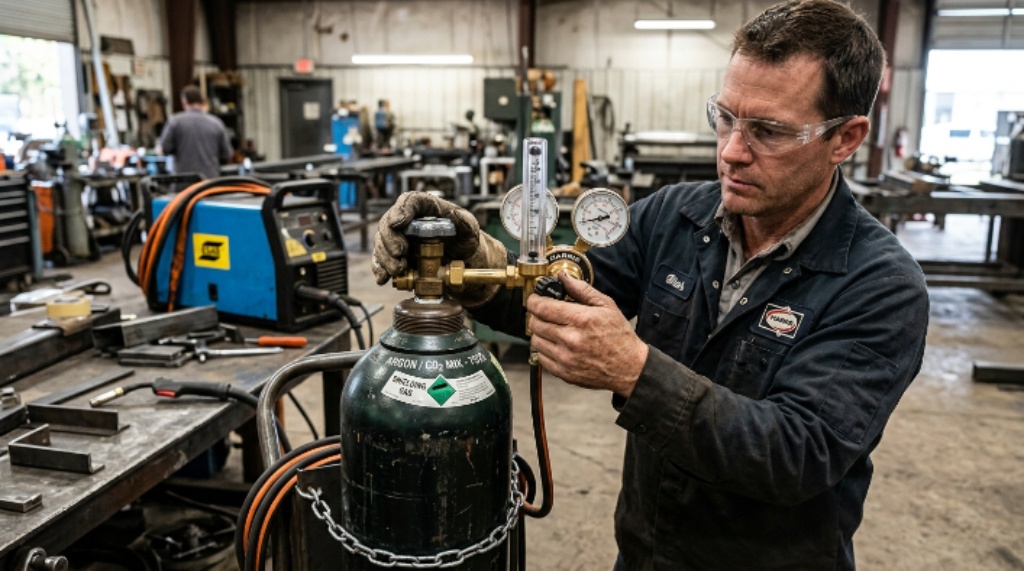
- Record your cylinder pressure at the start and end of each session to track actual consumption
- Always set your flow rate while the trigger is pressed and gas is actively flowing, not before
- Turn the regulator adjustment to zero at the end of each day to preserve the diaphragm
- Store cylinders upright and secured; CO2 cylinders must always remain vertical during use
- Open the cylinder valve fully and then back off a quarter turn to prevent valve freeze and seat the packing properly
Conclusion
Calculating welding gas flow rate, gas usage, and cylinder runtime does not require complex tools. The core formulas are straightforward: flow rate equals volume divided by time, gas consumed equals flow rate multiplied by arc-on hours, and cylinder runtime equals cylinder capacity divided by flow rate. Converting between CFH and L/min requires only a multiplication by 0.472. Recommended flow rates range from 15 to 22 CFH for indoor MIG on mild steel up to 35 to 50 CFH for plasma cutting, with adjustments for wind, gas type, and nozzle size. Choosing the right cylinder size and monitoring your actual consumption over time gives you full control over one of the most overlooked costs in any welding operation.
Frequently Asked Questions
What is a good gas flow rate for MIG welding?
For MIG welding mild steel indoors with a C25 mix (75% argon, 25% CO2), a flow rate of 15 to 22 CFH (7 to 10.4 L/min) works well for most applications. Start at around 20 CFH and adjust based on results. Reduce if you see turbulence-related porosity at higher settings, and increase slightly if welding in a light draft.
How do I convert CFH to L/min?
Multiply your CFH value by 0.472 to get L/min. For example, 20 CFH multiplied by 0.472 equals 9.44 L/min. To convert the other way, divide your L/min value by 0.472. This conversion applies to all shielding gas types and processes.
How long will an 80 cubic foot cylinder last?
At a flow rate of 20 CFH with continuous welding, an 80 CF cylinder lasts approximately four hours of arc-on time. With a typical 40 percent welding duty cycle — where you are actively welding less than half the time the machine is running — the same cylinder provides roughly ten hours of practical shop time.
Why does too much gas cause weld defects?
Above approximately 35 to 40 CFH, shielding gas flow becomes turbulent rather than smooth and laminar. Turbulent flow pulls ambient air into the weld zone instead of pushing it away, introducing oxygen and nitrogen that cause porosity. More gas does not always mean better shielding — the goal is steady, laminar coverage over the weld pool.
How do I calculate how much gas I need for a job?
Multiply your planned flow rate in CFH by your estimated arc-on hours. If you plan to weld for three arc-on hours at 25 CFH, you need 75 cubic feet of gas. Add 10 to 15 percent as a buffer for pre-flow, post-flow, and minor leaks, which brings your planned requirement to around 83 to 87 cubic feet. A 125 CF cylinder covers this comfortably.