
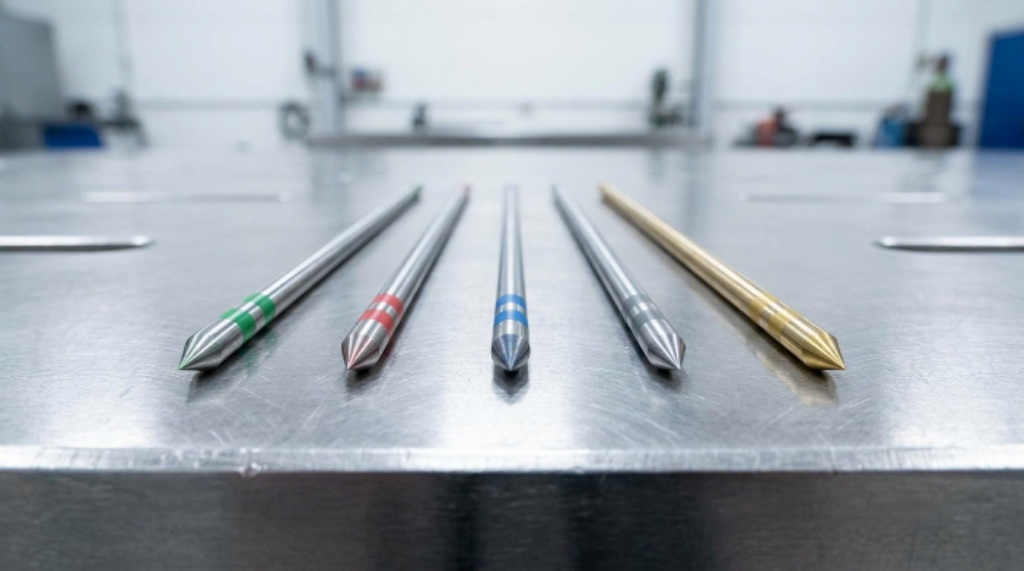
Choosing a TIG tungsten electrode looks simple until you stand in front of a welding-supply rack and see green, red, blue, gray, gold, brown, and other color bands staring back at you. Those colors are not just cosmetic. They identify different tungsten compositions, and the alloy you choose can affect arc starting, arc stability, electrode life, current capacity, tip shape, and the way the electrode behaves on AC and DC.
The good news is that you do not need a different tungsten for every welding job. Once you understand what the alloy actually does, tungsten selection becomes much more straightforward.
This guide covers the major TIG tungsten types, current AWS classification information, AC versus DC selection, electrode diameter, grinding and tip preparation, safety considerations, and practical recommendations for common welding applications.
Quick answer: For many modern TIG welders, 2% lanthanated tungsten is a strong all-around choice because it performs well on both AC and DC. For low-amperage work, ceriated tungsten can be useful. Thoriated tungsten remains an effective DC electrode but contains radioactive thorium, making thorium-free alternatives attractive for many shops. Pure and zirconiated tungsten still have applications, particularly with AC welding, but the best choice depends heavily on the machine and its manufacturer’s recommendations.
What Is a TIG Tungsten Electrode?
TIG, or gas tungsten arc welding (GTAW), uses a non-consumable tungsten electrode to establish and maintain the welding arc.
Unlike a MIG wire or stick electrode, the tungsten is not supposed to become part of the weld. Its job is to provide a stable path for the electrical arc while shielding gas protects the electrode and molten weld pool from atmospheric contamination.
Tungsten is exceptionally heat resistant, but pure tungsten is not always the best performer in a TIG arc. Manufacturers add small amounts of oxides such as lanthanum, cerium, zirconium, or thorium to change the electrode’s electron-emission characteristics and improve arc performance.
That is why two tungsten electrodes that look almost identical can behave very differently in the torch.
The Major Types of Tungsten for TIG Welding
The current AWS A5.12M/A5.12:2024 specification covers pure and oxide-dispersed tungsten electrodes and establishes classifications, chemical-composition requirements, sizes, identification, and color coding. It is the current eighth edition and replaced the 2009 edition.
Here are the most important tungsten types for TIG welding.
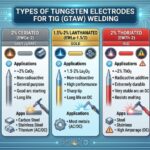
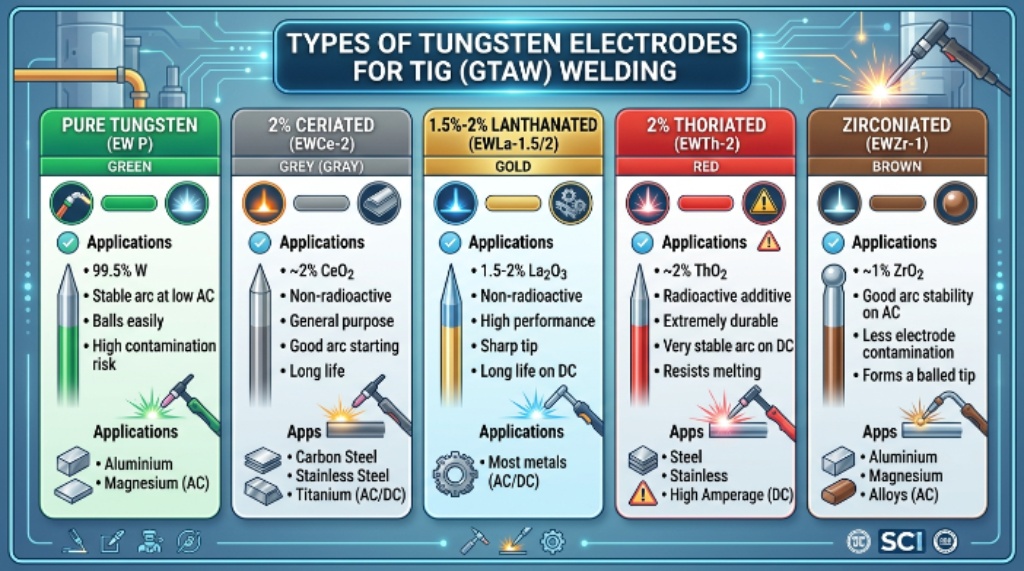
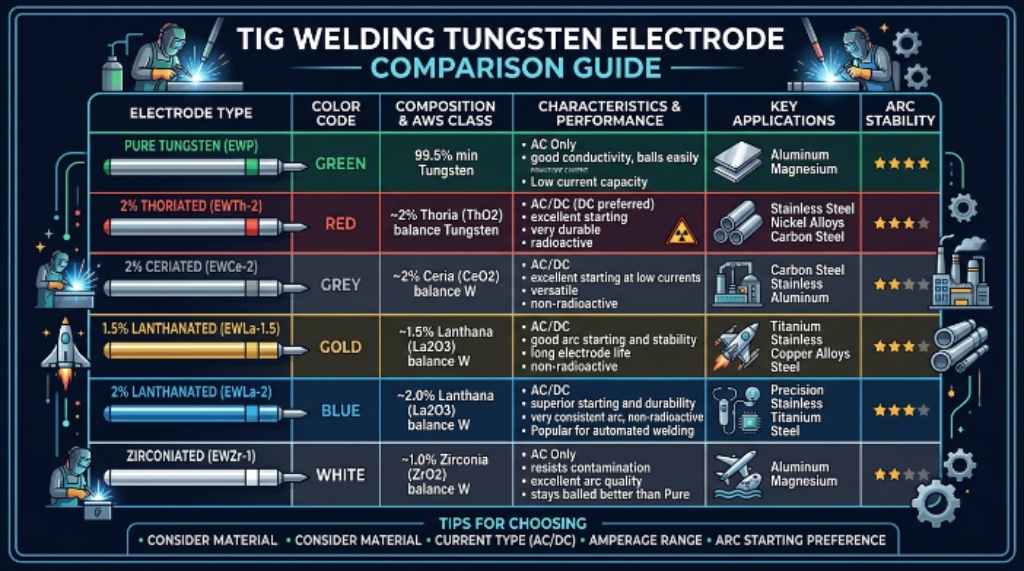
| Tungsten type | Common color* | AWS classification | Typical strengths | Common applications |
| Pure tungsten | Green | EWP | Good traditional AC performance; forms a ball | Older AC machines, aluminum and magnesium |
| 1% lanthanated | Black | EWLa-1 | Versatile, good starting characteristics | AC/DC general welding |
| 1.5% lanthanated | Gold | EWLa-1.5 | Excellent all-around performance | AC/DC, inverter TIG |
| 2% lanthanated | Blue | EWLa-2 | Strong arc starts, good current capacity | AC/DC, general-purpose work |
| 2% ceriated | Gray | EWCe-2 | Excellent low-current starting | Thin material, precision work, AC/DC |
| 1% thoriated | Yellow | EWTh-1 | Strong DC performance | DC welding |
| 2% thoriated | Red | EWTh-2 | Excellent DC arc characteristics | Steel, stainless, titanium |
| 1% zirconiated | Brown | EWZr-1 | Good AC performance and contamination resistance | Aluminum and magnesium |
| 0.8% zirconiated | White in many systems | EWZr-8 | AC performance and high-current capability | AC aluminum/magnesium |
| Rare-earth blends | Varies | EWG | Broad performance depending on formulation | Specialized AC/DC applications |
*Color identification can vary between standards and markets, so always verify the classification on the packaging rather than relying on color alone. AWS A5.12:2024 specifies identification and color coding, while ISO classifications may use somewhat different nomenclature.
1. Pure Tungsten — Green
Pure tungsten is generally identified by a green band and is classified as EWP.
It was traditionally the go-to electrode for AC aluminum and magnesium welding, particularly with older transformer-based TIG machines. When used with conventional AC, pure tungsten can form a rounded or balled end that was historically considered desirable for aluminum welding.
However, the old rule of “green tungsten for all aluminum” is no longer a good universal recommendation.
Modern inverter TIG machines provide considerably more control over AC frequency, balance, and waveform. Manufacturers now commonly recommend rare-earth tungsten, such as lanthanated or ceriated electrodes, instead of pure tungsten for many inverter AC applications.
Best use: Older transformer-style AC TIG equipment and applications where the machine or welding procedure specifically calls for pure tungsten.
Downside: Lower current capability and less favorable arc-starting characteristics on many modern inverter machines.
2. Lanthanated Tungsten — Black, Gold, or Blue
Lanthanated tungsten is one of the most useful choices for modern TIG welding.
The electrode contains lanthanum oxide, and common grades include 1%, 1.5%, and 2% lanthanated tungsten. In U.S. AWS color coding, these are generally black, gold, and blue respectively.
The 2% lanthanated electrode, commonly called blue tungsten, has become a popular general-purpose choice because it can perform well on both AC and DC.
Current manufacturer guidance specifically identifies 1.5% and 2% lanthanated tungsten as strong choices for modern TIG applications, including AC welding.
Why welders like lanthanated tungsten
- Good arc-starting characteristics
- Stable arc at low and high amperage
- Good resistance to tip erosion
- Suitable for AC and DC on many modern machines
- No radioactive thorium
- Works well with inverter TIG technology
If you are a beginner who wants to stock one general-purpose tungsten instead of buying five different boxes, 2% lanthanated is a sensible starting point, provided it is compatible with your machine and welding procedure.
1% vs. 1.5% vs. 2% lanthanated
The percentage refers to the approximate amount of lanthanum oxide dispersed through the tungsten.
For most hobby and general fabrication work, you should not obsess over the difference between 1%, 1.5%, and 2%. The welding machine, electrode diameter, current level, tip preparation, and actual application usually have a greater practical impact.
For a simple starting point, 1.5% or 2% lanthanated is a strong choice for a modern AC/DC inverter.
3. Ceriated Tungsten — Gray
Ceriated tungsten contains cerium oxide and is commonly identified as gray in current U.S. color coding.
Its biggest advantage is easy arc initiation at relatively low amperage.
That makes ceriated tungsten particularly useful for thin sheet, small components, precision TIG work, and applications where maintaining a small, controlled arc matters.
Ceriated tungsten can be used on both AC and DC, although its performance and service life at higher amperages can make lanthanated tungsten the more practical general-purpose choice for many shops.
Choose ceriated when:
- You frequently weld at low amperage.
- You work with thin sheet metal.
- Easy arc starting is important.
- You need precise control on small parts.
For high-current production work, another tungsten may offer better electrode life.
4. Thoriated Tungsten — Red
Two percent thoriated tungsten, or EWTh-2, is traditionally identified by a red band.
For decades, it was one of the standard choices for DC TIG welding. Adding thorium improves electron emission, which helps the electrode start easily, maintain a stable arc, and carry substantial current while retaining a pointed tip.
It is particularly associated with DC welding of:
- Carbon steel
- Stainless steel
- Nickel alloys
- Titanium
There is, however, an important tradeoff: thorium is radioactive.
The concern is not that a welder should panic when they see a red tungsten electrode. The issue is controlling exposure, particularly when the electrode is sharpened and grinding dust is generated. Research has measured airborne thorium-containing particles during TIG electrode sharpening, and AWS safety material has recommended considering thorium-free alternatives such as lanthanated, ceriated, yttrium-containing, or zirconium-containing electrodes.
For that reason, many welders can simplify their shop by using a thorium-free alternative such as lanthanated tungsten.
If a welding procedure, workplace, or application specifically requires thoriated tungsten, follow the applicable safety program, ventilation, dust-control, PPE, storage, and disposal requirements.
5. Zirconiated Tungsten — Brown or White
Zirconiated tungsten contains zirconium oxide and is strongly associated with AC welding.
Its major advantage is resistance to contamination and its ability to tolerate AC applications where a rounded electrode end is appropriate.
That makes it particularly useful for aluminum and magnesium welding.
Zirconiated tungsten is generally not the first choice for DC TIG, but it can be an excellent AC electrode when the machine and procedure call for it. Lincoln Electric’s TIG documentation, for example, identifies zirconiated tungsten as an AC-oriented electrode with good resistance to contamination and specifically warns against using it for DC.
For older transformer-based AC machines, zirconium-containing tungsten can still make a lot of sense. On a modern inverter machine, however, compare the electrode manufacturer’s recommendation with the TIG machine manual before making your choice.
Which Tungsten Is Best for TIG Welding?
There is no single tungsten that is objectively best for every TIG application.
A better way to choose is to work through these four questions:
1. Are you welding AC or DC?
DC TIG: Common for steel, stainless steel, titanium, nickel alloys, and many other metals.
AC TIG: Common for aluminum and magnesium.
2. What TIG machine are you using?
An older transformer machine and a modern inverter machine can behave very differently.
This is especially important for AC. Modern inverter machines can maintain a focused arc using alloyed tungsten and controlled AC waveforms, so the traditional advice to automatically use pure tungsten and a large ball is no longer universal.
3. What amperage are you running?
The tungsten diameter must be appropriate for the current.
A tiny electrode pushed beyond its useful current range can overheat, deform, or contaminate the weld. An oversized electrode may be unnecessarily difficult to start and less responsive at very low current.
4. What does the machine or welding procedure specify?
For production work, code work, aerospace, pressure equipment, or other critical applications, follow the applicable welding procedure rather than a generic internet chart.
What Tungsten Size Should You Use?
Common TIG tungsten diameters include:
- 040 inch — very low-current precision work
- 1/16 inch — thin material and lower amperage
- 3/32 inch — versatile general-purpose size
- 1/8 inch — higher-current applications
- 5/32 inch and larger — high-current welding
There is no universal amperage range that applies to every tungsten composition and every TIG machine.
AWS A5.12:2024 includes approximate current-range information based on electrode diameter, while equipment manufacturers publish their own recommendations based on electrode composition and machine characteristics.
For many beginners, 3/32-inch lanthanated tungsten is a practical size for learning TIG on mild steel and stainless steel. For very thin material, step down to 1/16 inch. And for higher-current aluminum work, a larger diameter may be necessary.
Do not choose diameter from metal thickness alone. Actual welding current and the electrode’s current capacity matter.
How Should You Grind a TIG Tungsten?
Tungsten preparation is just as important as alloy selection.
For typical DC TIG welding, grind the electrode lengthwise so the grinding marks run along the electrode rather than around it.
A longitudinal grind helps keep the arc concentrated and predictable. Manufacturer guidance specifically recommends using a diamond wheel and grinding in the longitudinal direction.
Basic tungsten preparation
- Use a clean, dedicated diamond grinding wheel or suitable tungsten grinder.
- Grind in the direction of the electrode’s length.
- Create the point or truncated point recommended for your application.
- Keep the tungsten clean after grinding.
- Do not use a contaminated electrode.
- Regrind immediately if the tungsten touches the weld pool or filler metal.
A tungsten that has dipped into the puddle can contaminate the weld and destabilize the arc. Continuing to weld with it usually makes the problem worse.
Pointed vs. truncated vs. balled tungsten
Pointed: Common for DC TIG because it produces a focused arc.
Truncated point: Often preferred for higher-current applications because removing the extremely sharp tip reduces the risk of the point overheating or breaking down.
Balled: Traditionally associated with AC welding using pure or zirconiated tungsten on transformer machines.
Modern AC inverter machines may use a tapered or truncated electrode rather than a large ball. Always follow the tungsten and machine manufacturer’s recommendation.
What Happens When Tungsten Touches the Weld?
It happens to everyone, especially while learning TIG.
When the tungsten touches the puddle, molten metal can stick to the electrode. You may notice:
- A wandering arc
- Difficult arc starts
- Spitting
- Black or dirty particles
- A wider or unstable arc
- Visible tungsten contamination in the weld
The fix is simple: stop welding and regrind or replace the tungsten.
Do not try to “burn the contamination off” while continuing the weld. You are more likely to make the problem worse and introduce tungsten into the weld.
Best Tungsten for Common TIG Applications
Mild steel
For DC TIG on mild steel, 1.5% or 2% lanthanated is an excellent modern choice. Thoriated tungsten also performs very well, but many welders choose lanthanated to avoid the additional thorium-related handling concerns.
Stainless steel
For DC TIG stainless work, lanthanated, ceriated, and thoriated electrodes can all be used depending on the application.
For a general-purpose shop setup, 2% lanthanated is a straightforward choice.
Remember that tungsten is only one part of stainless TIG quality. Clean material, proper shielding, heat control, and correct torch technique are equally important.
Aluminum
For AC aluminum, do not automatically reach for green tungsten.
Older transformer machines may work very well with pure or zirconiated tungsten. Modern inverter TIG machines commonly support alloyed tungsten such as lanthanated or ceriated electrodes and can use a more controlled tip geometry.
Your machine’s manual should take priority.
Thin sheet metal
For very low-current work, 2% ceriated can be an excellent option because of its arc-starting characteristics.
A properly sized 1/16-inch electrode may also be more appropriate than simply changing tungsten alloy.
A Simple Tungsten Buying Strategy for Beginners
If you are building your first TIG setup, you do not need a drawer full of every tungsten color.
A practical starting setup is:
For general AC/DC TIG: 2% lanthanated, usually blue in the AWS color system.
For low-current precision work: 2% ceriated, usually gray.
Traditional AC equipment: Pure or zirconiated, depending on the machine recommendation.
For specialized DC procedures: Thoriated may still be specified, but understand the handling and grinding considerations.
Then buy the correct diameter for the amperage you actually use.
This approach is more useful than memorizing a color chart because it connects the electrode choice to the welding process.
Tungsten Safety: What You Should Know
TIG welding has hazards beyond tungsten selection, including arc radiation, electrical hazards, hot metal, welding fumes, and grinding particles. OSHA identifies welding operations as presenting hazards including UV radiation, fumes and gases, burns, eye injuries, electrical shock, and other physical hazards.
When preparing tungsten:
- Wear appropriate eye protection.
- Control grinding dust.
- Use suitable ventilation or dust extraction.
- Keep the grinding area clean.
- Do not eat or drink around grinding dust.
- Store electrodes in a clean, labeled container.
- Keep different tungsten compositions separated.
- Take additional precautions when grinding thoriated tungsten.
For thoriated tungsten specifically, thorium’s radioactive nature makes dust control especially important. AWS and published occupational-exposure research support reducing unnecessary exposure and considering thorium-free alternatives where practical.
Frequently Asked Questions
What is the best all-purpose tungsten for TIG welding?
For many modern AC/DC inverter TIG machines, 2% lanthanated tungsten is one of the best all-purpose choices. It offers good arc starting, stable performance, and useful AC/DC versatility. Always check the machine manufacturer’s recommendation.
What color tungsten is best for stainless steel?
For DC TIG stainless steel, blue 2% lanthanated tungsten is a practical general-purpose choice. Red 2% thoriated tungsten also has excellent DC performance, but it contains radioactive thorium and requires appropriate handling and grinding controls.
Is blue tungsten better than red tungsten?
Not universally. Blue usually identifies 2% lanthanated tungsten, while red usually identifies 2% thoriated tungsten. Both can perform very well on DC. Lanthanated tungsten has the major advantage of being thorium-free.
What tungsten should I use for aluminum?
It depends on your TIG machine. Pure or zirconiated tungsten may be appropriate for traditional transformer AC welding, while modern inverter machines commonly use lanthanated or ceriated electrodes. Check the machine manual and electrode manufacturer’s recommendations rather than relying on an old “green for aluminum” rule.
Should TIG tungsten be pointed or balled?
For conventional DC TIG, a pointed or truncated electrode is typical. Older AC aluminum procedures commonly used a balled electrode. Modern inverter AC TIG often uses a tapered or truncated electrode instead. The correct geometry depends on the tungsten type, machine, current, and application.
Can I use 2% lanthanated tungsten for both AC and DC?
Yes. That is one of its major advantages. Many modern TIG systems can use 2% lanthanated tungsten effectively for both AC and DC, although specific machine and procedure recommendations should always take precedence.
Is thoriated tungsten dangerous?
Thoriated tungsten contains radioactive thorium. That does not mean ordinary use automatically creates a serious exposure, but grinding and handling can generate thorium-containing dust. Appropriate ventilation, dust control, hygiene, PPE, and workplace procedures are important. Thorium-free alternatives are widely available.
Why does my tungsten keep balling up?
Possible causes include excessive amperage for the electrode diameter, unsuitable tungsten type, AC settings, incorrect polarity, excessive electrode stickout, inadequate cooling, or an improperly prepared electrode.
Do not assume the tungsten itself is always the problem. Check amperage, polarity, AC balance, shielding gas, torch setup, and the machine’s recommended electrode type.
How often should I sharpen TIG tungsten?
There is no fixed number of welds. Regrind whenever the point becomes damaged, contaminated, excessively rounded, or unstable.
If the tungsten touches the puddle, filler rod, or another contaminated surface, stop and regrind it before continuing.
Final Takeaway
The best tungsten for TIG welding is not determined by color alone.
Think of tungsten selection as a combination of electrode composition + AC/DC current + machine technology + amperage + diameter + tip preparation.
For many welders using modern inverter equipment, 2% lanthanated tungsten is the easiest starting point because it covers a broad range of AC and DC applications. Ceriated tungsten makes sense for low-current precision work, while pure and zirconiated electrodes remain useful in specific AC applications. Thoriated tungsten still has strong DC characteristics, but its radioactive thorium content makes thorium-free alternatives worth considering.
Most importantly, do not let tungsten selection distract from the fundamentals. A perfectly chosen electrode will not compensate for contaminated base metal, poor shielding gas coverage, incorrect amperage, a dirty cup, bad torch technique, or the wrong AC settings.
Choose the tungsten based on the complete welding setup, prepare it correctly, keep it clean, and let your machine’s operating manual and applicable welding procedure have the final say.
Sources and technical references
- AWS A5.12M/A5.12:2024 — current specification for tungsten and oxide-dispersed tungsten electrodes.
- Miller Electric TIG guidance — current recommendations on tungsten selection, AC inverter welding, electrode preparation, and rare-earth tungsten.
- ESAB TIG guidance — tungsten selection, AC/DC applications, and electrode sizing considerations.
- OSHA welding safety guidance — welding, grinding, PPE, fumes, radiation, and workplace hazards.
- Published occupational-exposure research on thorium-containing TIG electrodes and electrode sharpening.