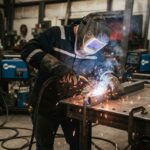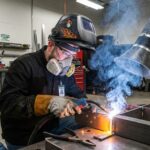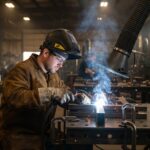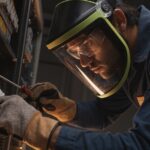
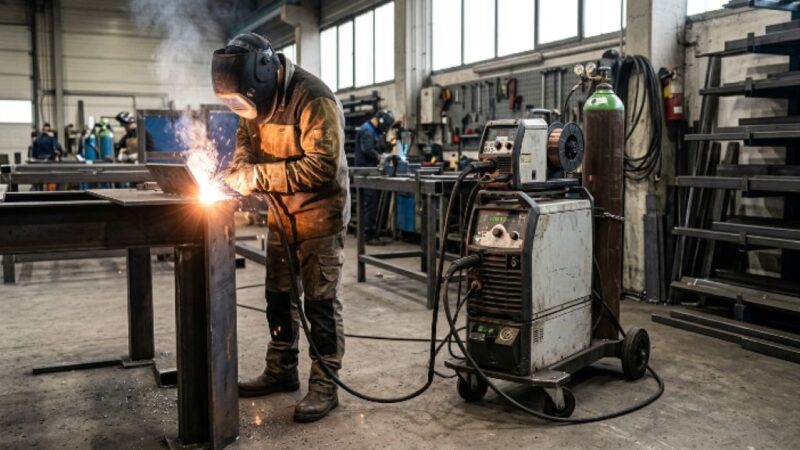

Welding is a vital skill used in construction, manufacturing, automotive work, and even small home repairs. It involves joining metals using heat, pressure, or both to create strong and lasting bonds. Along with the skill itself, welding machines play a key role in determining the quality, speed, and safety of the work.
This guide is designed to help beginners and experienced users alike. It covers the basics of welding, explains different types of welding machines, and offers practical tips to improve your results. Whether you are just starting or looking to sharpen your skills, this guide will give you clear and useful knowledge to work with confidence.
1. Basics of Welding Machines
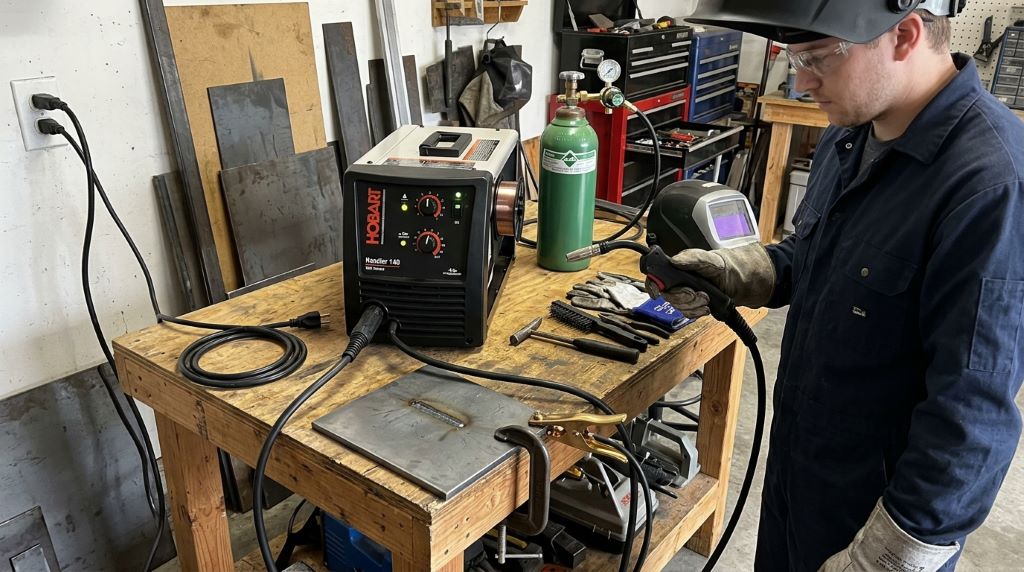
Welding is one of the most essential skills in manufacturing, construction, and repair work. Whether you are a beginner or a professional, understanding welding machines is the first step. This article covers the basics of welding machines, their types, how they work, and how to choose the right one for your needs.
What Is a Welding Machine?
A welding machine is a device that generates heat or energy to join two pieces of metal together. It does this by melting the base metals and allowing them to fuse as they cool. Additionally, most machines use a filler material to strengthen the joint.
Welding machines come in many shapes and sizes. However, they all share one common goal — to create a strong, lasting bond between metal surfaces. They are used in industries such as automotive, aerospace, shipbuilding, and home repair.
How Does a Welding Machine Work?
A welding machine works by converting electrical energy into heat. This heat melts the metal at the welding point. As a result, the metals bond together when they cool down.
Most machines use an electric arc to produce heat. The arc forms between the electrode and the base metal. Therefore, the electrode plays a very important role in the welding process. Some machines also use gas flames or laser beams, depending on the type of welding.
The basic components of a welding machine include:
- A power source (transformer or inverter)
- An electrode holder or welding torch
- Ground clamp and cables
- A control panel for adjusting settings
Each component works together to produce a clean, accurate weld.
Key Features to Look for in a Welding Machine
Choosing the right welding machine can feel overwhelming. However, focusing on a few key features makes the decision easier.
Power Output
Power output is measured in amperage. Higher amperage means the machine can weld thicker materials. Therefore, consider the thickness of the metal you will be working with before buying.
Duty Cycle
The duty cycle tells you how long a machine can run continuously before it needs to cool down. For example, a 60% duty cycle means the machine can weld for six minutes out of every ten.
A higher duty cycle is important for professional or heavy use. However, for occasional home projects, a lower duty cycle may be sufficient.
Input Voltage
Some machines run on 110V household power. Others require 220V or more. Therefore, check your available power supply before purchasing. Industrial machines often need higher voltage, while portable units work on standard outlets.
Portability
If you need to move your machine between job sites, portability matters. Inverter-based machines are lighter and more compact. Additionally, they are more energy-efficient than traditional transformer models.
Ease of Use
For beginners, a machine with simple controls and clear settings is ideal. MIG machines, for instance, are often recommended for first-time welders. Therefore, choose a machine that matches your current skill level.
Choosing the Right Welding Machine for Your Needs
The best welding machine depends on your specific needs. However, a few questions can help guide your decision.
First, what type of metal will you be welding? Aluminum, steel, and stainless steel all respond differently to various welding methods. Second, how thick is the material? Thicker metals require higher amperage. Third, where will you be working? Outdoor jobs may require a machine that does not rely on shielding gas.
Additionally, consider your budget. MIG and stick machines are generally more affordable. TIG and plasma machines cost more but offer greater precision. Therefore, match your machine choice to both your skill level and your budget.
2. Types of Welding Machines (Detailed Guides)
Welding is one of the most important processes in manufacturing, construction, and metalwork. Whether you are a beginner or a seasoned professional, choosing the right welding machine can make a big difference in your results. There are many types of welding machines available today. Therefore, understanding each one helps you work faster, safer, and more efficiently.
This guide covers all the major types of welding machines in simple language. You will learn how each machine works, what it is best used for, and who should use it.
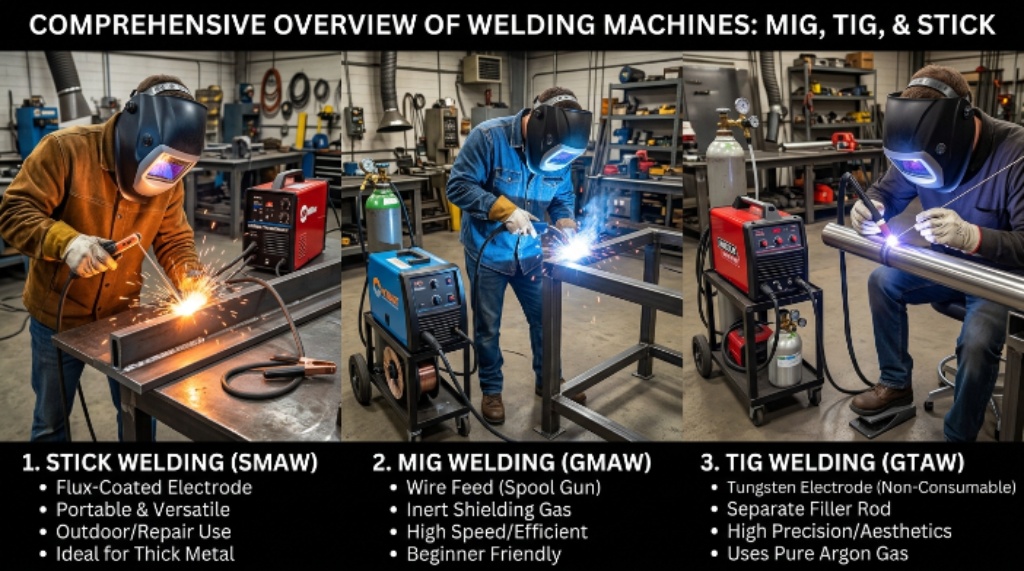
MIG Welding Machines
MIG stands for Metal Inert Gas. It is also called Gas Metal Arc Welding, or GMAW. MIG welding machines are among the most popular in the world. They are easy to learn, which makes them a great choice for beginners.
A MIG welder works by feeding a wire electrode through a welding gun. The wire melts and joins two pieces of metal together. At the same time, a shielding gas flows out to protect the weld from air and moisture.
MIG machines work well on mild steel, stainless steel, and aluminum. Additionally, they produce clean welds with very little spatter. This reduces the time you spend on cleanup after welding.
However, MIG welding is not ideal for outdoor work. Wind can blow away the shielding gas, which weakens the weld. Therefore, it works best in a workshop or controlled environment.
MIG welders are widely used in auto body repair, home projects, and light manufacturing. They come in small portable models as well as large industrial units.
TIG Welding Machines
TIG stands for Tungsten Inert Gas. It is also known as Gas Tungsten Arc Welding, or GTAW. TIG welding machines produce very precise and high-quality welds. They are commonly used in aerospace, automotive, and artistic metalwork.
A TIG welder uses a non-consumable tungsten electrode to create the arc. The welder then manually feeds a filler rod into the weld pool. This process requires both hands and a foot pedal, so it takes more skill to master.
The results, however, are outstanding. TIG welds are clean, strong, and visually neat. They are ideal for thin metals and delicate work where appearance matters.
TIG machines can weld steel, stainless steel, aluminum, copper, and even exotic metals like titanium. Additionally, they give the welder more control over heat, which prevents warping on thin materials.
The main downside is the learning curve. TIG welding takes more practice than MIG welding. It is also slower, so it may not be the best choice for high-volume production work.
Stick Welding Machines
Stick welding is one of the oldest and most versatile welding methods. It is officially called Shielded Metal Arc Welding, or SMAW. Stick welding machines are simple, durable, and cost-effective.
This process uses a consumable electrode coated in flux. When the electrode melts, the flux coating creates a gas that shields the weld from contamination. This means you do not need a separate gas tank, which makes stick welders very portable.
Stick welding works well on thick metals and rusty or dirty surfaces. Therefore, it is a popular choice for outdoor construction, pipeline work, and heavy equipment repair. It performs well in windy and wet conditions where MIG welding would struggle.
However, stick welding produces more spatter than MIG or TIG welding. It also requires more cleanup after each weld. Additionally, changing electrodes takes time, which can slow down the work process.
Despite these drawbacks, stick welders are highly reliable. They are widely used in shipbuilding, structural steel work, and maintenance jobs around the world.
Flux-Core Welding Machines
Flux-core welding is similar to MIG welding, but it uses a hollow wire filled with flux instead of solid wire. This type of welding is called Flux-Cored Arc Welding, or FCAW. Flux-core machines are popular for heavy-duty work.
There are two types of flux-core welding. The first uses only the flux inside the wire for shielding. The second combines the flux with an external shielding gas for even better protection. The gas-shielded version produces cleaner welds.
Flux-core machines are faster than stick welders and can handle thicker metals easily. Therefore, they are commonly used in construction, shipbuilding, and structural fabrication. They also perform well outdoors since the flux provides shielding even without gas.
However, they produce more smoke and fumes than other methods. Good ventilation is essential when using a flux-core welder. Additionally, the equipment can be more expensive than a basic MIG setup.
Plasma Arc Welding Machines
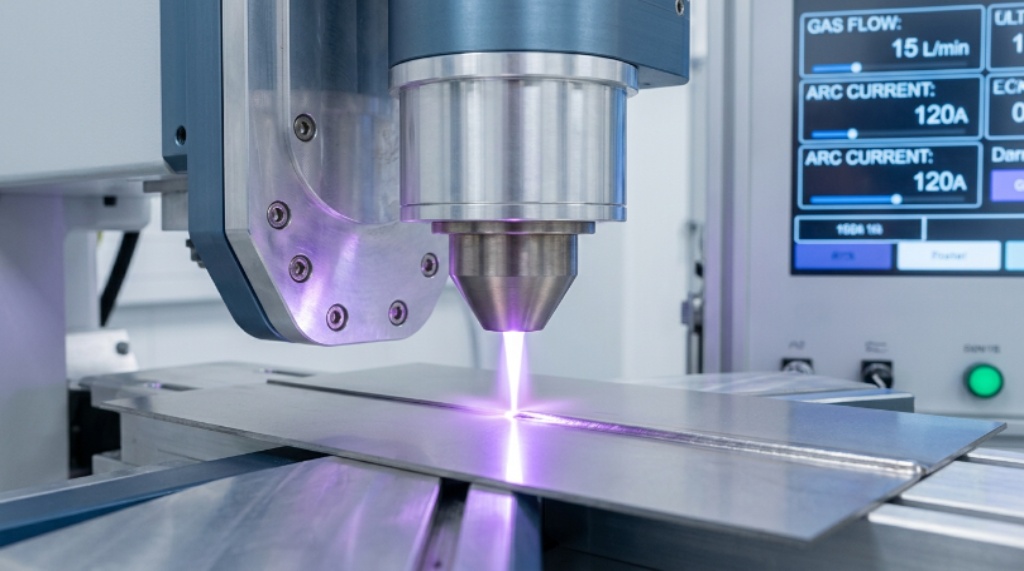
Plasma arc welding, or PAW, is an advanced variation of TIG welding. It uses a constricted arc and a plasma gas to create extremely high temperatures. This makes it one of the most precise welding methods available.
Plasma arc welding machines are used in aerospace manufacturing, electronics, and medical device production. They can weld very thin materials with great accuracy. Additionally, they offer faster welding speeds compared to standard TIG machines.
The setup and equipment cost is higher than most other types. Therefore, plasma arc welding is mostly used in professional and industrial settings rather than home workshops.
Submerged Arc Welding Machines
Submerged Arc Welding, or SAW, is designed for high-production industrial work. In this process, the arc is completely hidden under a layer of powdered flux. This is where the name “submerged” comes from.
SAW machines produce very deep and strong welds with minimal spatter. They are highly efficient and can weld thick steel plates quickly. Additionally, the flux cover prevents UV radiation from escaping, which improves safety for workers nearby.
However, SAW machines are large and not portable. They are mostly used in shipyards, pressure vessel manufacturing, and large structural steel fabrication. This method is not suitable for thin metals or small projects.
Multi-Process Welding Machines
Multi-process welding machines can perform more than one welding process. A single unit can switch between MIG, TIG, stick, and sometimes flux-core welding. This makes them extremely flexible.
These machines are ideal for professionals who work on different types of projects. Instead of buying multiple machines, you can use one unit for everything. Therefore, they save both space and money in the long run.
Multi-process welders are popular in fabrication shops, maintenance facilities, and among mobile welders. However, they tend to cost more upfront than single-process machines.
Spot Welding Machines
Spot welding machines join two pieces of metal by applying pressure and electrical current to a small area. This creates a “spot” weld without using any filler material. The process is fast, clean, and consistent.
Spot welders are widely used in the automotive industry for assembling car bodies. They work best on thin sheet metal. Additionally, they are easy to operate and require minimal training.
However, spot welding is limited to specific applications. It works mainly on overlapping sheets of metal and cannot be used for complex joints or thick materials.
3. Welding Techniques & Tutorials
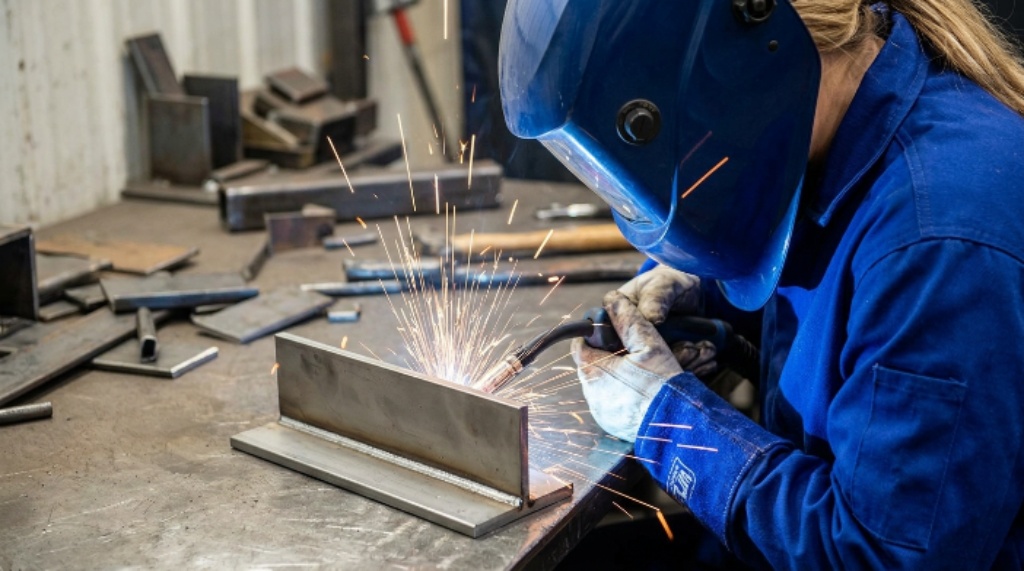
Welding is one of the most useful skills you can learn. It is used in construction, automotive repair, manufacturing, and even art. Whether you are a complete beginner or someone looking to sharpen your skills, this guide covers the most important welding techniques and tips. By the end, you will have a clear picture of where to start and how to improve.
What Is Welding and Why Does It Matter
Welding is the process of joining two or more pieces of metal by applying heat, pressure, or both. The result is a strong, permanent bond. Unlike bolts or screws, a good weld becomes part of the metal itself.
Welding matters because it holds our world together — literally. Bridges, buildings, ships, and cars all rely on welded joints. Additionally, welding opens doors to high-paying trade careers and satisfying DIY projects at home. Learning even the basics gives you a real-world skill that never goes out of demand.
The Most Common Welding Processes
There are several welding methods in use today. However, not all of them are suitable for beginners. Below are the four most widely used processes and what makes each one unique.
MIG Welding (GMAW)
MIG stands for Metal Inert Gas. It is also called Gas Metal Arc Welding, or GMAW. This method feeds a wire electrode through a welding gun while a shielding gas protects the weld from contamination.
MIG welding is the best starting point for most beginners. It is fast, relatively easy to learn, and produces clean results. Therefore, it is common in auto body shops, home garages, and light fabrication work. You can use it on steel, stainless steel, and aluminum.
TIG Welding (GTAW)
TIG stands for Tungsten Inert Gas. This process uses a non-consumable tungsten electrode to create the arc. The welder adds filler material by hand with a separate rod.
TIG welding produces very precise, high-quality welds. However, it requires more skill and practice than MIG welding. It is the method of choice for thin metals, pipework, and projects where appearance matters. Many professional welders consider TIG the most refined technique in the trade.
Stick Welding (SMAW)
Stick welding, or Shielded Metal Arc Welding (SMAW), is one of the oldest welding methods. It uses a flux-coated electrode — the “stick” — that melts into the weld pool as you work.
This method is rugged and simple. Additionally, it works well outdoors and on dirty or rusty metal. Stick welding does not require a shielding gas tank, which makes it portable and affordable. It is a great option for farm repairs, structural work, and field jobs.
Flux-Core Welding (FCAW)
Flux-core welding is similar to MIG welding in setup, but it uses a hollow wire filled with flux instead of a solid wire. This means you can sometimes skip the external shielding gas.
Flux-core welding is fast and works well on thicker metals. Therefore, it is popular in construction and heavy fabrication. It does produce more spatter than MIG welding, so finishing work takes a bit more effort.
How to Set Up Your Welding Equipment
Good preparation leads to better welds. Before you start, make sure your equipment is set up correctly. This section focuses on MIG welding setup, since it is the most beginner-friendly process.
Choosing the Right Wire and Gas
For mild steel, use ER70S-6 wire. It is versatile and widely available. The most common shielding gas mix for MIG welding steel is 75% argon and 25% carbon dioxide. This blend gives a stable arc and a clean bead.
Setting Voltage and Wire Speed
These two settings control the quality of your weld. Too much voltage causes burn-through. Too little gives you a weak, lumpy bead. Wire speed affects how much filler material enters the weld pool.
Start with the settings recommended in your machine’s manual. Then, run a few test beads on scrap metal and adjust from there. Always test on scrap before welding your actual project.
Preparing the Metal
Clean metal is critical. Dirt, oil, rust, and paint all interfere with the arc. Use a wire brush, grinder, or angle grinder to clean the surface before welding. Additionally, clamp your workpiece securely so it does not move during the weld.
Basic Welding Techniques for Beginners
Once your setup is correct, it is time to focus on technique. Good technique is what separates a strong weld from a weak one.
Maintaining the Right Angle
Hold your welding gun at a 10 to 15 degree angle in the direction of travel. This is called the “push” technique for MIG welding. It gives you good visibility and produces a flat, wide bead. However, some welders prefer the “pull” technique, which tilts the gun away from the direction of travel. Pull welding results in deeper penetration.
Keeping a Consistent Travel Speed
Travel speed affects bead width and penetration. Moving too fast creates a thin, weak bead. Moving too slow causes excess buildup and can burn through thin metal. Practice moving at a steady, even pace. With time, the right speed becomes instinct.
Maintaining Arc Length
Arc length is the distance between the electrode and the base metal. For MIG welding, keep the wire about 3/8 of an inch from the surface. A shorter arc gives more penetration, while a longer arc spreads heat over a wider area.
Reading the Weld Pool
Watch the weld pool, not the arc. The pool tells you what is happening. A smooth, round pool means things are going well. A pool that freezes quickly or looks uneven signals a problem with your speed or settings.
How to Improve Your Welding Skills
Learning to weld well takes practice. However, there are smart ways to speed up your progress.
Weld on scrap metal every day if possible. Repetition builds muscle memory. Try to replicate the same bead over and over until it looks consistent.
Watch experienced welders work. Online video tutorials are a great resource. Seeing the technique in action helps you understand what to aim for. Additionally, many community colleges and trade schools offer hands-on welding courses at a low cost.
Keep a welding journal. Note your machine settings, the metal type, and the results for each session. Over time, this record becomes a valuable reference that helps you repeat your successes and avoid repeat mistakes.
Choosing the Right Welding Process for Your Project
The best welding method depends on your project. Here is a simple way to think about it.
For home repairs and light fabrication, MIG welding is the most practical choice. It is fast, clean, and easy to learn. For detailed or artistic work on thin metals, TIG welding delivers the best results. However, it demands patience and practice. For outdoor repairs or work on rusty metal, stick welding is the most reliable option. Finally, for thick structural metal or heavy fabrication, flux-core welding offers the speed and penetration you need.
4. Welding Machine Accessories & Tools
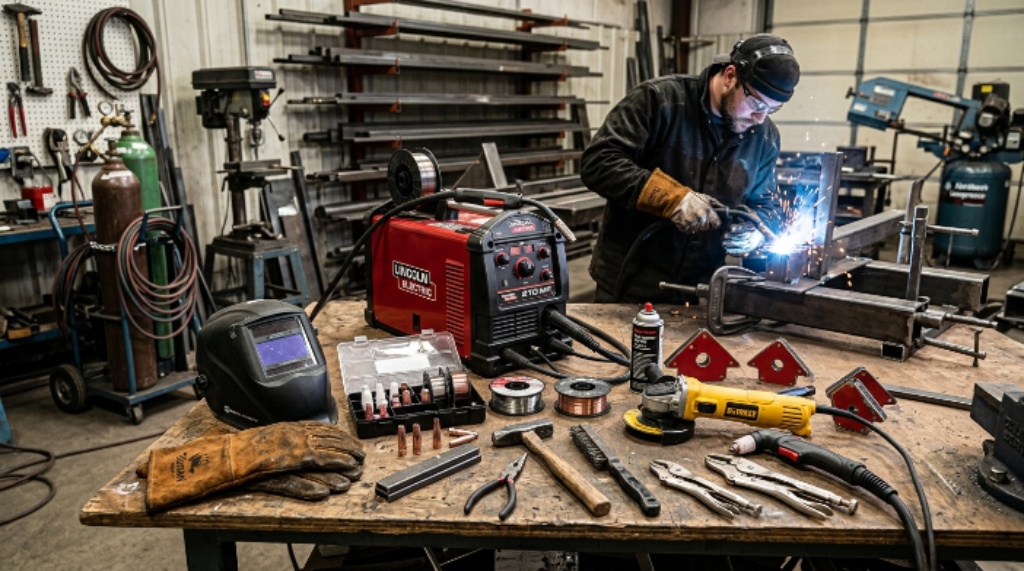
Welding is one of the most essential skills in manufacturing, construction, and repair work. However, the welding machine alone is not enough to get the job done well. You also need the right accessories and tools to work safely, efficiently, and with precision. Whether you are a beginner or a seasoned professional, understanding these accessories will help you get better results every time.
This article covers the most important welding machine accessories and tools. It explains what they are, why they matter, and how to choose the right ones for your needs.
Why Welding Accessories Matter
Many people focus only on the welding machine itself. They overlook the role that accessories play in the quality of a weld. However, the right tools make a huge difference. They improve safety, increase speed, and ensure a cleaner, stronger weld.
Additionally, proper accessories help extend the life of your welding machine. When you use the right consumables and protective gear, you reduce wear and avoid costly mistakes. Therefore, investing in quality accessories is just as important as investing in a good machine.
Welding Cables and Connectors
Cables are a vital part of any welding setup. They carry the electrical current from the machine to the electrode and the workpiece. Poor-quality cables can cause voltage drops, overheating, and even electrical hazards.
Electrode Holders
The electrode holder, also called a stinger, holds the welding rod in place during stick welding. It must have a secure grip and good insulation. A loose or poorly insulated holder can cause poor arc performance and safety risks.
Choose a holder that matches your machine’s amperage rating. Using an undersized holder can lead to overheating and early failure.
Ground Clamps
The ground clamp connects the welding circuit back to the machine. A strong, clean ground connection is essential for a stable arc. Therefore, always attach the ground clamp as close to the weld area as possible. This reduces electrical resistance and improves weld quality.
Look for clamps with heavy-duty jaws and durable cable connections. Weak clamps can cause poor grounding, which leads to spatter and inconsistent welds.
Welding Cable Extensions
Sometimes your machine cannot reach the workpiece. In these cases, a cable extension is very useful. However, always use cables with the correct gauge for your amperage. Using a cable that is too thin will cause resistance and heat buildup, which can be dangerous.
Torches and Guns
The torch or gun is the tool you hold while welding. It directs the heat and filler material to the weld joint. Different welding processes require different torches.
MIG Welding Guns
MIG guns feed wire automatically from a spool through the gun to the weld pool. They are available in different sizes and duty cycles. A higher duty cycle means the gun can run for longer periods without overheating. Therefore, choose a gun that matches your machine’s output and your typical welding duration.
TIG Welding Torches
TIG torches are more delicate and precise than MIG guns. They are used for thin metals and applications where appearance matters. TIG torches can be air-cooled or water-cooled. Water-cooled torches handle higher amperages and are better for heavy-duty work. However, they require an extra water cooling unit, which adds to the cost and complexity of the setup.
Plasma Cutting Torches
While not strictly a welding torch, plasma torches are often used alongside welding machines. They cut through metal quickly and cleanly. Using the right consumables for your plasma torch, such as the correct nozzle and electrode, is essential for clean cuts and longer torch life.
Consumables and Filler Materials
Consumables are items that wear out and need regular replacement. They include electrodes, wire, filler rods, nozzles, contact tips, and shielding gas nozzles. Choosing the right consumables directly affects the quality of your weld.
Welding Electrodes and Wire
Electrodes and wire are the filler materials that melt and join the base metals. They come in many types, each suited to specific metals and welding processes. For example, ER70S-6 wire is a common choice for MIG welding mild steel. Using the wrong filler material can result in weak welds or cracking.
Additionally, store your electrodes in a dry place. Moisture can cause defects like porosity in the weld.
Contact Tips and Nozzles
Contact tips guide the wire out of the MIG gun. They wear out over time due to heat and electrical erosion. Replacing them regularly is important for maintaining a stable arc. Nozzles, meanwhile, direct the shielding gas around the weld pool. Spatter buildup inside the nozzle can disrupt gas flow, so clean them often.
Shielding Gas and Regulators
Shielding gas protects the weld pool from atmospheric contamination. Common gases include argon, CO2, and mixtures of the two. A gas regulator controls the flow rate from the cylinder. Therefore, always set the correct flow rate for your process. Too little gas leads to porosity, while too much wastes gas and can cause turbulence in the weld pool.
Welding Positioners and Clamps
Holding your workpiece in the right position is crucial for a good weld. Fortunately, there are many tools designed to help with this.
Welding Clamps and Magnets
Clamps hold pieces of metal together before and during welding. They come in many shapes and sizes. Angle clamps are especially useful for holding parts at a precise angle. Magnetic welding squares are also popular. They hold metal at common angles like 45 and 90 degrees without extra clamping.
However, be aware that strong magnetic fields can sometimes affect the arc during welding. Therefore, remove magnets from near the arc zone when needed.
Welding Positioners
A welding positioner is a rotating device that holds the workpiece and turns it during welding. This allows you to weld in the flat position rather than overhead or vertical, which is easier and produces better results. Positioners are especially useful for circular or cylindrical parts, such as pipes and tanks.
Finishing and Cleaning Tools
After welding, you often need to clean and finish the weld. Several tools are commonly used for this purpose.
Chipping Hammers and Wire Brushes
In stick welding, a layer of slag covers the weld bead after it cools. A chipping hammer breaks away this slag. A wire brush then cleans the surface further. These simple tools are used in almost every stick welding job.
Angle Grinders
Angle grinders are versatile tools used to grind down welds, remove rust, and smooth surfaces. They accept different discs for cutting, grinding, and flap finishing. Additionally, they can be used to prepare the base metal before welding by cleaning off paint, rust, or mill scale.
Always wear a face shield when using an angle grinder, as the sparks and debris can be dangerous.
Choosing the Right Accessories for Your Work
Not every welder needs every accessory. Therefore, start with the basics and build your toolkit over time. Begin with essential safety gear, quality cables, and the right consumables for your process. As your work becomes more complex, add tools like positioners, specialized torches, and precision clamps.
Additionally, buy from reputable brands whenever possible. Cheap accessories may seem like a good deal at first. However, they often wear out quickly and can compromise both safety and weld quality.
5. Welding Safety Guide
Welding is one of the most useful skills in the world. It joins metal parts together and builds everything from cars to bridges. However, welding also comes with real dangers. Without the right safety habits, welders can face serious injuries. Therefore, understanding welding safety is not optional. It is essential for every welder, beginner or expert.
This guide covers the key safety rules you need to follow. It explains the hazards, the protective gear, and the best practices that keep you safe on the job.
Understanding the Hazards of Welding
Before you can stay safe, you need to know what you are up against. Welding creates several types of hazards at the same time.
Heat and Fire Risks
Welding produces extremely high temperatures. The arc alone can reach over 6,500 degrees Fahrenheit. Sparks and molten metal fly in all directions. These sparks can travel up to 35 feet from the welding point. Therefore, any flammable material nearby becomes a fire risk.
Combustible items like paper, cloth, wood shavings, and fuel containers must be removed from the work area. Additionally, metal surfaces can stay dangerously hot long after the welding stops. Never touch a recently welded surface with bare hands.
Toxic Fumes and Gases
Welding releases fumes and gases that are harmful to breathe. These fumes come from the base metal, the filler material, and any coatings on the surface. Some metals, like galvanized steel or stainless steel, release especially toxic gases when heated.
Breathing these fumes over time can lead to lung disease, metal fume fever, and even cancer. Therefore, proper ventilation is one of the most critical safety steps in welding.
Electric Shock
Electric shock is another major hazard in welding. It can cause injury or even death. Welders touch the welding circuit regularly, so the risk is always present. Wet conditions, damaged cables, and improper grounding all increase this risk.
Additionally, secondary voltage shock — though lower in voltage — is still dangerous enough to cause muscle contractions and falls.
Radiation and UV Exposure
The welding arc produces intense light. This light includes ultraviolet (UV) and infrared (IR) radiation. Even a brief look at an unprotected arc can permanently damage your eyes. This condition is known as “arc eye” or welder’s flash. It is painful and can cause temporary or lasting vision loss.
Essential Personal Protective Equipment
Personal protective equipment, or PPE, is your first line of defense. Wearing the right gear can prevent most welding injuries.
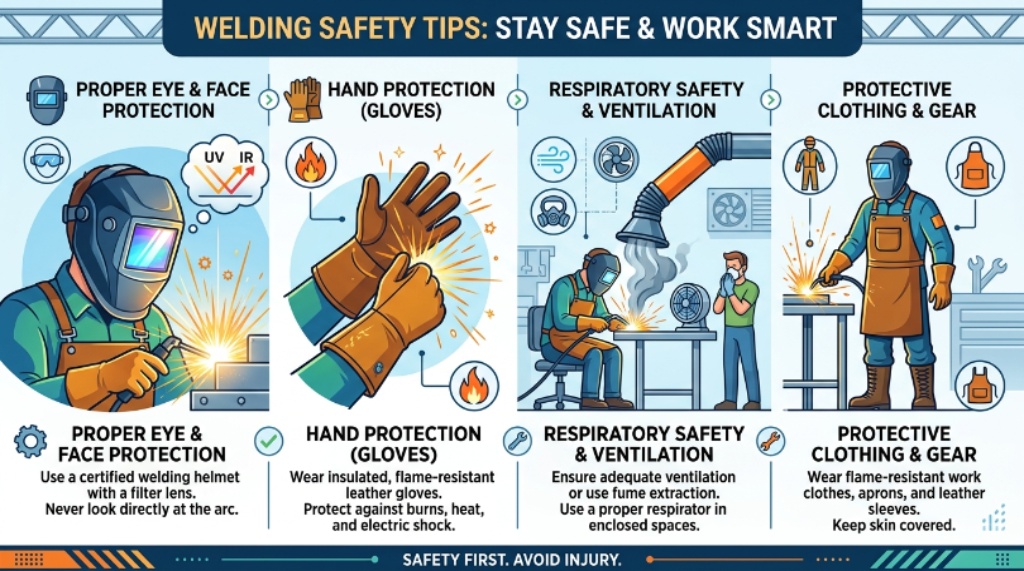
Welding Helmet and Eye Protection
A proper welding helmet is non-negotiable. It protects your eyes and face from radiation, sparks, and heat. Choose a helmet with an auto-darkening lens so you can see clearly before striking the arc. The shade level of the lens should match the type of welding you are doing.
Additionally, wear safety glasses under your helmet. Sparks can sometimes get inside the helmet from the sides. Safety glasses add a second layer of protection.
Welding Gloves
Welding gloves protect your hands from heat, sparks, and electrical hazards. Choose gloves made from leather, as leather resists heat well. Make sure the gloves fit properly. Loose gloves reduce your grip and control.
However, do not wear gloves that are worn out or have holes. Damaged gloves offer little protection and should be replaced immediately.
Protective Clothing
Wear flame-resistant clothing when welding. A leather jacket or a flame-resistant cotton shirt works well. Avoid synthetic fabrics like nylon or polyester. These melt when exposed to heat and can cause severe burns.
Additionally, wear long pants without cuffs. Cuffs can catch sparks and hold them against your skin. Leather boots with steel toes protect your feet from falling metal and sparks.
Respiratory Protection
When ventilation is not enough, wear a respirator. Choose a respirator rated for welding fumes. A standard dust mask will not protect you from welding gases. Therefore, investing in the right respirator is critical for long-term lung health.
Setting Up a Safe Welding Environment
Your workspace plays a huge role in your safety. A well-organized, properly ventilated area reduces risk significantly.
Ventilation and Air Quality
Always weld in a well-ventilated space. Natural ventilation works in large, open areas. However, enclosed spaces require mechanical ventilation, such as exhaust fans or local exhaust systems. Local exhaust ventilation captures fumes directly at the source before you breathe them in.
If you must weld in a confined space, follow strict confined space entry procedures. These include air testing, continuous monitoring, and having someone outside to assist if needed.
Fire Prevention Setup
Before welding, inspect the area for fire hazards. Remove or cover flammable materials. Keep a fire extinguisher nearby and make sure it is the right type for your work area. Additionally, check the area for hidden combustibles, like material inside walls or under floors.
After you finish welding, wait and monitor the area. Fires from welding sparks can start hours after the work is done. Therefore, a fire watch is often required after welding operations end.
Electrical Safety
Inspect your welding equipment before every use. Look for damaged cables, loose connections, and worn insulation. Never use faulty equipment. Additionally, always keep your welding machine properly grounded. Use dry insulating gloves when handling the electrode holder.
Do not weld in wet conditions unless you take extra precautions. Water and electricity are a deadly combination.
Safe Welding Practices and Techniques
Good habits are just as important as good gear. Following safe techniques every day keeps accidents from happening.
Before You Start Welding
Read the material safety data sheets (MSDS) for all materials you will be using. This tells you about the fumes they produce and the precautions you need. Additionally, inspect your equipment. Check cables, connections, and the welding torch or electrode holder.
Set up your workpiece securely. A piece that moves during welding can cause arc flash, burns, or loss of control.
While You Are Welding
Keep your head out of the fume plume. The fumes rise directly above the welding point, so position yourself to the side. Additionally, never weld near pressurized containers or pipes. Heat can cause pressure to build up and lead to explosions.
Keep bystanders at a safe distance. Use welding screens or curtains to protect others from arc radiation. However, make sure the screens do not block ventilation flow.
After You Finish Welding
Turn off the welding machine when you are not actively welding. This reduces electrical hazards. Allow the metal to cool before touching it. Mark hot metal clearly so others do not accidentally touch it.
Additionally, store your equipment properly. Coil cables neatly to avoid damage. Put away your PPE in a clean, dry location to extend its life.
Special Safety Considerations
Some welding situations require extra caution. Understanding these special cases can save your life.
Welding Galvanized or Coated Metals
Galvanized steel has a zinc coating. When heated, zinc releases zinc oxide fumes. Breathing these fumes causes metal fume fever, which feels like a bad flu. Therefore, always use extra ventilation when welding coated metals. In some cases, you may need to grind off the coating before welding.
Welding in Confined Spaces
Confined spaces trap fumes and deplete oxygen quickly. This makes them especially dangerous. Always test the air before entering. Use a continuous air monitor while working. Additionally, never work alone in a confined space. A trained attendant must stay outside and be ready to respond in an emergency.
Welding Overhead
Overhead welding increases the risk of burns from falling sparks and molten metal. Wear a leather welding cap to protect your head and hair. Make sure your jacket has no gaps at the collar or wrists. Additionally, angle your helmet slightly to prevent sparks from entering at the top.
Training and Ongoing Safety Education
Safety knowledge must be kept up to date. Welding equipment and techniques change over time. Therefore, regular training is important for all welders, no matter their experience level.
Attend safety refresher courses when they are offered. Stay informed about new regulations and best practices in your industry. Additionally, new welders should always work under the supervision of experienced professionals until they are fully trained.
Many organizations offer welding safety certification programs. These programs teach not just how to weld, but how to weld safely. Completing such a program shows your commitment to protecting yourself and those around you.
6. Welding Machine Maintenance & Troubleshooting
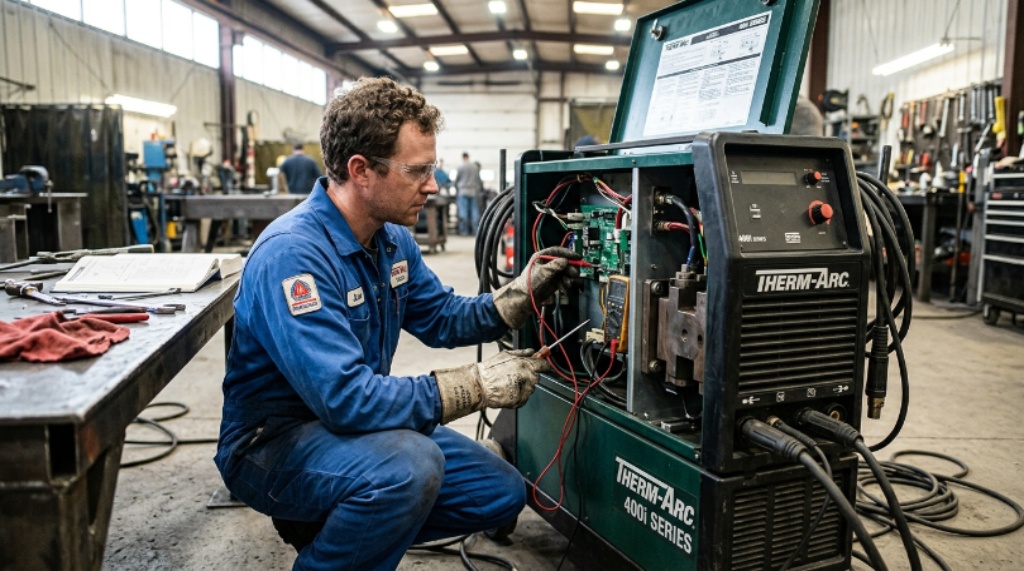
Welding machines are the backbone of many industries. They cut through metal, join parts, and make countless products possible. However, like any piece of heavy equipment, they need regular care. Without proper maintenance, even the best welding machine can fail at the worst possible time. This guide will walk you through everything you need to know to keep your welder in top shape and fix common problems when they come up.
Why Regular Maintenance Matters
Many welders only think about maintenance after something breaks. This is a costly mistake. A well-maintained welding machine lasts longer, performs better, and uses less energy. Additionally, regular upkeep reduces the risk of dangerous electrical faults and fire hazards.
Think of maintenance as an investment. A small amount of time spent each week can save you hundreds of dollars in repair costs. Therefore, building a simple maintenance routine is one of the smartest things any welder or shop owner can do.
Daily Maintenance Checklist
Before you strike an arc, take a few minutes to inspect your equipment. Daily checks do not need to be complicated. In fact, most of them take less than five minutes.
Start by checking the power cable and ground clamp. Look for cuts, fraying, or burn marks. A damaged cable is a safety hazard and should be replaced immediately. Next, inspect the electrode holder or welding gun. Make sure the connections are tight and the insulation is intact.
Additionally, check that the work area is clean. Dust, metal shavings, and moisture can all cause problems for your machine. Keep the area around the welder clear and dry at all times.
Finally, look at the cooling vents. Blocked vents cause the machine to overheat. Use compressed air to blow out any dust or debris from the vents before you begin welding.
Weekly Maintenance Tasks
Once a week, go a little deeper with your inspection. These tasks help you catch issues before they become serious problems.
Clean the inside of the machine with compressed air. Dust and metal particles build up quickly inside the casing. Over time, this buildup can damage internal components or cause overheating. A short burst of compressed air through the vents clears out most of this debris.
Check all electrical connections inside the machine. Look for loose terminals, corroded contacts, or signs of heat damage. Loose connections cause voltage drops and poor arc quality. Therefore, tighten any loose terminals you find and clean away any corrosion with a wire brush.
Also, inspect the wire feed system if you use a MIG welder. Check the drive rolls for wear and make sure the wire liner is clean and free of blockages. A dirty liner is one of the most common causes of wire feed problems.
Monthly and Long-Term Maintenance
Some maintenance tasks do not need to happen every day or every week. However, doing them monthly or quarterly keeps your machine running at its best.
Lubricate the drive rolls and wire feed mechanism according to the manufacturer’s guidelines. Over-lubrication can cause just as many problems as under-lubrication, so follow the recommended amounts closely.
Inspect the welding torch or gun body for cracks or damage. Replace worn contact tips, nozzles, and liners on a regular schedule. These parts are inexpensive, but worn tips and nozzles cause poor weld quality and wasted gas.
Additionally, test the gas flow rate if you use a shielding gas. Check the regulator and hose for leaks by applying soapy water to the connections. Bubbles indicate a leak that needs to be fixed right away.
Common Welding Machine Problems and How to Fix Them
Even a well-maintained machine will sometimes develop problems. Knowing how to troubleshoot common issues saves time and gets you back to work quickly.
Poor Arc Quality or Unstable Arc
An unstable arc is one of the most frustrating problems a welder can face. Several things can cause it. First, check your ground connection. A loose or corroded ground clamp is often the culprit. Clean the contact point and make sure the clamp is firmly attached to the workpiece or welding table.
Next, look at your welding settings. Using the wrong amperage or voltage for your electrode and material thickness leads to an inconsistent arc. Refer to a welding parameter chart and adjust your settings accordingly.
Additionally, contaminated base metal can disrupt the arc. Rust, paint, oil, and moisture all interfere with the welding process. Therefore, always clean the base metal thoroughly before you begin.
Wire Feed Problems in MIG Welders
Wire feed issues are extremely common in MIG welding. The wire may stop feeding, feed unevenly, or bird-nest inside the machine. Each of these problems has a specific cause.
If the wire stops feeding altogether, check the drive rolls first. They may be worn or set at the wrong tension. Too little pressure lets the wire slip, while too much pressure crushes the wire and causes jams. Adjust the tension until the wire feeds smoothly.
A bird’s nest, which is a tangle of wire inside the machine, is usually caused by a blocked liner or a kink in the wire. Remove the tangled wire carefully and replace the liner if it is damaged. Always make sure the wire spool unwinds freely without binding.
Overheating
Overheating is a sign that the machine is working too hard or that airflow is restricted. First, check the duty cycle of your machine. Every welder has a rated duty cycle, which tells you how long you can weld continuously before the machine needs to cool down. Exceeding this limit causes overheating and can damage internal components.
If the machine is overheating within its duty cycle, the vents are likely blocked. Clean them out with compressed air. Also, make sure the machine has enough space around it for air to circulate freely. Placing a welder in a tight corner restricts airflow and leads to overheating.
Porosity in Welds
Porosity refers to small holes or voids in the finished weld. It is a sign that gas is getting trapped in the weld pool. This is usually caused by contamination, incorrect gas flow, or a faulty gas supply.
Check your shielding gas flow rate first. Too little gas allows air to contaminate the weld. Too much gas creates turbulence that pulls in air from the sides. The correct flow rate depends on your welding position and nozzle size, so consult your machine’s manual for guidance.
Also, inspect the gas hose and connections for leaks. Even a small leak lets air enter the gas stream and causes porosity. Replace any damaged hoses or fittings you find.
Machine Fails to Start or Powers Off Unexpectedly
If your welding machine will not start, begin with the basics. Check that the power supply is on and that the input voltage matches the machine’s requirements. A machine designed for 240V will not work properly on a 120V outlet.
Look at the circuit breaker or fuse on the machine itself. Many welders have a built-in thermal protection switch that trips when the machine overheats. Allow the machine to cool down for several minutes and then try again.
If the machine powers off during welding, the problem is often the duty cycle or a faulty thermal sensor. Check the duty cycle first. If you are not exceeding it, the thermal sensor may need to be tested or replaced by a qualified technician.
Safety Practices During Maintenance
Maintenance is important, but safety comes first. Always disconnect the machine from its power source before you open the casing or inspect internal components. Welding machines carry high voltages that can cause serious injury or death.
Wear appropriate protective gear when cleaning the machine, especially when using compressed air. Dust and metal particles can be thrown into the air. Therefore, safety glasses should always be worn during cleaning tasks.
Additionally, never attempt to repair complex electrical faults yourself unless you are a qualified electrician. Some repairs require specialized knowledge and tools. When in doubt, contact the manufacturer or a certified repair technician.
Keeping a Maintenance Log
One simple habit can make a huge difference in machine reliability. Keep a written log of all maintenance activities and any problems you notice. Record the date, the task performed, and any parts replaced.
A maintenance log helps you spot recurring problems and plan for part replacements. It also adds value if you ever sell the machine, as it shows the buyer that the equipment has been properly cared for.
7. Applications of Welding Machines
Welding machines are everywhere. From the car you drive to the building you work in, welding holds the modern world together. These powerful tools join metal parts using heat, pressure, or both. They are essential across dozens of industries. Understanding where and how welding machines are used can help you appreciate just how important this technology truly is.
Why Welding Machines Matter
Welding machines create strong, lasting bonds between metals. No other joining method matches their strength and durability. Therefore, industries that work with metal rely on them daily. Additionally, advances in welding technology have made machines faster, safer, and more precise than ever before. This means more industries can now benefit from welding than at any point in history.
Construction and Infrastructure
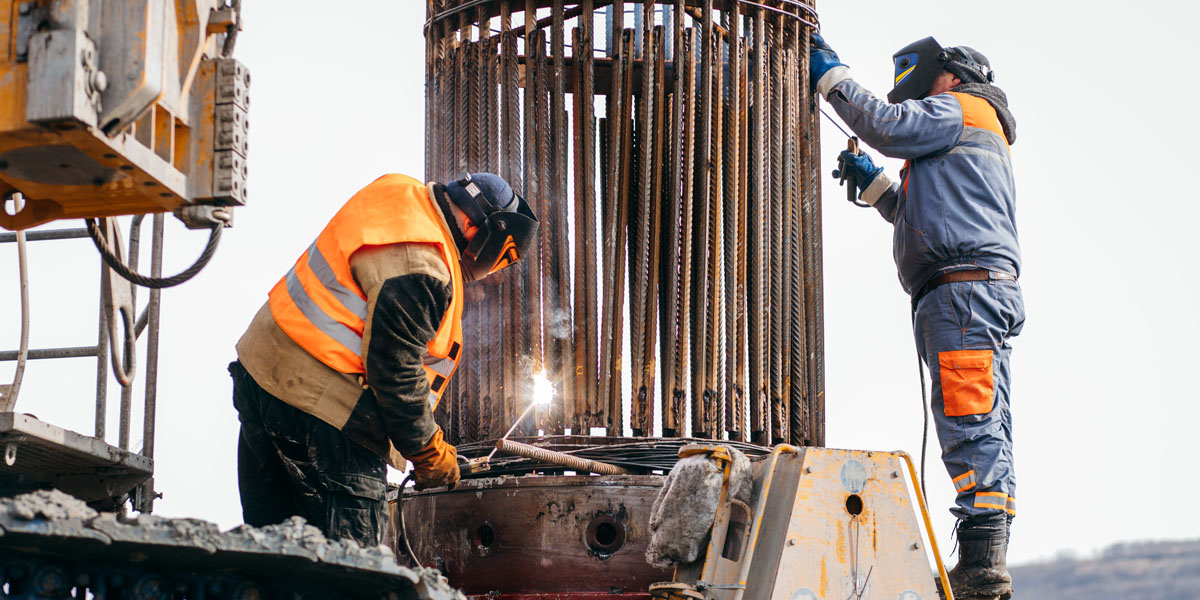
One of the most common uses of welding machines is in construction. Buildings, bridges, tunnels, and highways all depend on welded steel structures. Welding machines join steel beams, columns, and reinforcing bars. This gives structures the strength they need to last for decades.
However, it is not just large buildings that benefit. Small commercial spaces, warehouses, and even residential homes use welded frames and fixtures. Additionally, infrastructure projects like pipelines and water treatment plants rely heavily on welding. Without it, constructing safe, reliable infrastructure would be nearly impossible.
Welding machines are also used to repair aging structures. Bridges and tunnels often need maintenance work over time. Therefore, welding plays a key role in keeping existing infrastructure safe for public use.
Automotive Manufacturing
The automotive industry is one of the largest users of welding machines in the world. Every car, truck, or bus you see on the road contains thousands of welds. Manufacturers use automated welding systems to assemble vehicle frames, exhaust systems, fuel tanks, and body panels.
Robotic welding arms are especially common on modern assembly lines. They work quickly and with great precision. As a result, car manufacturers can produce vehicles faster while maintaining consistent quality. Additionally, robotic welders reduce the risk of human error in the process.
However, welding in the automotive world is not limited to new vehicles. Auto repair shops also use welding machines to fix damaged frames and body panels. Therefore, welding supports both production and maintenance in the automotive sector.
Aerospace and Aviation
Welding machines play a critical role in aerospace manufacturing. Aircraft frames, engine components, and fuel systems must meet incredibly strict standards. Therefore, only the most precise welding methods are used in this industry.
Tungsten Inert Gas (TIG) welding is especially popular in aerospace. It produces clean, precise welds on thin and lightweight metals like aluminum and titanium. Additionally, electron beam welding is used for highly specialized components. It works in a vacuum environment and produces exceptionally strong welds.
However, the stakes in aerospace are extremely high. A faulty weld could lead to catastrophic failure. Therefore, every weld in an aircraft must pass rigorous inspection and quality testing. Welding machines used in this field must be top-of-the-line and regularly maintained.
Shipbuilding and Marine Industry
Shipbuilding is another sector where welding machines are essential. Large ships, submarines, oil tankers, and naval vessels are built from massive steel plates. These plates must be welded together with extreme precision to create a watertight seal.
Welding machines used in shipbuilding are often large and powerful. They must handle thick steel sections that smaller machines cannot manage. Additionally, welders must work in tight, difficult spaces inside a ship’s hull. This makes the job both technically challenging and physically demanding.
However, the marine environment adds another layer of difficulty. Ships are constantly exposed to saltwater and extreme weather. Therefore, welded joints must be especially strong and corrosion-resistant to ensure the vessel remains safe at sea.
Oil and Gas Industry
The oil and gas industry depends heavily on welding machines. Pipelines that carry oil, natural gas, and other fuels stretch for thousands of kilometers. Every section of pipe must be welded securely to prevent leaks. A single failed weld can result in dangerous spills or explosions.
Additionally, offshore oil rigs and drilling platforms are built using welded steel structures. These structures must withstand harsh ocean conditions, including powerful waves and corrosive saltwater. Therefore, welding quality in this industry is held to the highest possible standards.
Pressure vessels and storage tanks used in oil refineries are also welded. These containers hold dangerous substances under high pressure. As a result, welders working in this field must follow strict safety codes and undergo specialized training.
Manufacturing and Heavy Industry
General manufacturing is one of the broadest applications of welding machines. Factories use welding to produce everything from household appliances to industrial machinery. Washing machines, refrigerators, boilers, generators, and conveyor systems all contain welded parts.
Metal Inert Gas (MIG) welding is widely used in manufacturing because it is fast and cost-effective. It works well on a variety of metals and thicknesses. Additionally, it can be automated, making it ideal for high-volume production environments.
However, not all manufacturing welding is automated. Skilled human welders are still needed for complex or custom work. Therefore, manufacturing facilities often employ a combination of robotic and manual welding to meet their production needs.
Agriculture and Farming Equipment
Farmers rely on heavy equipment every day. Tractors, plows, harvesters, and irrigation systems all use welded metal components. Welding machines are used to build this equipment and to repair it when it breaks down.
Agricultural machinery takes a lot of punishment. It operates in dusty, muddy, and rough conditions. Therefore, the welds used in farming equipment must be tough and long-lasting. Additionally, repairs must often be done quickly to avoid costly delays during planting or harvest seasons.
Many farms have their own welding equipment on-site. This allows workers to fix broken parts without waiting for outside help. As a result, welding skills and machines are a practical necessity in the farming world.
Art, Architecture, and Design
Welding machines are not just for heavy industry. Artists and designers also use them to create stunning works. Metal sculptures, decorative gates, custom furniture, and architectural installations all benefit from welding.
Artists use welding to join different metals and create unique shapes. The results can be both beautiful and durable. Additionally, architects use welded metal elements as design features in modern buildings. Staircases, railings, facades, and lighting fixtures are often crafted using welding techniques.
However, artistic welding requires a different kind of skill. Precision and aesthetics matter just as much as strength. Therefore, welders in this field must combine technical ability with a creative eye.
Defense and Military
The defense industry relies on welding machines for manufacturing military vehicles, weapons systems, and equipment. Tanks, armored personnel carriers, warships, and aircraft all require precision welding. Additionally, weapons components and ammunition storage units must be welded to strict specifications.
Military welding must meet the highest standards of strength and reliability. Equipment used in combat must perform flawlessly under extreme conditions. Therefore, defense contractors employ highly skilled welders and use advanced welding technology to meet these demands.
8. Advanced & Technical Topics of Welding Machines
Welding machines have come a long way from simple arc welders. Today, they are complex systems built on cutting-edge technology. Understanding the advanced and technical aspects of these machines helps operators, engineers, and buyers make smarter decisions. This article breaks down those technical topics clearly and practically.
How Welding Machines Produce and Control Heat
At the core of every welding machine is a power source. This source converts electricity into a usable welding current. However, not all power sources work the same way.
Traditional transformer-based machines use alternating current (AC). They are heavy and consume a lot of energy. Modern inverter-based machines, on the other hand, convert AC to DC and back again at very high frequencies. This process allows the machine to produce a stable arc with far less energy. Therefore, inverter machines are lighter, more efficient, and easier to carry.
Heat control is critical in welding. Too much heat causes warping and burn-through. Too little heat results in weak, incomplete fusion. Advanced machines use closed-loop feedback systems to monitor voltage and current in real time. When values drift, the machine adjusts instantly. This ensures consistent heat output throughout the weld.
Duty Cycle and Its Technical Importance
Duty cycle is one of the most important technical specifications of any welding machine. It refers to how long a machine can weld continuously within 10 minutes without overheating.
For example, a machine rated at 60% duty cycle at 200 amperes can weld for six minutes and must then rest for four minutes. Additionally, duty cycle ratings change with the amperage setting. Running a machine at lower amperage often allows a higher duty cycle.
Industrial machines are built for high-duty-cycle operation, sometimes reaching 100%. This means they can run non-stop. Therefore, choosing a machine with the right duty cycle for your workload is essential to avoid equipment damage and downtime.
Welding Current Types: AC, DC, and Pulsed Waveforms
The type of welding current greatly affects weld quality. Each type serves a different purpose.
AC (alternating current) is best for welding aluminum. It creates a cleaning action that removes the oxide layer on aluminum’s surface. However, AC can be harder to control, especially for beginners.
DC (direct current) offers a smoother, more stable arc. It is ideal for steel and stainless steel. DC comes in two polarities. DC electrode positive (DCEP) provides deeper penetration. DC electrode negative (DCEN) deposits metal faster with less penetration.
Pulsed current is an advanced option found in high-end TIG and MIG machines. The machine alternates rapidly between a high peak current and a low background current. This approach reduces heat input while maintaining good fusion. Additionally, pulsed current minimizes distortion and is especially useful for thin metals.
Synergic MIG Welding Technology
Synergic MIG welding is a smart technology that simplifies the setup process. In a standard MIG machine, the operator must manually set wire feed speed and voltage separately. Synergic machines link these two settings together automatically.
The operator only needs to set the material type, wire diameter, and shielding gas. The machine then calculates and adjusts all other parameters. Therefore, it reduces the risk of human error and speeds up production setup.
Furthermore, synergic machines often include pre-programmed welding curves developed by engineers for specific wire and gas combinations. These curves have been tested extensively. As a result, even less experienced welders can produce high-quality welds more consistently.
Pulse-on-Pulse and AC Frequency Control in TIG Welding
Advanced TIG welding machines offer features that go beyond basic current control. Two of the most important are pulse-on-pulse and AC frequency control.
Pulse-on-pulse is a specialized feature used mainly for aluminum. It involves two overlapping pulse frequencies. The first pulse controls penetration. The second pulse creates a rippled bead appearance similar to hand-crafted TIG welds. This is valuable in industries where weld aesthetics matter, such as food processing or aerospace.
AC frequency control is equally powerful. At lower frequencies, such as 60 Hz, the arc is wider and softer. This is useful for thicker aluminum. At higher frequencies, such as 200 Hz or more, the arc becomes narrow and focused. This allows for precise, controlled welds on thin material. Additionally, higher frequencies reduce heat spread, which minimizes distortion.
Wire Feed Systems and Their Technical Differences
In MIG and flux-core welding, the wire feed system plays a huge role in weld quality. There are two main types: push systems and push-pull systems.
A push system uses a single motor inside the welding machine to push the wire through the liner to the gun. This works well for shorter cable lengths and with stiffer wires like solid steel wire. However, soft wires like aluminum tend to buckle or tangle in the liner when pushed over long distances.
A push-pull system adds a second motor inside the welding gun itself. This motor pulls the wire as the main motor pushes it. Therefore, the wire feeds smoothly even over long cable distances and works very well with aluminum. Spool guns are another solution. They mount the wire spool directly on the gun, eliminating liner issues.
Digital Controls and Communication Protocols
Modern welding machines are no longer purely mechanical. Many now include digital control panels and microprocessors. These components allow for precise parameter setting and storage.
Some machines can store hundreds of weld programs. An operator can recall a specific job setup with a single button press. This is extremely useful in production environments where multiple jobs run on the same machine.
Advanced machines also support communication protocols like CAN bus or EtherNet/IP. These allow the welding machine to connect to robotic systems or factory automation networks. Therefore, production data, weld logs, and quality reports can be captured and analyzed automatically.
Additionally, some manufacturers offer remote monitoring through cloud-based software. Supervisors can check machine status, weld counts, and error codes from anywhere in the world. This improves maintenance planning and reduces unexpected downtime.
Thermal Management and Cooling Systems
Heat is both the tool and the enemy in welding. Managing it inside the machine is just as important as managing it in the weld pool.
Air-cooled machines rely on fans to push air over internal components. They are simple, lightweight, and cost-effective. However, they are limited in high-amperage, high-duty-cycle applications.
Water-cooled machines use a coolant loop to pull heat away from torches and internal components. They can handle much higher duty cycles and amperage levels. Furthermore, water-cooled torches are smaller and lighter than air-cooled ones of the same amperage rating, giving operators better maneuverability.
Thermal protection circuits add another layer of safety. When a machine detects overheating, it shuts down automatically until it cools. This prevents permanent damage and extends the machine’s lifespan.
Arc Force, Hot Start, and Anti-Stick Features
These three features are commonly found in stick (SMAW) and TIG welding machines. Each one addresses a specific challenge in the welding process.
Arc force, also called dig control, increases current automatically when the arc voltage drops too low. This prevents the electrode from sticking to the base metal during short-arc conditions. Therefore, it helps maintain a stable arc even in tight joints.
Hot start provides a brief surge of extra current at the moment of arc ignition. Striking an arc can be difficult, especially with certain electrodes. The hot start feature makes ignition easier and prevents the electrode from sticking at startup.
Anti-stick reduces the output current immediately if the electrode sticks. This prevents the electrode from overheating and welding itself permanently to the workpiece. The operator simply releases the electrode, and the machine restores normal current.
Understanding Power Factor and Energy Efficiency
Power factor is a technical concept that matters in industrial settings. It describes how efficiently a machine uses the electrical power supplied to it. A machine with a low power factor draws more current from the grid than it actually uses for welding. This wastes energy and increases electricity costs.
Older transformer machines often have low power factors. Modern inverter machines, however, typically include power factor correction (PFC) circuits. These circuits improve efficiency significantly. Therefore, facilities that switch to inverter machines often see meaningful reductions in their energy bills.
Energy efficiency ratings are also becoming more important due to environmental regulations. Some machines now carry energy efficiency certifications. These ratings give buyers and facility managers a clearer picture of long-term operating costs.
9. Industry Trends & Future of Welding Machines
Welding has been a cornerstone of manufacturing and construction for over a century. However, the welding industry is no longer the same as it was even a decade ago. New technologies, shifting workforce needs, and growing environmental concerns are reshaping how welding machines are built and used. Understanding these trends is essential for businesses, engineers, and welders who want to stay ahead of the curve.
The Rise of Automation in Welding
Automation is one of the most significant forces changing the welding industry today. More factories are replacing manual welding stations with robotic welding systems. These machines work faster, produce consistent results, and reduce the risk of human error.
Robotic welding is especially common in the automotive and aerospace industries. In these sectors, precision is critical. Even a small mistake can lead to costly failures. Therefore, manufacturers are investing heavily in automated systems that can perform the same weld thousands of times with perfect accuracy.
However, automation does not mean the end of human welders. Instead, it is shifting the role of workers. Welders are increasingly needed to program, operate, and maintain these advanced machines. As a result, the demand for skilled technicians with both welding knowledge and technical expertise is growing.
Smart Welding Machines and the Internet of Things
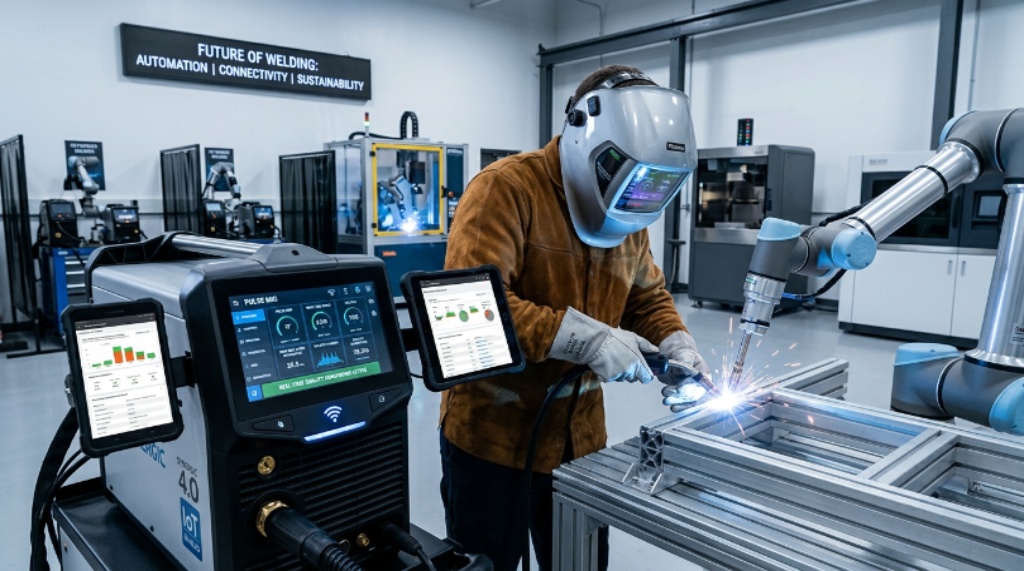
The Internet of Things, or IoT, is making its way into welding shops around the world. Modern welding machines can now connect to the internet and share real-time data. This allows supervisors to monitor weld quality, track machine performance, and detect problems before they cause downtime.
Smart welding machines can also store data about every weld they produce. This information is valuable for quality control and compliance purposes. For example, industries like oil and gas or medical device manufacturing require detailed records of every weld. Smart machines make this process much easier and more reliable.
Additionally, data collected from connected machines can be analyzed to improve efficiency. Manufacturers can identify patterns, reduce waste, and optimize their processes over time. This kind of data-driven decision-making is becoming a standard expectation in modern production environments.
Advances in Welding Technology
Welding technology itself is evolving rapidly. Several new methods and improvements are gaining traction across different industries.
Laser welding is one area seeing significant growth. It uses a focused beam of light to join materials with extreme precision. Laser welding is faster than many traditional methods and produces cleaner results. Therefore, it is becoming popular in electronics, medical devices, and fine metalwork.
Friction stir welding is another technology on the rise. It joins materials without melting them, which reduces distortion and improves strength. This method is widely used in aerospace and shipbuilding, where material integrity is absolutely critical.
Hybrid welding, which combines different welding processes, is also gaining attention. By merging, for example, laser and arc welding, manufacturers can enjoy the benefits of both methods. This approach increases speed while maintaining strong, high-quality welds.
Energy Efficiency and Green Welding
Sustainability is a growing concern in every industry, and welding is no exception. Traditional welding machines consume large amounts of electricity and can produce harmful fumes. However, manufacturers are now developing machines that are cleaner and more energy efficient.
Inverter-based welding machines are a good example of this shift. They use advanced electronics to convert power more efficiently than older transformer-based models. As a result, they consume less electricity while delivering the same or better performance. They are also lighter and more portable, making them practical for a wider range of jobs.
Additionally, manufacturers are working to reduce harmful emissions from welding processes. Better fume extraction systems, cleaner shielding gases, and improved electrode materials are all helping to make welding safer for workers and less damaging to the environment.
Green certifications and environmental regulations are pushing companies to adopt cleaner practices. Therefore, businesses that invest in energy-efficient equipment today are better positioned to meet future regulatory requirements.
The Workforce Challenge and Skills Gap
One of the most pressing issues facing the welding industry is a growing shortage of skilled workers. Many experienced welders are retiring, and not enough young people are entering the trade to replace them. This skills gap is a serious concern for manufacturers who depend on quality welding work.
To address this, companies and educational institutions are investing in welding training programs. Community colleges, trade schools, and apprenticeship programs are expanding their offerings. Additionally, simulation-based training tools are becoming more common. These systems allow new welders to practice their skills in a virtual environment before working with real equipment.
Augmented reality, or AR, is also making training more effective. AR headsets can overlay instructions and guidance directly into a trainee’s field of view. This hands-on, visual approach helps new welders learn faster and make fewer mistakes. Therefore, it is a promising solution to the workforce challenge.
The Impact of Additive Manufacturing
Additive manufacturing, commonly known as 3D printing, is beginning to intersect with welding in exciting ways. Wire arc additive manufacturing, or WAAM, uses welding technology to build metal parts layer by layer. This process can create complex metal components that would be difficult or impossible to make through traditional methods.
WAAM is particularly useful for producing large or custom parts. It reduces material waste and can significantly shorten production times. Industries like aerospace, defense, and energy are already exploring its potential. As the technology matures, it is likely to become a mainstream manufacturing option.
However, WAAM also requires skilled operators who understand both welding principles and additive manufacturing processes. This reinforces the importance of investing in workforce training and development.
Global Market Growth and Regional Trends
The global welding machine market is growing steadily. Rapid industrialization in Asia, particularly in countries like India, China, and Vietnam, is driving strong demand for welding equipment. Infrastructure projects, automotive manufacturing, and construction are all fueling this growth.
In North America and Europe, the market is also expanding, though for different reasons. Here, the focus is on upgrading older equipment with smarter, more efficient systems. Companies are also responding to labor shortages by automating more of their welding operations.
Additionally, the renewable energy sector is creating new opportunities for the welding industry. Building wind turbines, solar panel structures, and hydrogen fuel infrastructure all require significant amounts of welding work. Therefore, the clean energy transition is expected to be a major driver of welding machine demand in the coming years.
What the Future Holds for Welding Machines
Looking ahead, the future of welding machines is bright and full of possibility. Several key developments are expected to shape the industry over the next decade.
Artificial intelligence will play a larger role in welding quality control. AI systems can analyze images and sensor data to detect weld defects in real time. This reduces the need for manual inspection and catches problems early, before they become expensive issues.
Collaborative robots, often called cobots, will become more common on the shop floor. Unlike traditional industrial robots, cobots are designed to work safely alongside human workers. They can handle repetitive or physically demanding tasks while leaving more complex or variable work to skilled welders.
Portable and battery-powered welding machines will also improve. As battery technology advances, field welders will have access to powerful, lightweight machines that do not require a connection to an external power source. This will open up new possibilities for remote and outdoor welding applications.
Finally, connectivity and cloud-based management tools will continue to evolve. Welding operations will be monitored and managed from centralized platforms, giving managers greater visibility and control over production quality and efficiency.
Staying Competitive in a Changing Industry
The welding industry is undergoing a period of rapid and meaningful change. Automation, smart technology, sustainability, and workforce development are all reshaping what it means to weld in the modern world.
For businesses, the key to success is staying informed and being willing to adapt. Investing in newer equipment, training programs, and data management tools is not just a good idea today. It is a necessity for long-term competitiveness.
For individual welders, embracing new skills and technologies will open doors to better opportunities. The welders of tomorrow will need to be comfortable with computers, software, and advanced machinery, in addition to mastering the fundamentals of the trade.
The future of welding machines is not just about the machines themselves. It is about how people, technology, and industry work together to build the world of tomorrow.
Closing Remarks
Welding is a valuable skill that blends technique, safety, and the right equipment. From basic tools to advanced machines, understanding how each part works helps you achieve better results and work more efficiently. Whether you are a beginner or experienced, choosing the right welding machine and practicing proper methods will improve both quality and safety. With the right approach, welding becomes not just a task, but a reliable skill you can build on for years.
Related Topics: