
Aluminum bronze MIG wire is a specialized copper-alloy filler metal used when a weld needs more than ordinary strength. It is valued for its combination of corrosion resistance, wear resistance, strength, and performance in marine and industrial environments.
But there is an important distinction many welding articles miss: not all aluminum bronze MIG wires are interchangeable.
The two classifications you will encounter most often are ERCuAl-A1 and ERCuAl-A2. Their chemistry, mechanical behavior, and recommended applications are different enough that choosing the wrong one can create unnecessary problems with weldability, cracking, strength, or service performance.
This guide explains what aluminum bronze MIG wire is, how A1 and A2 compare, which shielding gas to use, how to set up your MIG welder, when preheating is appropriate, and how to avoid common defects.
What Is Aluminum Bronze MIG Wire?
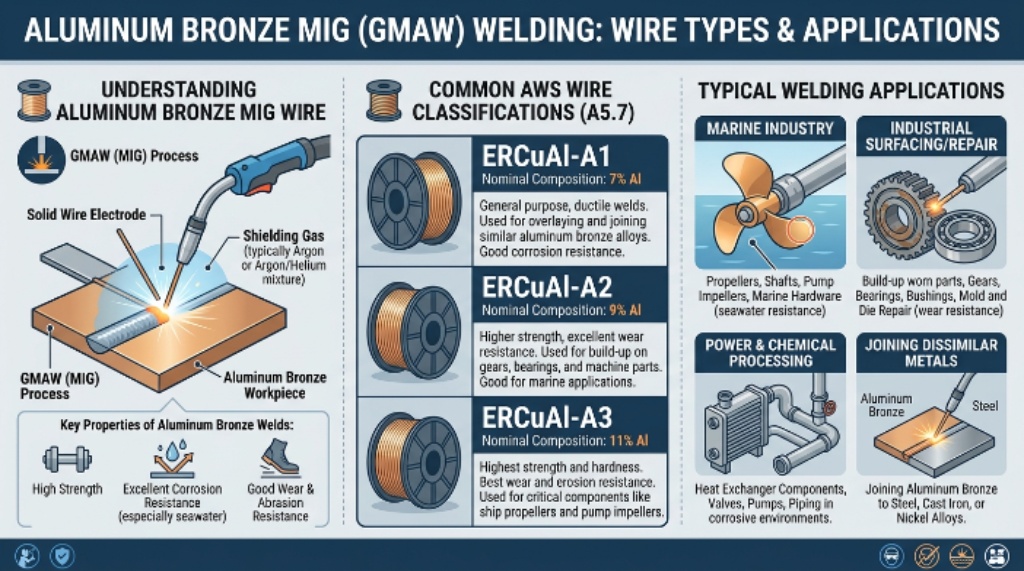
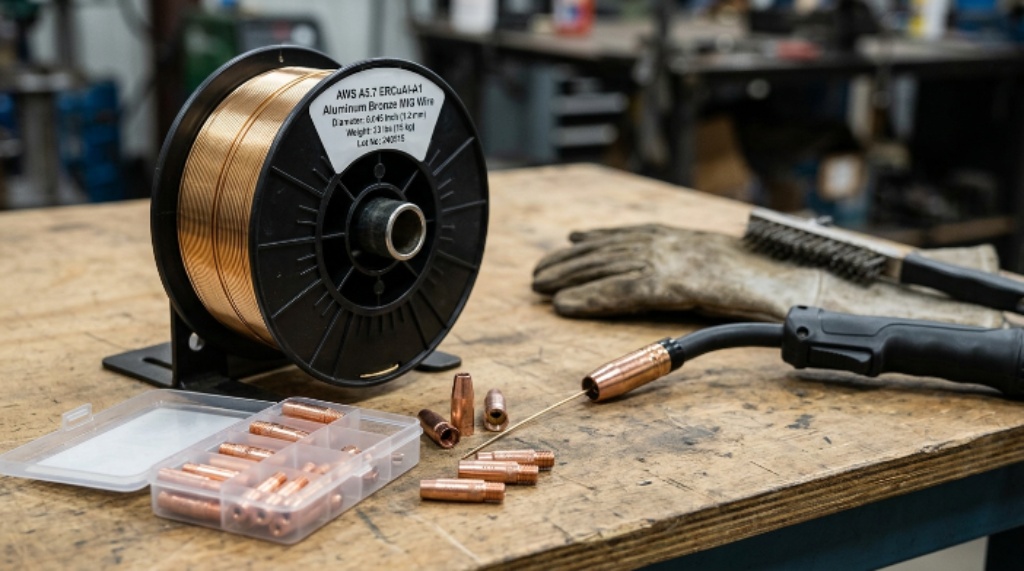
Aluminum bronze MIG wire is a solid copper-based welding wire containing aluminum as a major alloying element. Depending on the classification, it can also contain controlled amounts of iron, manganese, and other elements.
Unlike conventional bronze, which is primarily associated with copper and tin, aluminum bronze gets its name from the addition of aluminum to copper. Commercial aluminum bronzes commonly contain roughly 5% to 11% aluminum, with other alloying elements added to tailor strength, hardness, corrosion resistance, and microstructure.
For MIG welding, the wire is continuously fed through the gun while an inert shielding gas protects the molten weld pool from atmospheric contamination. MIG is technically gas metal arc welding (GMAW), although “MIG” is the term most welders use in the shop.
The current AWS specification covering copper and copper-alloy bare welding rods and electrodes is AWS A5.7/A5.7M:2026. The specification covers filler metals for GMAW, GTAW and plasma arc welding and classifies them primarily according to chemical composition.
That matters because the AWS classification on the spool tells you much more than simply “bronze wire.”
ERCuAl-A1 vs. ERCuAl-A2: What’s the Difference?
If you’re shopping for aluminum bronze MIG wire, this is one of the first things you should understand.
ERCuAl-A1
ERCuAl-A1 is an iron-free aluminum bronze classification. A representative A1 wire contains approximately 6.0%–8.5% aluminum, with copper making up the balance and relatively small limits on manganese, silicon, zinc, and lead.
A1 is commonly used for wear-resistant overlays and applications where corrosion and erosion resistance are important.
One important caution is that some A1 manufacturer guidance specifically says it is not recommended for general joining applications because of the deposit’s tendency toward hot shortness. In other words, don’t automatically assume A1 is the best choice simply because the base metal is aluminum bronze.
ERCuAl-A2
ERCuAl-A2 is an iron-bearing aluminum bronze filler and is generally the more versatile choice for many joining and repair applications.
It is used for joining aluminum bronze and for selected dissimilar-metal combinations involving materials such as:
- Aluminum bronze
- Brass
- Steel
- Copper
- Copper alloys
- Some copper-nickel alloys
- Cast iron in appropriate applications
It is also used for wear- and corrosion-resistant overlays on components such as shafts, propellers, housings, couplings, bushings, valve seats and pumps.
Quick comparison
| Feature | ERCuAl-A1 | ERCuAl-A2 |
| Aluminum bronze type | Iron-free | Iron-bearing |
| Primary strength | Wear/corrosion-resistant overlay | Joining, repair and overlay |
| Similar aluminum bronze | Yes, application-dependent | Yes |
| Dissimilar joining | More limited | More versatile |
| Marine/corrosive service | Excellent in appropriate applications | Excellent in appropriate applications |
| Typical use | Overlay and wear surfaces | Joining, repair and overlay |
The correct filler should ultimately be selected from the base-metal chemistry, joint design, service environment and qualified welding procedure, not simply from the material’s color or name.
Why Use Aluminum Bronze MIG Wire?
The appeal of aluminum bronze is its combination of properties.
1. Corrosion resistance
Aluminum bronze is well known for corrosion resistance, particularly in marine environments. Certain aluminum bronze filler metals are specifically promoted for resistance to seawater and other corrosive conditions. ESAB, for example, lists its ERCuAl-A1 product for applications requiring high resistance to seawater corrosion.
That makes aluminum bronze attractive for components exposed to:
- Seawater
- Salt spray
- Marine environments
- Certain chemical environments
- Moisture
- Erosive service
2. Wear resistance
Aluminum bronze weld deposits can provide a hard, durable surface where ordinary steel filler would not provide the desired combination of wear and corrosion resistance.
This is why aluminum bronze filler is frequently used for overlays on pumps, shafts, bushings, valve components, propellers and similar parts.
3. Dissimilar-metal applications
ERCuAl-A2 can be particularly useful when a repair involves different copper-based alloys or a copper alloy and ferrous material.
That does not mean it should be used indiscriminately. Dissimilar-metal welding changes the chemistry of the weld deposit through dilution, so filler selection should consider the actual combination of metals and the required service properties.
4. High-temperature strength and toughness
Aluminum bronze filler metals can provide useful mechanical properties in demanding industrial applications. Actual properties depend heavily on filler classification, shielding gas, welding parameters, dilution, and the resulting weld-metal microstructure.
For example, ESAB reports a typical as-welded tensile strength of about 420 MPa for its ERCuAl-A1 MIG wire, while other commercial A2 products report different values. These figures should be treated as product-specific typical values—not universal properties of every aluminum bronze weld.
What Shielding Gas Should You Use?
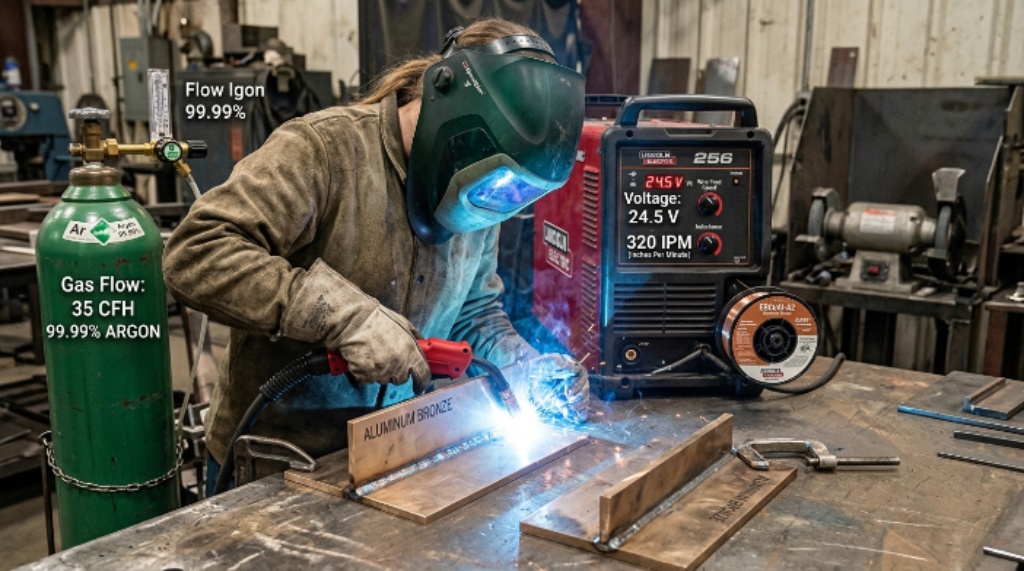
For aluminum bronze MIG welding, 100% argon is a common starting point.
Some manufacturers also specify argon-helium mixtures, particularly when additional arc energy or heat input is desirable. DuraMax, for example, lists either 100% argon or a 75% argon/25% helium mixture for its ERCuAl-A1 MIG applications.
Lincoln Electric likewise lists pure argon and argon/helium mixtures for its CuAl8 aluminum bronze MIG wire.
A practical starting point is therefore:
100% Argon
If your application, wire manufacturer’s data sheet, or welding procedure calls for additional heat, an argon/helium mixture may be appropriate.
Don’t assume that the gas mix used for ordinary steel MIG welding is suitable. Aluminum bronze is a copper alloy, and shielding requirements should be based on the consumable manufacturer’s recommendations.
Aluminum Bronze MIG Welding Settings
There is no single “correct” setting for every aluminum bronze wire.
Wire diameter, joint design, material thickness, transfer mode, welding position, shielding gas, machine characteristics,s and desired deposition rate all affect the correct settings.
As an example, DuraMax provides the following MIG ranges for its ERCuAl-A1 wire:
| Wire diameter | Amperage | Voltage | Shielding gas |
| 0.035 in. | 100–200 A | 20–26 V | Argon or Ar/He |
| 0.045 in. | 100–200 A | 22–28 V | Argon or Ar/He |
| 1/16 in. | 250–400 A | 29–32 V | Argon or Ar/He |
| 3/32 in. | 350–500 A | 32–34 V | Argon or Ar/He |
These numbers are manufacturer-specific starting ranges, not a universal welding procedure.
ESAB’s ERCuAl-A1 product data also shows different recommended current and voltage ranges depending on wire diameter, reinforcing the point that settings must be matched to the exact consumable and equipment.
For production work, use the manufacturer’s data sheet and your qualified WPS/PQR where applicable.
Polarity: DCEP or DC Positive?
Aluminum bronze MIG wire is commonly welded using direct current electrode positive (DCEP), also called reverse polarity.
For example, published A1 welding data from Harris specifies GMAW/MIG using DC reverse polarity and spray transfer.
Always confirm polarity against the particular wire manufacturer’s documentation before striking an arc.
Do You Need to Preheat Aluminum Bronze?
This is an area where generic welding advice can confuse.
Do not automatically preheat aluminum bronze simply because it is a copper alloy.
Aufhauser’s copper-alloy welding guidance specifically states that aluminum bronze and copper-nickel alloys generally should not be preheated, while noting that welding conditions, alloy, thickness, ss and weldment mass must be considered.
At the same time, individual filler manufacturers may provide different guidance for heavy sections and particular applications.
The safest rule is:
Follow the filler manufacturer’s recommended preheat/interpass range and the qualified welding procedure for the actual base metal.
Avoid unnecessary heat. Excessive heat input can affect the metallurgy of the base material and weld deposit and can increase distortion.
For heavy copper-alloy sections, thermal management becomes particularly important because copper-based materials can conduct heat away from the weld area rapidly.
Preparing Aluminum Bronze Before MIG Welding
Surface preparation has a major effect on weld quality.
Before welding:
- Remove oil, grease, and other contaminants.
- Remove surface oxidation and dirt.
- Use a clean brush appropriate for the alloy.
- Keep the filler wire clean and dry.
- Avoid touching the prepared joint with dirty gloves.
- Make sure the shielding-gas system is leak-free.
- Protect the weld area from drafts that can disturb gas coverage.
Miller’s current welding guidance emphasizes that contaminants and oxide layers can contribute to poor aluminum weld quality, while general MIG troubleshooting identifies inadequate shielding, equipment problems,s and wind as contributors to porosity.
For aluminum bronze specifically, the goal is the same: start with clean metal and stable shielding before trying to fix the weld with machine settings.
How to MIG Weld Aluminum Bronze
Once the joint is properly prepared, the process is relatively straightforward, but technique matters.
Step 1: Identify the base metal
Don’t start with the wire spool. Start with the material.
Determine whether you’re welding:
- Aluminum bronze to aluminum bronze
- Aluminum bronze to steel
- Aluminum bronze to brass
- Aluminum bronze to copper
- Aluminum bronze to copper-nickel
- Another dissimilar combination
The joint combination determines whether your selected filler is appropriate.
Step 2: Select the correct AWS classification
For many applications, the choice will come down to ERCuAl-A1 or ERCuAl-A2, but other copper-alloy classifications exist.
AWS currently groups ERCuAl-A1, ERCuAl-A2, ERCuAl-A3 and related aluminum-bronze classifications within its copper-alloy welding classifications.
Step 3: Set up the shielding gas
Start with the gas specified by the consumable manufacturer—often 100% argon for aluminum bronze MIG applications.
Check gas flow, hose connections, and the regulator before welding.
Step 4: Use the recommended polarity
DCEP is a common configuration for aluminum bronze MIG wire, but verify the manufacturer’s instructions.
Step 5: Establish a stable arc
Avoid excessive arc length. Use a controlled travel speed and maintain consistent torch positioning.
For difficult joints, make practice welds on representative material before committing to the production component.
Step 6: Control heat input
Don’t simply turn the machine higher because the puddle appears sluggish.
Copper alloys can move heat away from the weld rapidly, so the temptation is often to compensate with excessive heat. Instead, use the correct wire diameter, transfer mode, gas mixture and travel speed.
Step 7: Inspect the finished weld
Look for:
- Consistent bead profile
- Adequate fusion
- Cracks
- Porosity
- Undercut
- Excessive spatter
- Incomplete fill
- Signs of overheating
For critical components, visual inspection alone may not be enough. Use the inspection and testing requirements specified by the applicable code, drawing, or welding procedure.
Common Aluminum Bronze MIG Problems
Porosity
Porosity often points to contamination or inadequate shielding.
Check:
- Gas flow
- Gas leaks
- Wind or drafts
- Torch position
- Contaminated base metal
- Contaminated filler
- Excessive arc length
Miller identifies poor shielding coverage and equipment problems among common causes of MIG porosity.
Poor fusion
If the filler is sitting on top rather than properly fusing into the joint, examine heat input, joint preparation, travel speed and torch technique.
Do not automatically solve poor fusion by dramatically increasing amperage.
Excessive spatter
Spatter can result from inappropriate transfer conditions, incorrect voltage/wire-feed relationships, poor shielding or contamination.
Start by checking whether your settings actually match the manufacturer’s data for the wire diameter.
Cracking
Cracking is a metallurgy problem, not simply a “bad setting.”
The base-metal chemistry, filler classification, dilution, restraint, heat input, and cooling conditions all matter. For critical work, follow a qualified procedure rather than relying on generic Internet settings.
Can You Use Aluminum Bronze MIG Wire on Steel?
Yes, some aluminum bronze classifications can be used for selected steel-to-copper-alloy or overlay applications, particularly ERCuAl-A2.
Commercial A2 documentation specifically lists steel and dissimilar-metal welding among its applications.
However, “can be welded” is not the same as “is automatically the best filler.”
The service environment, joint geometry, required mechanical properties, dilution and corrosion conditions should all be evaluated before selecting the filler.
For structural, pressure-containing, safety-critical or code-regulated work, use an applicable qualified welding procedure.
Aluminum Bronze vs. Silicon Bronze MIG Wire
These two wires are frequently confused.
Silicon bronze is a copper-silicon filler commonly used for applications such as MIG brazing and joining certain thin or coated materials.
Aluminum bronze is a different copper-alloy family containing substantially more aluminum and is selected when properties such as wear resistance, corrosion resistance,e and higher-strength copper-alloy deposits are required.
They should not be treated as interchangeable simply because both produce a bronze-colored weld.
The right choice depends on the base metal and application.
Best Applications for Aluminum Bronze MIG Wire
Aluminum bronze MIG wire is particularly useful in applications involving wear, corrosion, or difficult copper-alloy combinations.
Common applications include:
- Marine equipment
- Propellers
- Pumps
- Valve components
- Bushings
- Shafts
- Couplings
- Housings
- Wear-resistant overlays
- Corrosion-resistant overlays
- Repair of copper-alloy components
- Selected dissimilar-metal joints
- Industrial machinery
ESAB and Airgas/Harris documentation both identify marine, pump, shaft, propeller, valve, and overlay applications for aluminum bronze filler metals.
Frequently Asked Questions
Is aluminum bronze MIG wire the same as bronze wire?
No. Aluminum bronze contains aluminum as a major alloying element. Other bronze filler metals, such as silicon bronze or tin bronze, have different chemistry and properties.
What is the most common aluminum bronze MIG wire?
ERCuAl-A1 and ERCuAl-A2 are two important AWS classifications. A1 is an iron-free aluminum bronze commonly associated with overlay applications, while A2 is an iron-bearing grade used for a broader range of joining, repair, and overlay work.
Can I weld aluminum bronze with a regular MIG welder?
Potentially, yes, provided the machine can deliver the required output and is configured appropriately for the wire. The gun, liner, drive rolls, contact tip, shielding gases,s and consumable diameter all need to be suitable for the application.
What gas is best for aluminum bronze MIG?
100% argon is a common starting point. Some aluminum bronze wires also permit argon/helium mixtures. Always follow the manufacturer’s consumable data.
What polarity should aluminum bronze MIG wire use?
DCEP is commonly specified for aluminum bronze GMAW/MIG. Verify the exact wire manufacturer’s instructions before welding.
Does aluminum bronze require preheating?
Not necessarily. Some copper-alloy guidance specifically advises against preheating aluminum bronze in typical applications, while particular heavy-section procedures may require controlled thermal management. Follow the consumable manufacturer’s recommendations and the qualified welding procedure.
Can ERCuAl-A2 weld steel?
A2 aluminum bronze is used for selected steel-to-copper-alloy and other dissimilar-metal applications. However, filler selection should be based on the actual materials, joint design,gn and service requirements rather than assuming A2 works for every steel application.
Is ERCuAl-A1 good for joining?
Be careful here. Some A1 manufacturers specifically recommend the classification for overlay applications and caution against joining because of hot-shortness concerns. If the objective is joining rather than surfacing, compare the base-metal and application requirements carefully before choosing A1.
Is aluminum bronze corrosion resistant?
Yes. Corrosion resistance is one of its major advantages, particularly in appropriate marine and industrial environments. The actual performance depends on the alloy, weld quality, and service conditions.
What AWS standard covers aluminum bronze welding wire?
The current AWS specification is AWS A5.7/A5.7M:2026, covering copper and copper-alloy bare welding rods and electrodes for processes including GMAW, GTAW, and plasma arc welding.
Final Takeaway
Aluminum bronze MIG wire is a specialty consumable, and getting good results requires more than choosing a spool labeled “aluminum bronze.”
The most important decision is selecting the correct AWS classification for the actual application. ERCuAl-A1 and ERCuAl-A2 may look similar on a product page, but their chemistry and intended applications are not identical.
For general shop work, start by identifying the base metals, then check the applicable AWS classification, manufacturer data sheet, shielding-gas recommendation, wire diameter, and polarity. Keep the joint clean, maintain reliable gas coverage, control heat input, and qualify the procedure when the application requires it.
For critical fabrication, don’t rely on generic online amperage or voltage settings. Manufacturer data and a qualified welding procedure should take priority.
That approach will give you a much better chance of producing an aluminum bronze weld that isn’t just visually acceptable—but is actually appropriate for the service conditions it will face.