
If you have a stick welder sitting in your shop and need to join two pieces of sheet metal, it is natural to wonder: Can a stick welder be used for spot welding? The short answer is no—not for true resistance spot welding. A stick welder can make small tack welds, and in some applications it can make plug welds that serve a similar purpose to a spot weld. But a stick machine does not become a resistance spot welder simply because you use a short arc, a small electrode, or a high amperage setting.
That distinction matters. Resistance spot welding and shielded metal arc welding (SMAW), commonly called stick welding, use fundamentally different ways of generating and controlling heat.
If your project requires actual resistance spot welds—particularly automotive sheet metal, production assemblies, or joints where repeatable weld size matters—you need equipment designed for resistance welding.
Quick Answer
A stick welder cannot make a true resistance spot weld.
A resistance spot welder clamps overlapping sheets between electrodes and passes a controlled electrical current through the joint while applying electrode force. The electrical resistance of the workpieces generates localized heat and forms a weld nugget between the sheets. AWS describes resistance welding as a process that combines mechanical pressure with electrical current, with resistance at the joint producing the heat needed for fusion.
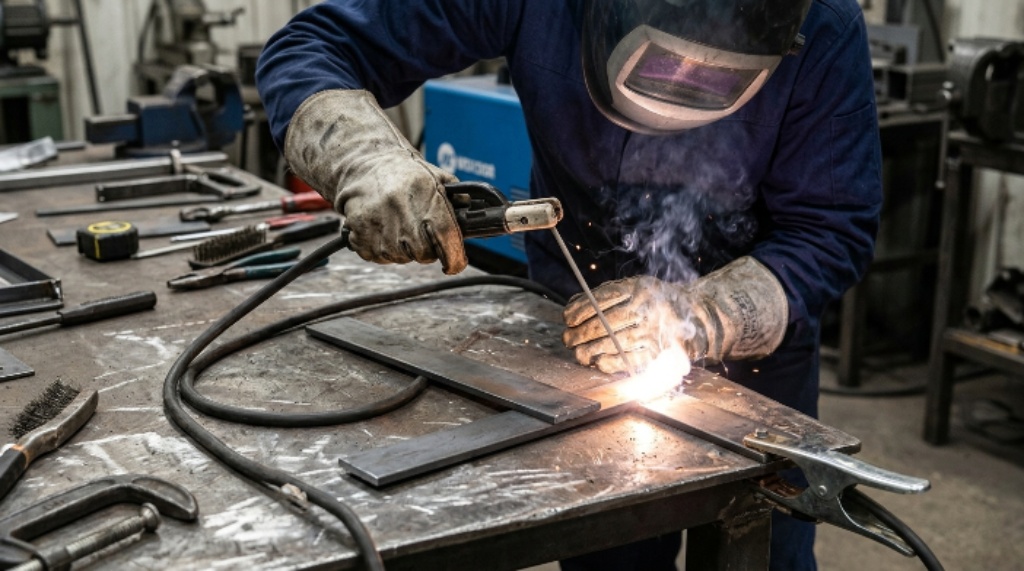
A stick welder works differently. SMAW creates an electric arc between a flux-coated consumable electrode and the workpiece. The electrode melts and supplies filler metal while its flux coating provides shielding and forms slag.
So, while a stick welder can produce a small weld, it does not produce a true resistance spot weld.
At a glance
| Welding method | Can a stick welder do it? | Typical purpose |
| Resistance spot welding | No | Joining overlapping sheet metal with controlled nuggets |
| Tack welding | Yes | Holding parts in alignment |
| Plug welding | Sometimes | Joining overlapping material through a hole |
| Short arc weld | Yes | Localized joining where the material is suitable for SMAW |
| Automotive factory-style spot replacement | Usually no | Requires the specified repair process and equipment |
The important question is therefore not simply, “Can I make a small weld with my stick welder?” You can.
The better question is: Does the application require a resistance spot weld?
What Is a True Spot Weld?
In welding terminology, “spot welding” normally refers to resistance spot welding (RSW).
The process uses two electrodes to squeeze overlapping pieces of metal together. Electrical current then passes through the material between the electrodes. Resistance in the joint produces heat, and that heat creates a localized molten region called the weld nugget.
The electrodes perform several important jobs. AWS notes that spot-welding electrodes apply force, influence resistance at the contact interfaces, contain the molten nugget, and help remove heat from the weld area.
That means resistance spot welding depends on more than current alone. The process involves several interacting variables, including:
- Electrode force
- Welding current
- Weld time
- Electrode geometry
- Material type
- Material thickness
- Surface condition
- Number of sheets in the stack
- Electrical resistance
- Cooling and electrode condition
This is one of the biggest information gaps in many beginner explanations of spot welding: amperage by itself does not define the process.
A stick welder may have plenty of output current to melt a welding rod, but it does not have the electrode arrangement, controlled squeeze force, resistance-welding circuit, timing system, and tooling used to create a repeatable resistance weld nugget.
AWS continues to treat resistance welding as a specialized process with dedicated equipment, procedures, electrode selection, quality control, and technician training.
How Is Stick Welding Different?
Stick welding is shielded metal arc welding (SMAW).
Instead of clamping two sheets between resistance electrodes, the welder holds a consumable electrode above the workpiece and establishes an electric arc. The arc melts the electrode and base metal, producing a weld pool. The electrode’s flux coating provides shielding and leaves a layer of slag that must generally be removed after welding.
The welder controls important variables manually, including:
- Arc length
- Travel speed
- Electrode angle
- Amperage
- Rod diameter
- Welding position
- Joint fit-up
That makes SMAW extremely useful for many repair and fabrication jobs, especially where portability, outdoor capability, and relatively thick steel are important.
It also explains why stick welding is a poor substitute for resistance spot welding on thin sheet.
With SMAW, the arc puts substantial localized heat into the surface and joint. With resistance spot welding, the workpieces are clamped and the process is engineered to concentrate heat between the electrodes.
They are not interchangeable processes.
Can a Stick Welder Make a Small “Spot” Weld?
Yes—but calling it a spot weld can create confusion.
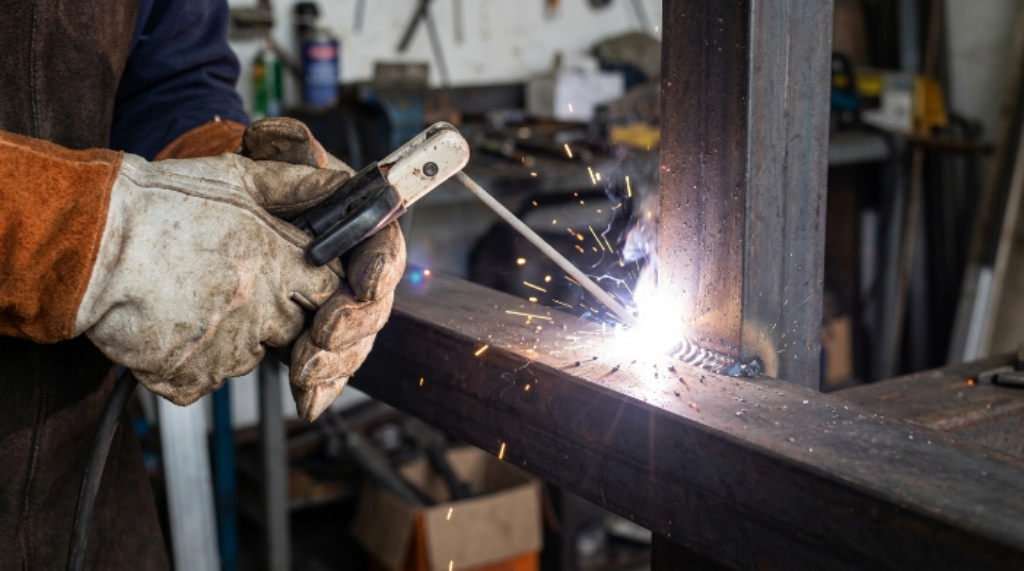
A stick welder can make a small tack weld. A tack is a small weld used to temporarily hold components in position before the final weld is completed.
For example, you might use several SMAW tacks to hold two pieces of steel together while checking alignment.
The tack may look like a small round spot, but its appearance does not make it a resistance spot weld.
Tack weld vs. resistance spot weld
A tack weld:
- Uses an arc
- Uses a welding electrode
- Adds filler metal
- Is made by the welder
- Is commonly used for positioning and fit-up
A resistance spot weld:
- Uses opposing electrodes
- Applies mechanical pressure
- Uses a controlled electrical current through the workpieces
- Forms a localized weld nugget between overlapping sheets
- Usually does not require filler metal
This terminology is particularly important when reading automotive repair procedures or welding specifications. A manufacturer calling for a “spot weld” generally is not telling you to make a small SMAW tack.
What About Plug Welding?
This is where the answer becomes more nuanced.
A plug weld can sometimes be used as an alternative to a resistance spot weld when the correct repair procedure permits it.
A plug weld is made through a hole in one piece of material so that the weld fuses the upper piece to the material underneath.
In practical terms, the upper sheet acts somewhat like a flange with a hole in it. The welder deposits metal through that opening and must achieve proper fusion with the lower sheet.
This is an arc-welding process, not resistance spot welding.
A stick welder can theoretically make certain plug welds, particularly on material substantial enough to tolerate SMAW heat. But that does not mean it is automatically a good choice.
The difficulty increases dramatically as the material becomes thinner.
I-CAR’s collision-repair information shows why this distinction matters. Vehicle manufacturers frequently specify particular resistance spot-welding or MIG/MAG plug-welding procedures, including weld quantity, hole dimensions, locations, and minimum weld requirements.
For example, I-CAR reports that certain Ford/Lincoln procedures allow factory welds to be replaced with resistance spot welds or MIG plug welds when specified, while requiring the replacement welds to match the required location and quantity.
That is very different from saying, “Any small plug weld made with a stick welder is equivalent to a factory spot weld.”
It isn’t.
Why Stick Welding Thin Sheet Metal Is Difficult
Thin sheet metal has very little thermal mass. That leaves you with a narrow process window between getting adequate fusion and simply blowing a hole through the material.
The main problems include:
1. Burn-through
Too much heat can melt completely through the sheet.
2. Distortion
Uneven heating and cooling can pull a panel out of shape.
3. Excessive heat-affected area
A small-looking arc weld can affect more surrounding material than you might expect.
4. Slag
SMAW produces slag. In a small plug-weld opening, slag can become difficult to manage and may contribute to defects if the procedure and technique are poor.
5. Limited control
Compared with processes commonly used for sheet metal, SMAW gives the operator less practical control for extremely thin material.
ESAB’s guidance on thin materials emphasizes minimizing heat input, preventing burn-through and distortion, and selecting the welding process and consumable according to the material and application. Its current equipment guidance also highlights specialized low-heat-input approaches for thin sheet.
So while a highly experienced welder may accomplish things that a beginner cannot, “possible” and “appropriate” are not the same thing.
What Should You Use for Sheet Metal Instead?
The best process depends on the material, thickness, joint design, accessibility, and required strength.
For true resistance spot welding, use a resistance spot welder.
For certain sheet-metal fabrication and repair jobs, MIG/GMAW is often more practical than SMAW because continuous wire feeding and appropriate transfer modes can provide better control on thin material.
TIG can also provide excellent control when precision matters, although productivity and technique requirements differ.
The important point is not that one process is universally “better.” It is that each process is designed around a particular operating window.
A practical comparison
| Process | Thin sheet | Overlapping sheets | True spot weld? | Filler electrode |
| SMAW / Stick | Difficult | Possible in some joints | No | Yes |
| MIG / GMAW | Good with appropriate setup | Possible with plug welding | No | Yes |
| TIG / GTAW | Very controllable | Possible | No | Usually yes |
| Resistance spot welding | Excellent application | Excellent application | Yes | No |
What About Automotive Body Panels?
Automotive work is one of the most serious situations where you should not assume that a stick tack is an acceptable replacement for a factory spot weld.
Modern vehicle bodies can contain mild steel, high-strength steel, advanced high-strength steel, ultra-high-strength steel, aluminum, adhesives, coatings, and multi-layer assemblies.
Repair requirements can therefore vary considerably by vehicle and location.
I-CAR documents multiple OEM procedures in which resistance spot welding is preferred or required where access permits, while MIG/MAG plug welding may be permitted in specified locations where a spot-welding gun cannot reach.
For example, I-CAR reports that Toyota/Lexus procedures can specify the number and location of replacement spot welds and provide requirements for plug-weld holes where resistance spot welding cannot be performed.
The implication is important:
Do not substitute a stick-welded tack for a vehicle manufacturer’s specified structural weld.
The correct repair method may affect strength, fatigue performance, corrosion protection, dimensional accuracy, and ultimately crash performance.
For collision repair, use the vehicle-specific body repair information and follow the specified welding procedure.
Can You Modify a Stick Welder to Make Spot Welds?
You may find improvised setups, carbon-arc attachments, electrode accessories, or homemade tools described online as ways to create “spot welds” with an arc-welding power source.
Be careful with this idea.
Heating a small area of metal is not the same thing as producing a controlled resistance spot weld.
A proper resistance welding system has to manage electrode force, electrical characteristics, weld time, electrode geometry, heat generation, and—depending on the system—cooling.
Modern resistance spot welding also has extensive applications in automated and production environments precisely because repeatability matters. AWS describes resistance spot welding as a mature production process and continues to publish guidance on electrode selection, equipment, monitoring, and quality assurance.
For a non-critical experiment on scrap, an improvised setup might produce a fused area.
That does not make it equivalent to a qualified resistance spot-welding process.
If the weld has to carry a meaningful load, pass inspection, or reproduce a manufacturer’s repair, use equipment and procedures intended for the application.
You Only Have a Stick Welder, What Can You Do?
If buying another machine is not practical, you still have options—but choose the alternative based on the actual joint requirement.
For temporary alignment
Use tack welds.
Make sure the tacks are properly fused and positioned so they do not interfere with the final weld.
For overlapping thicker steel
A plug weld may be possible if the joint design and material thickness are appropriate for SMAW.
Practice on scrap first.
For very thin sheet
Consider whether MIG, TIG, or resistance spot welding is more appropriate.
Trying to force SMAW into an application for which it has a poor process window can create more problems than it solves.
For structural or safety-critical work
Do not improvise.
Follow the applicable welding procedure, engineering requirements, code, or manufacturer repair instructions.
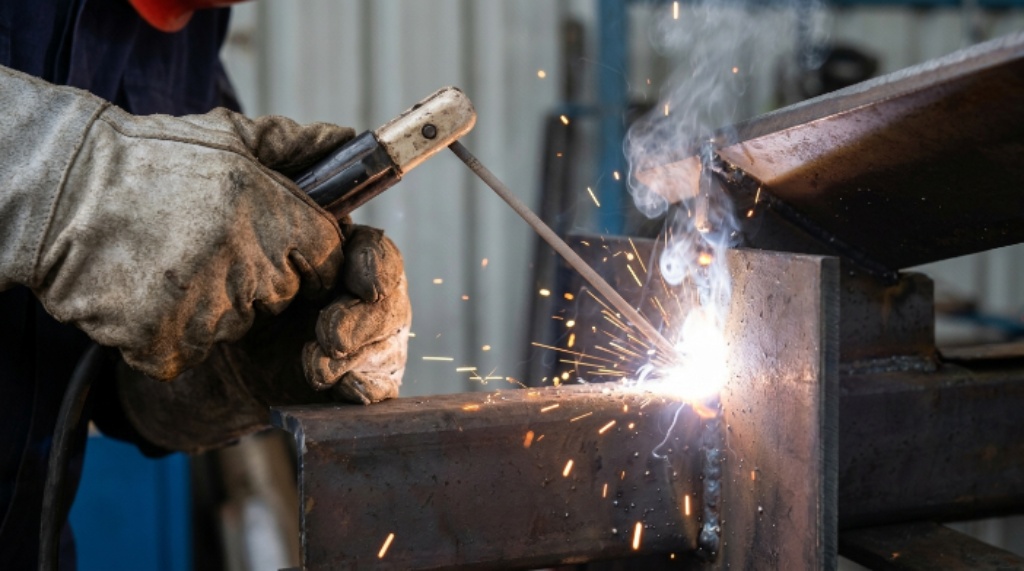
How to Practice Plug or Tack Welding With a Stick Welder
If you are learning, practice on scrap rather than on the actual project.
A sensible practice sequence is:
- Use clean, bare material.
- Clamp overlapping pieces tightly so there are no unnecessary gaps.
- Select an electrode and amperage appropriate for the material and position.
- Make a small tack or practice plug weld.
- Allow the material to cool when heat buildup becomes a problem.
- Remove slag after the weld has cooled sufficiently.
- Inspect the weld visually.
- On non-critical test coupons, cut through sample welds to check whether fusion reached the lower piece.
- Watch for burn-through, cracks, porosity, undercut, slag inclusions, and lack of fusion.
- Do not assume a visually attractive weld is automatically a structurally adequate weld.
For a plug weld, one of the most important checks is whether the deposited metal actually fused to the lower piece. Filling the hole without properly joining both sheets does not create the intended joint.
Safety: A Small Weld Is Still a Welding Operation
Never treat a tack weld as harmless simply because it takes only a second.
Arc welding exposes the operator to ultraviolet radiation, molten metal, sparks, fumes, burns, electrical hazards, and fire hazards. OSHA specifically identifies welding hazards including metal fumes, UV radiation, burns, eye damage, electric shock, and fire.
Use appropriate:
- Welding helmet and eye protection
- Welding gloves
- Flame-resistant clothing
- Closed-toe protective footwear
- Adequate ventilation or local exhaust
- Fire prevention measures
- Proper electrical connections and grounding
- Workpiece preparation and housekeeping
Coated and galvanized metals require additional caution. OSHA notes that zinc-containing coatings and galvanized steel can produce zinc oxide fumes associated with metal fume fever, while some coatings can introduce more serious toxic exposures.
Never weld on a fuel tank, sealed container, or other potentially hazardous vessel simply because the repair looks small.
The Bottom Line
Can a stick welder be used for spot welding?
If by “spot welding” you mean true resistance spot welding, the answer is no.
A stick welder uses SMAW: an arc between a flux-coated consumable electrode and the workpiece.
A resistance spot welder uses pressure and controlled electrical current between electrodes to create a localized weld nugget between overlapping pieces.
Those are different welding processes.
A stick welder can still be useful when you need:
- Small tack welds
- Fit-up welds
- Certain plug welds
- Repairs on appropriately thick steel
- Practice joints on scrap
But don’t confuse those welds with resistance spot welds, and don’t assume a small tack or stick-welded plug automatically reproduces the strength or performance of a factory spot weld.
For automotive repairs, structural work, production applications, and any joint where the welding procedure matters, follow the applicable specification or manufacturer repair procedure. Current AWS material continues to emphasize dedicated resistance-welding equipment, electrode selection, process control, and quality assurance for resistance spot welding.
The practical rule is simple: use a stick welder when the job calls for SMAW; use a resistance spot welder when the job calls for resistance spot welding.
Frequently Asked Questions
Can I make a spot weld with a 6011 or 6013 rod?
Not a true resistance spot weld. A 6011 or 6013 electrode can be used for SMAW tack or other arc welds when appropriate, but the resulting weld is not a resistance spot weld.
Can I spot weld 20-gauge sheet metal with a stick welder?
It may be possible to create an arc tack under some circumstances, but that does not make it a practical substitute for resistance spot welding. Thin sheet has a high risk of burn-through and distortion, so a process designed for thin material is generally the better choice.
Is a tack weld stronger than a spot weld?
There is no universal answer. Strength depends on weld size, material, geometry, loading, fusion, spacing, and the specific process. A tack and a resistance spot weld are different joint types and should not be compared solely by appearance.
Can I replace automotive spot welds with stick welds?
Generally, you should not do this without an applicable repair procedure that specifically permits it. Vehicle manufacturers can specify resistance spot welding, MIG/MAG plug welding, weld quantity, weld location, hole size, and other requirements. Follow the vehicle-specific repair information.
Is MIG better than stick for sheet metal?
MIG is often more practical for thin sheet because the process can be configured for relatively low heat input and continuous wire feeding. But “better” depends on the material, thickness, joint, position, equipment, and required quality. ESAB identifies MIG and TIG among the common choices for thin materials.
Can I use a homemade spot-welding attachment on a stick machine?
A homemade attachment may create localized heating, but it should not be assumed to provide the controlled electrode force, current, timing, and repeatability of a resistance spot welder. Avoid improvised equipment for structural, automotive, production, or safety-critical work.
What is the best machine for true spot welding?
A purpose-built resistance spot welder is the appropriate machine for resistance spot welding. The required equipment depends on the material, thickness, access, electrode geometry, weld schedule, and quality requirements.
Do spot welds use filler metal?
Traditional resistance spot welding normally forms the joint by heating and fusing the workpieces between electrodes rather than depositing a separate filler rod or wire. SMAW, by contrast, normally melts the consumable electrode into the joint.
Can a stick welder be used for plug welding?
Sometimes, particularly on material thick enough to tolerate SMAW. However, plug-weld requirements vary by joint and application, and automotive repairs may specifically require MIG/MAG or another process. Always verify the procedure before treating a plug weld as a substitute for a spot weld.
What is the biggest mistake beginners make?
The most common conceptual mistake is treating “small weld,” “tack weld,” “plug weld,” and “spot weld” as interchangeable terms. They are not. Understanding the process behind each term is more important than simply making a weld that looks like a small dot.
Information Gaps Addressed in This Revision
This version strengthens the original article by adding several underdeveloped areas:
- A technical explanation of why SMAW cannot perform true resistance spot welding
- The role of electrode force, weld time, resistance, and electrode geometry
- A clearer distinction between tack, plug, and resistance spot welds
- More precise guidance on thin-sheet burn-through and distortion
- Current AWS resistance-welding guidance
- Current OSHA welding and fume-safety guidance
- Automotive repair context based on I-CAR/OEM repair information
- A more careful discussion of plug-weld substitution
- The limitations and risks of homemade/improvised spot-welding attachments
- A process-selection table for SMAW, MIG, TIG, and resistance spot welding
- A more comprehensive FAQ section addressing the questions beginners are most likely to search for
- Stronger E-E-A-T signals through primary/industry sources rather than relying solely on generic welding claims
Source basis: AWS’s current resistance-welding materials, AWS’s 2025 electrode-selection guidance, AWS’s 2026 aerospace resistance-welding update, OSHA welding-safety guidance, I-CAR collision-repair information, and manufacturer technical guidance were used to update and fact-check the rewrite.