
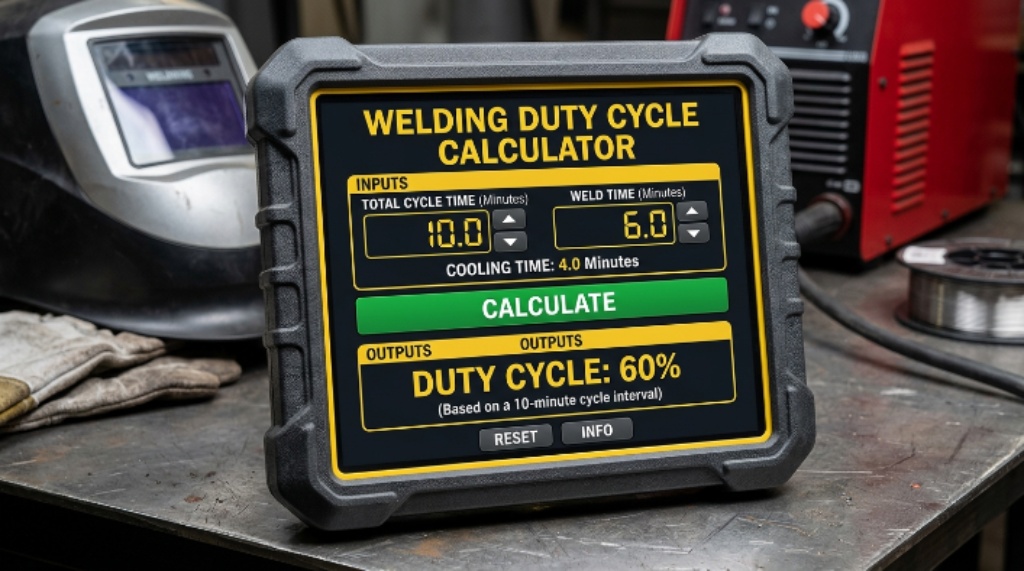

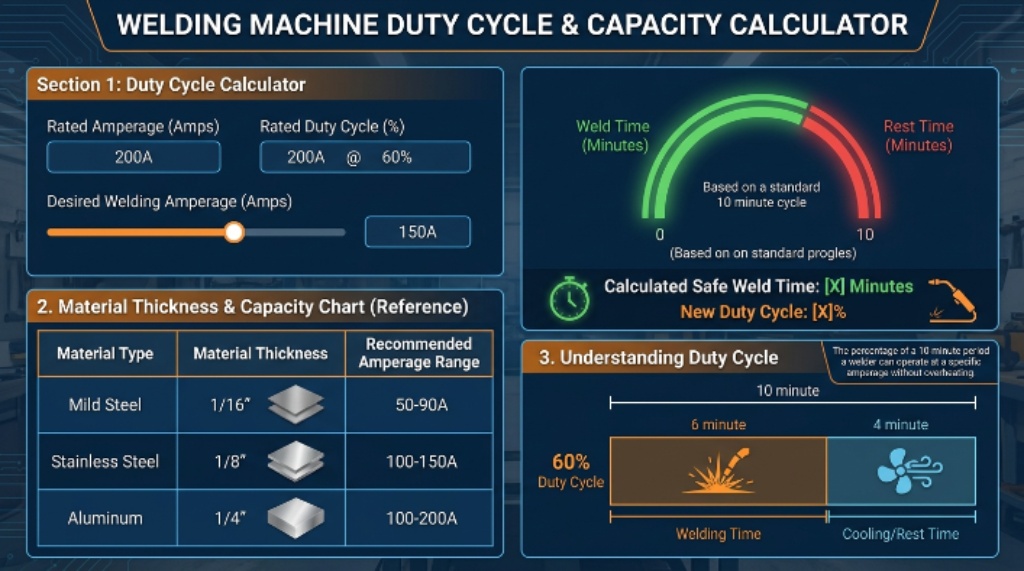
A welding machine’s duty cycle tells you something important that the maximum amperage rating alone cannot: how long the machine can sustain a particular welding output before thermal limits become a problem. If your welder is rated at 60% duty cycle at 200 amps, for example, that does not mean you can weld for 60% of your workday. It means the machine is rated to operate at 200 amps for 6 minutes during a 10-minute test period, with the remaining 4 minutes representing the non-load portion of that cycle.
That distinction matters when you are choosing a welder for fabrication, estimating production time, or trying to understand why a machine’s thermal protection keeps shutting down.
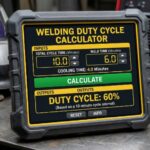
Use the calculator above to convert a duty-cycle percentage into practical weld time. Then use the guide below to understand what that number really means—and, just as importantly, what it does not mean.
Quick Welding Duty Cycle Calculator
For a standard 10-minute duty-cycle rating:
Weld time = 10 × (Duty Cycle ÷ 100)
Non-welding time = 10 − Weld Time
For example:
- 20% duty cycle = 2 minutes of rated welding time
- 30% duty cycle = 3 minutes
- 40% duty cycle = 4 minutes
- 50% duty cycle = 5 minutes
- 60% duty cycle = 6 minutes
- 80% duty cycle = 8 minutes
- 100% duty cycle = 10 minutes
| Duty Cycle | Rated Arc-On Time | Remaining Time in 10-Minute Cycle |
| 20% | 2 minutes | 8 minutes |
| 30% | 3 minutes | 7 minutes |
| 40% | 4 minutes | 6 minutes |
| 50% | 5 minutes | 5 minutes |
| 60% | 6 minutes | 4 minutes |
| 70% | 7 minutes | 3 minutes |
| 80% | 8 minutes | 2 minutes |
| 100% | 10 minutes | 0 minutes |
Manufacturers such as Miller and Fronius describe duty cycle using 10 minutes, with the percentage representing the portion of that period the equipment can operate at the specified output without exceeding its thermal limits.
What Is Duty Cycle on a Welder?
Duty cycle is a thermal operating rating for a welding power source.
During welding, electrical components inside the machine generate heat. Transformers, switching components, rectifiers, conductors, connections, and other components all have temperature limits. The machine’s cooling system—including fans, heat sinks, airflow, and internal design—has to remove enough heat to keep those components within their allowable limits.
The duty-cycle rating tells you how much operating time the machine can handle at a specified welding output under the conditions used for the rating.
This is why a duty-cycle percentage should never be read by itself.
A specification such as:
200 A @ 60% duty cycle
is much more useful than simply saying:
60% duty cycle
The amperage is part of the rating.
In fact, many machines have several duty-cycle ratings. A machine might operate at 100% duty cycle at a lower current, 60% at a higher current, and 40% near its maximum rated output. Current product specifications from manufacturers demonstrate this pattern. For example, Fronius lists different current/duty-cycle combinations for its machines rather than treating duty cycle as one fixed percentage across the entire output range.
How Does a Welding Duty Cycle Calculator Work?
The calculation is straightforward when the machine uses the standard 10-minute rating period.
Suppose your machine has a:
60% duty cycle at 200 amps
Convert 60% to a decimal:
60 ÷ 100 = 0.60
Then multiply by 10 minutes:
0.60 × 10 = 6 minutes
So the rated operating portion is 6 minutes.
The remaining portion is:
10 − 6 = 4 minutes
Therefore:
60% duty cycle = 6 minutes on + 4 minutes off within a 10-minute cycle
This is the same basic calculation manufacturers use in their explanations of duty cycle. Miller gives the example of a 30% rating at 215 amps as three minutes of continuous operation followed by seven minutes of cooling time.
Reverse calculation: finding duty cycle from weld time
You can also work backward.
If a machine operates for 4 minutes during a 10-minute period:
Duty cycle = (4 ÷ 10) × 100
Duty cycle = 40%
So:
4 minutes welding in 10 minutes = 40% duty cycle
Why Amperage Matters So Much
One of the most common mistakes beginners make is assuming that a welder has one universal duty-cycle percentage.
It does not.
Duty cycle is normally associated with a particular output condition. A machine may have substantially different duty-cycle ratings at different amperages.
For example, a specification might look something like this:
| Welding Output | Duty Cycle |
| 100 A | 100% |
| 150 A | 60% |
| 200 A | 40% |
These numbers are illustrative, not a substitute for the rating table for your particular machine.
The important point is that higher welding output generally creates more thermal stress, so manufacturers often provide lower duty-cycle percentages at higher current settings.
This is why you should never take a machine’s “60% duty cycle” and assume it applies at the machine’s maximum amperage.
Always check the manufacturer’s actual duty-cycle chart.
What Does 60% Duty Cycle Mean?
A 60% duty cycle means the machine can operate at the specified rated output for 60% of a standard 10-minute cycle.
That equals:
6 minutes of rated operation
and:
4 minutes of non-load time
For example, if a welding power source is rated:
200 A @ 60%
the rating means approximately six minutes at 200 amps within the 10-minute test cycle under the stated test conditions.
It does not mean:
- six minutes of welding every hour
- six minutes of welding regardless of amperage
- six minutes followed by a universally mandatory four-minute shutdown
- that the machine is safe to operate continuously at 200 amps
- that every accessory connected to the machine has the same duty-cycle rating
The manufacturer’s manual takes priority over a generic calculator.
What Does 100% Duty Cycle Mean?
A 100% duty cycle means the machine is rated for continuous operation at the specified output during the complete 10-minute duty-cycle period.
That is useful for production welding because there is no scheduled non-load portion within that rated cycle.
But 100% duty cycle does not mean unlimited operation under every condition.
The rating still applies to the specified output and test conditions. Ambient temperature, installation, airflow, machine configuration, input power, accessories, and other manufacturer limitations can still matter.
Fronius, for example, explains that its duty-cycle values are referenced to an ambient temperature of 40°C (104°F) and instructs users to reduce power or amperage when necessary if operating conditions are hotter.
Why the 10 minutes Matters
The 10-minute period is a standardized way of expressing the thermal capacity of welding equipment.
Think of it as a reference window rather than a promise that every welding job will follow a stopwatch perfectly.
For a 40% rating:
40% × 10 minutes = 4 minutes
For a 70% rating:
70% × 10 minutes = 7 minutes
For a 100% rating:
100% × 10 minutes = 10 minutes
The key is to use the test period specified by the equipment manufacturer. Don’t assume that every welding product, accessory, or specialty power source uses the same rating convention without checking its documentation.
IEC 60974-1:2021 is the current valid edition of the international standard covering arc-welding power sources for industrial and professional use.
Does Duty Cycle Mean You Must Stop Welding for the Entire Remaining Time?
Not necessarily in the simplistic way that many online calculators suggest.
The rating is based on the equipment’s thermal performance under defined conditions. Manufacturers may explain the rating as a welding phase followed by a rest or cooling phase, but the exact operating instructions for a particular machine control how you should use it.
For example, Fronius describes a 60% duty-cycle example as six minutes of welding followed by four minutes of rest before the cycle begins again.
If your actual welding is intermittent—such as short beads separated by repositioning, cleaning, measuring, fit-up, or inspection—the machine may have time to dissipate heat naturally.
However, you should not use intermittent operation as an excuse to ignore a duty-cycle rating. If the machine manual gives specific instructions for thermal protection, follow those instructions.
Duty Cycle and Actual Welding Productivity
Duty cycle becomes especially important when you’re trying to estimate production capacity.
Consider two machines:
Welder A: 200 A at 30% duty cycle
Welder B: 200 A at 60% duty cycle
At the rated output, the first machine provides three minutes of rated operation per 10-minute reference period, while the second provides six.
That difference can matter considerably in production work.
But duty cycle is only one part of productivity.
Actual welding time also depends on:
- joint design
- welding position
- material thickness
- welding process
- travel speed
- wire-feed speed
- electrode changes
- fit-up
- grinding and cleaning
- part handling
- inspection
- operator technique
- required preheat and interpass temperature
- number of passes
A machine with a higher duty cycle isn’t automatically faster if the welding process itself requires frequent stops.
MIG vs. TIG vs. Stick: Does Duty Cycle Change?
The answer is yes, depending on the machine and its published ratings.
A multi-process welder can have different duty-cycle specifications for different operating modes.
For example, a machine may publish separate ratings for MIG, TIG, and stick welding. The current and voltage associated with those ratings can also differ.
This matters because the thermal load on the power source isn’t determined by amperage alone in every practical operating situation.
Always use the duty-cycle table for the specific process and output conditions you’re using.
A manufacturer’s technical specification can look like:
- MIG: X amps at Y% duty cycle
- TIG: X amps at Y% duty cycle
- Stick: X amps at Y% duty cycle
Never substitute one process’s rating for another unless the manufacturer explicitly says you can.
What About Welding Guns and TIG Torches?
Duty cycle isn’t limited to the welding power source.
MIG guns, TIG torches, plasma components, and other accessories can also have their own operating ratings.
A machine may be capable of running a particular current for a given duty cycle while the connected gun or torch has a different rating.
This is especially important at higher amperages.
For example, ESAB publishes duty-cycle information for MIG welding guns and explains the relationship between the gun’s amperage rating and its ability to operate without overheating.
The practical rule is simple:
Check the rating of the entire welding setup—not just the power source.
What Happens If You Exceed the Duty Cycle?
Modern welding machines commonly include thermal protection.
If internal components become too hot, the machine may shut down or stop producing welding output while the cooling system continues operating.
Older equipment manuals also warn that exceeding the published duty cycle can damage the machine.
If your machine enters thermal protection:
- Stop welding.
- Leave the machine powered according to the manufacturer’s instructions so its cooling system can operate if applicable.
- Allow it to cool.
- Do not bypass thermal protection.
- Check the operator’s manual before resuming.
- If thermal shutdown happens unusually often, investigate airflow, ambient temperature, load, maintenance, and the actual amperage being used.
Repeated thermal shutdowns are not something you should simply work around.
Ambient Temperature Can Change the Picture
A duty-cycle rating is based on defined test conditions.
For many professional welding systems, 40°C (104°F) is an important reference temperature. Fronius explicitly states that its published duty-cycle values relate to an ambient temperature of 40°C and says that higher ambient temperatures require a reduction in duty cycle or power.
That means a machine operating in a cool shop and the same machine operating outdoors in extreme heat should not automatically be expected to behave identically.
Airflow also matters.
Keep cooling vents clear, install the machine according to the manufacturer’s requirements, and don’t position it where dust, debris, walls, or other equipment restrict the cooling airflow.
Lincoln Electric documentation similarly describes duty cycle as the amount of time the welding power source can operate at its rated welding current without exceeding component temperature limits and provides installation guidance for adequate ventilation.
Duty Cycle Is Not a Weld-Quality Rating
A common misconception is that a higher duty-cycle machine automatically produces better welds.
That’s not what duty cycle measures.
Duty cycle primarily addresses the equipment’s ability to handle thermal load at a specified output.
Weld quality depends on many other variables, including:
- correct amperage and voltage
- travel speed
- electrode or filler-metal selection
- shielding gas
- joint preparation
- polarity
- material condition
- operator technique
- welding position
- procedure requirements
A 20% duty-cycle machine can produce an excellent weld when used within its capabilities.
Likewise, a 100% duty-cycle machine can produce a poor weld if the welding parameters or technique are wrong.
How to Choose a Welder Based on Duty Cycle
If you’re buying a welder, start with the work—not the biggest number on the specification sheet.
For occasional repair work
A lower-duty-cycle machine may be perfectly adequate if your workflow naturally includes plenty of setup and repositioning time.
For fabrication
Look at the duty cycle at the amperage you actually expect to use, not merely the machine’s maximum output.
For production welding
A higher duty cycle can reduce thermal interruptions and improve throughput. Compare the duty-cycle rating at your normal operating current and process.
For high-amperage work
Pay particular attention to:
- duty cycle
- output amperage
- voltage
- input power requirements
- cooling system
- cable and torch ratings
- ambient operating conditions
- manufacturer’s installation requirements
A large maximum-amperage number is not useful if the machine cannot sustain the output required by your application.
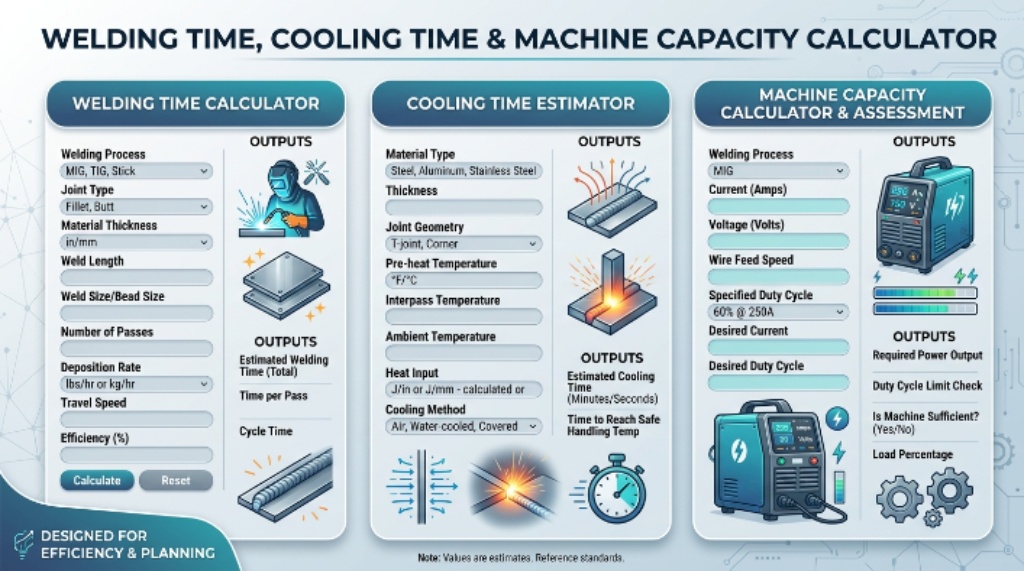
A Practical Example
Suppose you’re fabricating steel components and your welding machine is rated:
250 amps at 40% duty cycle
Calculate the rated weld time:
250 amps × 40%
The amperage itself does not change the time calculation. The duty-cycle percentage does:
10 minutes × 0.40 = 4 minutes
So the rating allows:
4 minutes of operation at the specified 250-amp rating during a 10-minute cycle
with:
6 minutes remaining in the reference cycle.
Now suppose you reduce the welding current and the manufacturer’s chart gives the machine a 100% duty-cycle rating at the lower output.
That’s a major practical difference: instead of planning around thermal interruptions, you may be able to weld continuously at that lower output.
This is one reason the full duty-cycle chart is more valuable than a single headline percentage.
Common Duty-Cycle Mistakes
Mistake 1: Looking only at the percentage
“60% duty cycle” is incomplete information.
You need to know 60% at what current, voltage, process, and conditions?
Mistake 2: Assuming the maximum amperage has the maximum duty cycle
Usually the opposite is true.
Higher output can come with a lower duty-cycle rating.
Mistake 3: Treating the cooling period as a universal rule
The calculator provides a mathematical interpretation of the rating. The manufacturer’s operating instructions determine how the machine should actually be used.
Mistake 4: Ignoring ambient temperature
A rating based on 40°C conditions may not represent operation in a significantly hotter environment.
Mistake 5: Forgetting accessories
Your welding gun, torch, cables, or cooling equipment can have their own ratings.
Mistake 6: Bypassing thermal protection
If the machine shuts down because of excessive temperature, don’t defeat the protection system.
Welding Duty Cycle Formula
For a standard 10-minute rating:
Duty Cycle (%) = Weld Time ÷ 10 × 100
To calculate weld time:
Weld Time = 10 × Duty Cycle ÷ 100
To calculate the remaining portion:
Rest/Non-Load Time = 10 − Weld Time
Example
A welder has a 75% duty cycle.
Weld Time = 10 × 75 ÷ 100
Weld Time = 7.5 minutes
Therefore:
7.5 minutes operating + 2.5 minutes remaining in the 10-minute cycle
If you are calculating a real machine’s rating, verify that its specification uses a 10-minute reference period before applying these formulas.
Welding Duty Cycle Safety
Duty cycle is fundamentally an equipment-performance issue, but welding itself involves additional hazards that a calculator cannot evaluate.
OSHA’s welding standards address equipment selection, installation, operator qualification, fire prevention, PPE, ventilation, and other hazards associated with welding and cutting. OSHA also requires appropriate ventilation in specified welding environments and additional controls for certain materials and confined spaces.
The American Welding Society’s ANSI Z49.1:2021 covers welding safety and health, including personnel protection, ventilation, fire prevention, and confined-space considerations.
So don’t interpret a duty-cycle calculation as a safety clearance.
Before welding:
- Follow the machine manufacturer’s operating manual.
- Use appropriate PPE.
- Maintain adequate ventilation and fume control.
- Control combustible materials and fire hazards.
- Inspect cables, connections, torches, and electrode holders.
- Use equipment appropriate for the job.
- Follow applicable workplace procedures and regulations.
- Never work inside energized welding equipment unless you are qualified and following the required service procedure.
Frequently Asked Questions
What is a duty cycle on a welding machine?
Duty cycle is the percentage of a specified operating period during which a welding machine can operate at its rated output without exceeding its thermal limits. A common rating period is 10 minutes.
How long can I weld with a 20% duty cycle?
On a standard 10-minute rating, 20% equals 2 minutes of rated welding operation.
How long can I weld with a 40% duty cycle?
A 40% duty cycle equals 4 minutes in a 10-minute cycle at the specified rated output.
How long can I weld with a 60% duty cycle?
A 60% duty cycle equals 6 minutes of rated operation during a 10-minute period.
What does 100% duty cycle mean on a welder?
It means the machine is rated for continuous operation during the complete 10-minute test period at the specified output and conditions. It does not mean unlimited operation under every environmental or operating condition.
Does a higher amperage reduce duty cycle?
Often, yes. Welding machines commonly have lower duty-cycle percentages at higher output currents because increased electrical load produces more heat. Always check the manufacturer’s output/duty-cycle chart.
Does duty cycle apply to MIG, TIG, and stick welding?
It can, but the rating may differ by process. Always check the specification for the particular welding mode, current, and voltage you’re using.
Can I weld for shorter periods and avoid exceeding the duty cycle?
Intermittent welding changes the machine’s thermal behavior, but you should still follow the manufacturer’s operating instructions. Don’t assume that short welds automatically make any operating pattern safe.
Why does my welder keep shutting down?
Thermal protection may be activating because the machine is being operated beyond its rated conditions, the ambient temperature is high, airflow is restricted, the machine needs maintenance, or another equipment problem exists.
Check the actual amperage, duty-cycle rating, operating environment, ventilation, and manufacturer’s troubleshooting instructions.
Does duty cycle affect weld quality?
Not directly. Duty cycle primarily describes thermal operating capacity. Weld quality depends on the welding parameters, materials, procedure, equipment setup, and operator technique.
Is the duty-cycle rating based on a 10-minute period?
For many professional arc-welding power sources, yes. However, always confirm the rating convention in the equipment’s technical documentation rather than assuming every product uses the same specification.
Is a 100% duty-cycle welder better?
Not automatically. A 100% duty-cycle machine is advantageous when your application requires sustained output, but the right machine depends on the current, process, materials, workload, input power, and other requirements.
Bottom Line
A welding duty-cycle calculator is useful because it turns a percentage on a specification sheet into a number you can actually work with.
The basic calculation is simple:
Duty Cycle × 10 minutes = rated operating time
But the percentage is only meaningful when you also know the welding current, process, voltage, ambient conditions, and manufacturer’s test conditions.
A 60% duty cycle at 200 amps is not the same thing as a 60% rating at 300 amps. And a 100% duty cycle at one output setting does not automatically mean the machine can operate continuously at its maximum output.
For the safest and most accurate result, use the calculator to understand the rating, then verify the machine’s nameplate and operator’s manual before relying on it for real welding work.