
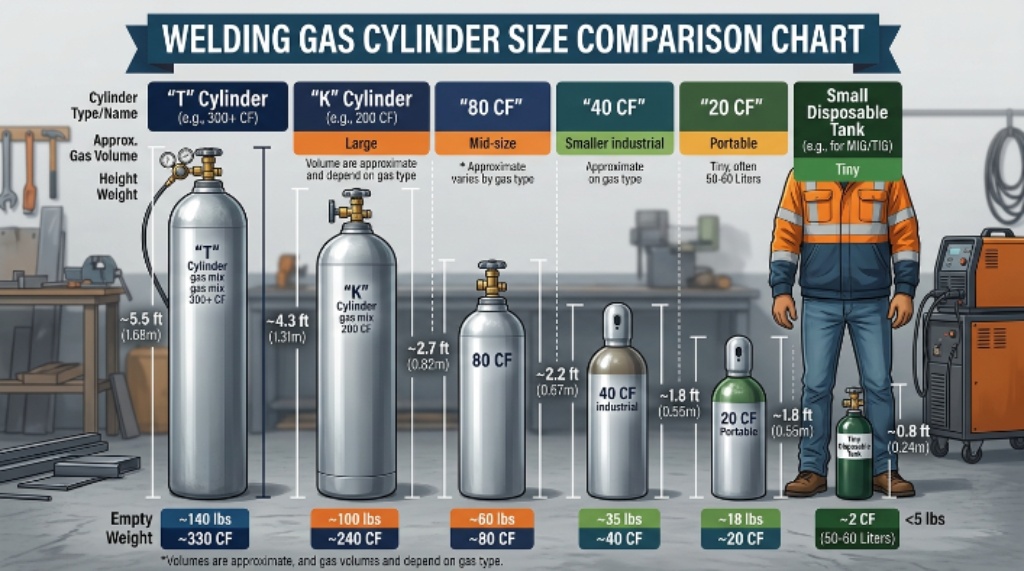
If you’re buying gas for a MIG or TIG welder, one of the first questions you’ll run into is: What size welding tank do I need? The answer isn’t as simple as choosing the biggest cylinder you can fit in your shop. Welding gas cylinders come in several capacities, and the naming system can vary by gas supplier, cylinder material, location, and application. A cylinder advertised as 40, 80, or 125 cubic feet generally refers to the approximate amount of compressed gas available under a specified reference condition—not the physical volume of the steel or aluminum bottle itself.
For most hobby and small-shop welders, 40-, 80-, and 125-cubic-foot cylinders are practical starting points for argon and common argon/CO₂ shielding-gas blends. Larger cylinders can make sense for production work, while smaller cylinders are useful when portability matters more than runtime.
This guide explains the common welding tank sizes, how long they may last, which size makes sense for MIG or TIG, and what you should know before buying or exchanging a cylinder.
Important: Cylinder capacities, dimensions, pressures, and supplier size names vary. Use this chart as a planning reference, then verify the exact specifications with your gas supplier.
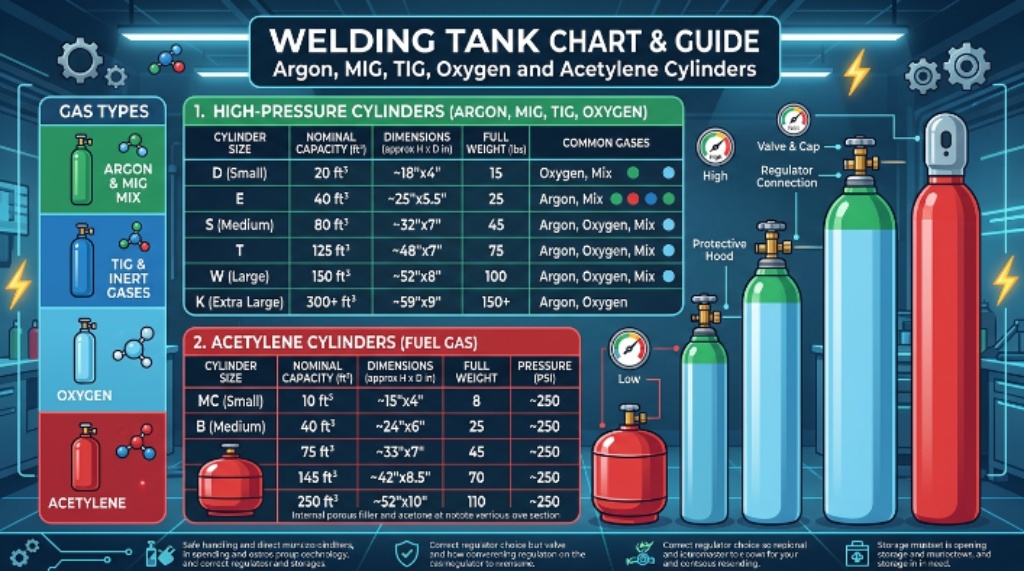
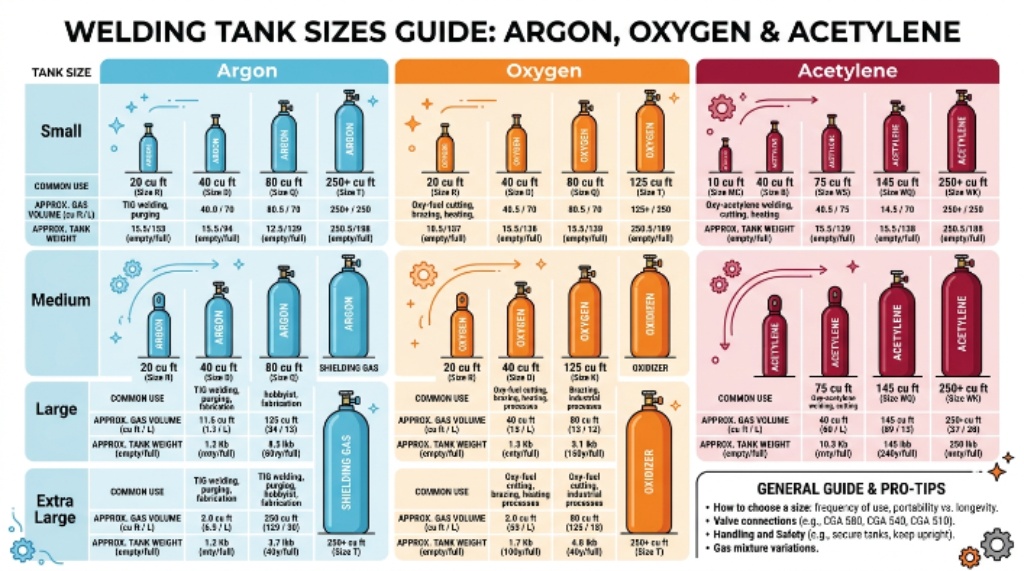
Quick Welding Tank Size Chart
For compressed shielding gases such as argon and argon/CO₂ mixtures, these are common sizes you’ll encounter in U.S. welding shops:
| Approx. Gas Capacity | Approx. Metric Volume | Typical Use | Portability | General Runtime |
| 20 cu ft | 566 L | Occasional repairs, very portable setups | Excellent | Short |
| 40 cu ft | 1,133 L | Hobby welding, light MIG/TIG | Very good | Short–moderate |
| 80 cu ft | 2,265 L | Home shops, regular MIG/TIG | Good | Moderate–long |
| 125 cu ft | 3,540 L | Frequent welding, fabrication | Moderate | Long |
| 250+ cu ft | 7,080+ L | High-volume or production use | Poor | Very long |
The metric figures above are approximate conversions from nominal cubic-foot capacity. Actual delivered gas volume can vary with cylinder fill pressure, temperature, gas type, and supplier specifications.
Airgas, for example, notes that actual cylinder volume can fluctuate and that cylinder sizes and availability may vary by location.
Which size should you choose?
For a typical home welder:
- 20–40 cu ft: Choose this when portability is the priority or you weld only occasionally.
- 80 cu ft: A strong all-around choice for many hobbyists.
- 125 cu ft: Better if you weld regularly and want fewer cylinder exchanges.
- 250 cu ft or larger: Usually more appropriate for high-volume users rather than casual welding.
For many home shops, 80 or 125 cubic feet offers the best balance between runtime, portability, and cost.
What Does “Cubic Feet” Mean on a Welding Tank?
The number printed in a welding-gas listing can be confusing.
An 80-cubic-foot cylinder does not mean the bottle itself has an internal volume of 80 cubic feet. The gas is compressed into a much smaller physical container.
The cubic-foot figure describes the approximate amount of gas that would occupy that volume when measured under a specified reference condition.
Airgas, for example, defines standard cubic feet (scf) using gas measured at 1 atmosphere and 70°F on its gas-conversion resources.
That distinction matters because two cylinders with similar physical dimensions can have different gas capacities depending on:
- Fill pressure
- Cylinder material
- Cylinder design
- Gas type
- Temperature
- Supplier specifications
That’s why you should not assume that two bottles with the same height automatically contain the same amount of gas.
Welding Tank Size vs. Physical Cylinder Size
A common mistake is assuming the cylinder’s advertised gas capacity tells you its exact height and diameter.
It doesn’t.
Cylinder dimensions can change depending on whether the bottle is made from steel, aluminum, or another approved construction. Suppliers can also use different size designations.
For example, Airgas lists a 33-size high-pressure aluminum argon cylinder at approximately 34 cubic feet, with a 7-inch outside diameter and approximately 16-inch length.
That is a good example of why capacity and physical dimensions should be treated as separate specifications.
If you’re buying a cylinder for a welding cart, don’t order based only on “80 CF” or “125 CF.” Ask the supplier for:
- Overall height
- Outside diameter
- Empty/tare weight
- Full weight
- Gas capacity
- Service/fill pressure
- Valve connection
- Whether the cylinder is steel or aluminum
How Long Does a Welding Gas Tank Last?
This is where many welding tank charts become misleading.
A cylinder’s capacity alone does not tell you exactly how many hours you’ll weld.
The basic planning equation is:
Estimated gas time = usable gas volume ÷ gas flow rate
For example, if you have a nominal 80-cubic-foot cylinder and your welding setup consumes 20 cubic feet per hour:
80 ÷ 20 = approximately 4 hours
But that’s a theoretical estimate.
In real welding, you also use gas during:
- Pre-flow
- Post-flow
- Arc starts
- Purging
- Setup and testing
- Tack welding
- Gun repositioning
- Leaks or poor connections
So your actual productive arc time will usually be less than the simple calculation suggests.
Example gas-consumption estimates
| Cylinder | At 15 CFH | At 20 CFH | At 25 CFH | At 30 CFH |
| 40 CF | 2.7 hr | 2.0 hr | 1.6 hr | 1.3 hr |
| 80 CF | 5.3 hr | 4.0 hr | 3.2 hr | 2.7 hr |
| 125 CF | 8.3 hr | 6.3 hr | 5.0 hr | 4.2 hr |
These are theoretical calculations, not guaranteed welding times.
They assume the full nominal gas capacity is usable and do not account for pre-flow, post-flow, purging, residual gas, leaks, or other losses.
What Gas Flow Rate Do MIG and TIG Welding Use?
Your regulator’s flow-rate setting has a major effect on cylinder life.
For TIG, MillerWelds says typical shielding-gas flow rates commonly fall in the 10–35 CFH range, depending on consumables and conditions. It also warns that excessive flow can create turbulence and actually increase the chance of atmospheric contamination.
A Miller operator manual gives typical examples of:
- CO₂ MIG: 15–30 CFH
- Mixed-gas MIG: 25–45 CFH
- Argon TIG: 15–25 CFH
- Aluminum MIG: 35–45 CFH
The manual also says to check the wire manufacturer’s recommended flow rate.
The important lesson is simple:
More gas does not automatically mean better shielding.
Too little gas can allow atmospheric contamination and porosity. Too much can create turbulence and waste gas.
Start with the welding machine, torch, consumable, wire, and gas manufacturer’s recommended range.
What Size Gas Tank Do I Need for MIG Welding?
For most home MIG welding, an 80- or 125-cubic-foot cylinder is a practical choice.
40 CF MIG cylinder
A 40-cubic-foot bottle is convenient when:
- You weld occasionally.
- Your work is mostly small repairs.
- You need a lightweight setup.
- Your vehicle or welding cart has limited space.
The downside is that you’ll run out sooner.
80 CF MIG cylinder
An 80-cubic-foot cylinder is often the sweet spot for hobby welding.
It provides substantially more runtime than a 40-CF bottle without becoming as cumbersome as a larger industrial cylinder.
It’s a good fit for:
- Home fabrication
- Automotive repair
- Brackets and frames
- Small equipment repairs
- General mild-steel MIG welding
125 CF MIG cylinder
A 125-cubic-foot cylinder makes more sense if you’re welding regularly.
Its biggest advantage isn’t necessarily better weld quality. It’s fewer interruptions for cylinder exchanges or refills.
If you’re spending several hours a week welding, that convenience can quickly become worthwhile.
What Size Tank Do I Need for TIG Welding?
TIG welding typically uses argon, and TIG can consume shielding gas continuously while you’re working.
A 40-CF cylinder can work for occasional TIG practice, but an 80- or 125-CF cylinder is usually more convenient for regular work.
TIG can also involve gas-intensive applications such as:
- Long welds
- Aluminum welding
- Stainless-steel work
- Purging
- Gas lenses
- Specialized back-purge setups
If you’re doing stainless tubing or pipe where an internal purge is required, your gas consumption can be dramatically higher than normal torch shielding alone.
In that situation, choosing a cylinder based only on torch flow rate can give you a false estimate.
What Size Tank Do I Need for Oxy-Acetylene Welding?
Oxygen and acetylene should not be treated like argon or an argon/CO₂ MIG cylinder.
Acetylene cylinders use a different construction and storage method because acetylene cannot simply be handled like an ordinary compressed gas. OSHA specifically addresses acetylene-cylinder storage and requires acetylene cylinders to be stored valve-end up.
Oxy-fuel setups typically consist of:
- Oxygen cylinder
- Acetylene or other fuel-gas cylinder
- Oxygen regulator
- Fuel-gas regulator
- Hoses
- Torch
- Appropriate check valves/flashback protection as required by the equipment and application
Do not use an argon/MIG cylinder-size chart to determine the appropriate oxygen or acetylene cylinder.
The gas, cylinder design, regulator, valve connection, and operating requirements are different.
Oxygen Tank Safety: An Important Difference
Oxygen is not itself a fuel, but it strongly supports combustion. Oil, grease, sparks, and combustible materials can become extremely hazardous around oxygen equipment.
OSHA requires oxygen cylinders in storage to be separated from fuel-gas cylinders or combustible materials by at least 20 feet, or by a suitable noncombustible barrier at least 5 feet high with the required fire-resistance rating.
This isn’t just theoretical guidance. OSHA inspection records from 2025 and 2026 show that improper oxygen/fuel-gas cylinder separation continues to result in citations.
For a welding shop, cylinder storage should therefore be planned as carefully as the welding area itself.
Welding Gas Cylinder Safety Rules
Compressed-gas cylinders can contain gas at extremely high pressures. AWS notes that welding cylinders commonly contain gases at pressures around 2,500 psi, with some applications involving higher pressures.
Follow these basic practices:
1. Secure cylinders upright
Use a proper chain, strap, rack, cart, or other approved securing method.
OSHA’s construction standard requires compressed-gas cylinders to be secured in an upright position except for brief periods when they’re actually being hoisted or carried.
2. Protect the valve
Keep the valve-protection cap installed whenever the cylinder is designed to use one and is not connected for service.
3. Keep cylinders away from welding sparks
OSHA says cylinders must be positioned far enough away from welding or cutting operations that sparks, hot slag, or flame cannot reach them. If that isn’t practical, use appropriate fire-resistant shielding.
4. Don’t use oil or grease around oxygen equipment
Oxygen cylinders, regulators, fittings, and related equipment must be kept free of oily or greasy substances.
5. Store cylinders in a ventilated location
OSHA specifies well-protected, dry, well-ventilated storage and prohibits storing cylinders in unventilated enclosures such as lockers or cupboards.
6. Close the cylinder valve when finished
When welding is complete, close the cylinder valve according to your equipment procedure.
7. Don’t repair or modify cylinders yourself
Cylinder filling, repairs, markings, and gas transfers are controlled activities. AWS states that only the cylinder owner or an authorized party should fill a cylinder, and gas mixing or transferring between cylinders should be performed by the gas supplier.
Steel vs. Aluminum Welding Gas Cylinders
Both steel and aluminum cylinders are common.
Steel cylinders
Advantages:
- Generally durable
- Often less expensive
- Common in welding-gas exchange programs
- Suitable for many shop applications
Disadvantages:
- Heavier
- Can be less convenient to transport
Aluminum cylinders
Advantages:
- Much lighter than comparable steel cylinders
- Convenient for portable TIG and welding setups
- Easier to move around a small shop
Disadvantages:
- Can cost more
- Physical dimensions and capacity vary by manufacturer
The best choice depends on how often you move the cylinder and how your local supplier handles fills and exchanges.
How to Choose the Right Welding Tank Size
Instead of asking, “What’s the biggest welding tank I can buy?” use this checklist.
Choose a smaller cylinder if:
- You weld only occasionally.
- Portability matters.
- You’re practicing TIG or MIG.
- Your storage space is limited.
- Your supplier makes small-cylinder exchanges easy.
Choose an 80-CF cylinder if:
- You are a regular hobby welder.
- You want a good balance between size and runtime.
- You’re using MIG or TIG in a home shop.
- You don’t want to exchange cylinders constantly.
If Choose a 125-CF cylinder if:
- You weld several times a week.
- You fabricate larger projects.
- You want longer periods between refills.
- Cylinder weight and size aren’t major concerns.
Consider a larger supply system if:
- You’re using multiple cylinders every week.
- Your operation has high gas consumption.
- Cylinder exchanges are disrupting production.
- You’re operating a fabrication or manufacturing business.
Gas suppliers offer larger supply modes for high-volume users, including liquid and bulk options. Airgas specifically notes that frequent runouts and repeated cylinder swaps can be signs that a customer should consider a different supply mode.
Common Welding Tank-Sizing Mistakes
Mistake 1: Buying based only on physical height
Two cylinders of similar height can have different capacities.
Always check the actual cylinder specification.
Mistake 2: Assuming bigger is always cheaper
A larger cylinder may provide a lower cost per cubic foot, but the economics depend on your supplier’s rental, lease, exchange, refill, and delivery structure.
Mistake 3: Using an unnecessarily high gas flow rate
High flow can waste gas and, in some TIG applications, cause turbulence that hurts shielding performance.
Mistake 4: Forgetting purge gas
If you’re TIG welding pipe or stainless tubing and need an internal purge, your actual gas consumption may be much higher than torch flow alone suggests.
Mistake 5: Treating every gas cylinder the same
Argon, CO₂, oxygen, acetylene, helium, and mixed shielding gases have different characteristics and cylinder requirements.
Frequently Asked Questions
Is an 80-CF welding tank big enough?
For many hobby MIG and TIG welders, yes. An 80-CF cylinder is a useful middle-ground size that provides significantly more runtime than a 40-CF bottle without being as large as a 125-CF cylinder.
Is a 125-CF welding tank worth it?
If you weld regularly, it often is. The main benefit is longer runtime and fewer cylinder exchanges. If you weld only a few small projects per year, a smaller cylinder may be easier to handle.
How long does an 80-CF welding tank last?
At a theoretical 20 CFH consumption rate, an 80-CF cylinder contains about four hours of gas. Actual welding time will be lower because of pre-flow, post-flow, purging, setup, residual gas, and other losses.
What size argon tank is best for TIG?
For occasional TIG work, 40 CF can be sufficient. For regular home-shop TIG welding, 80 CF is a practical choice, while 125 CF makes sense when longer runtime is important.
What size gas tank is best for MIG?
An 80- or 125-CF cylinder is a practical choice for many home MIG welders. Choose 40 CF when portability matters more than runtime.
Does a bigger gas cylinder make a better weld?
No. Cylinder size primarily affects how much gas you have available and how often you need to refill or exchange it. Weld quality depends on the correct gas, flow rate, machine settings, technique, joint preparation, and shielding conditions.
Can I use an argon tank for MIG welding?
You can use argon for certain MIG applications, but the appropriate shielding gas depends on the material, wire, transfer mode, and welding procedure. Mild-steel MIG commonly uses argon/CO₂ mixtures or CO₂, while aluminum MIG commonly uses argon. Always follow the wire and equipment manufacturer’s recommendations.
How do I know when my welding tank is empty?
Don’t rely only on the cylinder’s physical weight or pressure gauge without understanding the gas and cylinder type. For compressed gases, pressure can provide a useful indication of remaining contents, but the relationship differs for liquefied gases such as CO₂. Follow your regulator and supplier’s instructions.
Should I buy or rent a welding gas cylinder?
That depends on your supplier and how frequently you weld. Some suppliers offer customer-owned cylinders, while others use exchange, rental, or lease programs. Before purchasing a cylinder, ask whether your local supplier will fill or exchange that exact cylinder.
Bottom Line: What Welding Tank Size Should You Buy?
For most home welders, you don’t need to overthink the choice.
A 40-CF cylinder is portable. An 80-CF cylinder is a strong all-around choice. A 125-CF cylinder is better for frequent welding.
If you’re mainly doing MIG or TIG in a home shop, start by comparing 80 CF and 125 CF cylinders from your local gas supplier. Ask for the actual dimensions, full weight, fill pressure, valve connection, and exchange/refill cost rather than relying solely on the size number.
Most importantly, don’t calculate welding time from cylinder capacity alone. Your actual gas consumption depends on flow rate, welding process, torch configuration, pre-flow, post-flow, purge requirements, leaks, and how much time the arc is actually running.
And remember that cylinder safety isn’t optional. Secure cylinders upright, protect valves, keep oxygen away from fuel gases and combustible materials as required by OSHA, keep cylinders away from welding sparks, and follow the manufacturer’s and gas supplier’s handling instructions. OSHA and AWS both emphasize that compressed-gas cylinders require careful storage, handling, and identification.
The best welding tank isn’t necessarily the biggest one. It’s the cylinder that gives you enough gas for your work without creating unnecessary cost, weight, storage, or handling problems.
Editorial/EEAT note
Cylinder specifications change by supplier and region. Before publishing a final chart with exact dimensions, weights, pressures, or supplier-specific designations, verify those figures against the current specification sheet from the supplier serving your target U.S. market. AWS maintains welding codes and standards, while OSHA provides the applicable workplace safety requirements.