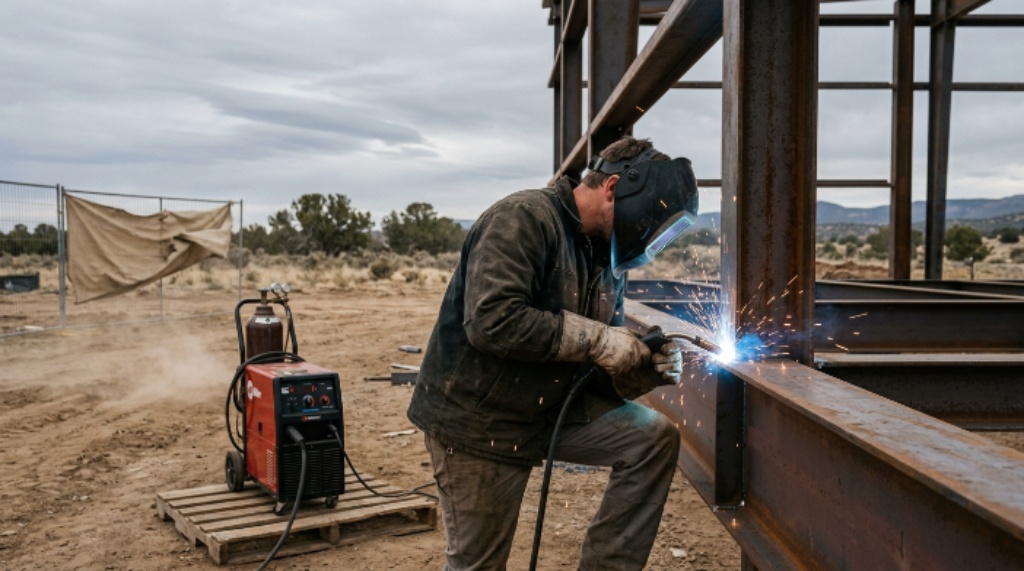

Yes, you can MIG weld outdoors—but conventional gas-shielded MIG is not naturally well suited to open-air welding. The problem is not that the MIG process suddenly stops working outside. The problem is that MIG depends on a controlled envelope of shielding gas around the arc and molten weld pool. Wind can disturb that envelope, allowing oxygen, nitrogen, and moisture from the atmosphere to reach the weld before it solidifies. The result can be porosity, excessive spatter, poor arc stability, and a weld that looks acceptable on the surface but has internal defects.
That is why outdoor MIG is very different from welding inside a garage or fabrication shop.
If you can create a genuinely sheltered, dry, fire-safe work area, gas MIG can work very well outdoors. If you’re working in an exposed yard, on a trailer repair, or beside a jobsite where the wind keeps changing, self-shielded flux-cored wire is often the more practical wire-feed option. AWS specifically identifies self-shielded FCAW as an outdoor-capable process because its flux generates the shielding protection rather than relying on an external gas cloud.
Can You MIG Weld Outside in the Wind?
You can, but there is no universal wind-speed number at which gas MIG becomes “safe” or “unsafe.”
A common mistake is looking for a single cutoff such as 5 mph, 10 mph, or 15 mph. In reality, the effect of wind depends on several variables:
- Wind direction
- Gusts versus steady airflow
- Joint configuration
- Nozzle position
- Stickout
- Gas type and flow rate
- Welding position
- How effectively the work area is screened
- The distance between the nozzle and weld pool
A small gust blowing directly across the nozzle can disrupt shielding more severely than a stronger airflow that is largely blocked by a building.
Miller’s current welding guidance recommends using a wind block or tent whenever a gas-shielded process is used outdoors. It also warns against simply increasing gas flow indefinitely: excessive flow can create turbulence, which can pull atmospheric contaminants into the shielding zone.
A practical rule
If you can feel moving air across the weld area, assume your shielding gas may be affected until you’ve proven otherwise with a properly protected test weld.
Do not judge the weld only by its appearance while it is hot. Clean the bead and inspect it. Porosity can be hidden beneath an otherwise decent-looking surface.
What Happens When Wind Blows Away MIG Shielding Gas?
MIG, formally called gas metal arc welding (GMAW), normally uses a continuously fed solid wire along with an external shielding gas.
The gas protects the molten weld pool from atmospheric contamination. AWS notes that shielding gas is fundamental to GMAW because exposure to atmospheric contaminants can contribute to weld defects and reduced weld quality. Common gas choices for steel include 100% CO₂ and argon/CO₂ mixtures such as 75/25.
When wind disrupts the gas shield, you may notice:
- Pinholes or porosity
- Excessive spatter
- A rough or irregular bead
- Unstable arc behavior
- Soot or discoloration
- Poor tie-in at the edges of the joint
- Inconsistent penetration
- Increased rework
Porosity is especially important because it isn’t always obvious from the surface.
If a test weld contains significant porosity, don’t simply make another pass over it. Remove the defective material, determine why the shielding failed, correct the problem, and retest.
Is 75/25 Gas Good for Outdoor MIG Welding?
Yes. A 75% argon/25% CO₂ mixture is commonly used for MIG welding steel and can be used outdoors.
But 75/25 gas does not make MIG windproof.
The gas mixture still has to reach the weld pool and remain there long enough to provide effective shielding. If wind carries it away, the weld can still become contaminated.
The same principle applies to CO₂. Pure CO₂ can be used for MIG welding steel, but its greater density does not mean it is immune to outdoor airflow. The shielding zone exists immediately around the arc, where moving air can still disturb it.
The better approach is to control the environment rather than rely on a particular gas to overcome the wind.
How to Protect a MIG Weld From Wind
A windbreak can make the difference between a clean MIG weld and a defective one.
For outdoor gas MIG, consider creating a three-sided sheltered area around the welding operation. The barrier should reduce airflow around the arc without creating a dangerous enclosure that traps fumes.
Suitable barriers can include appropriately rated welding screens, metal panels, or purpose-built welding shelters.
Do not improvise a windbreak with combustible materials such as cardboard, plastic sheeting, loose cloth, or other materials that can catch fire from sparks and spatter.
OSHA requires welding areas to be made fire-safe. Where combustible hazards cannot be removed, appropriate guards must be used to contain heat, sparks, and slag; if those requirements cannot be met, the welding operation should not proceed.
Your windbreak also needs enough space for:
- Safe movement
- Cable routing
- Gas-cylinder access
- Fume dispersion
- Emergency access
- Proper welding position
Blocking wind should never mean trapping fumes directly around your breathing zone.
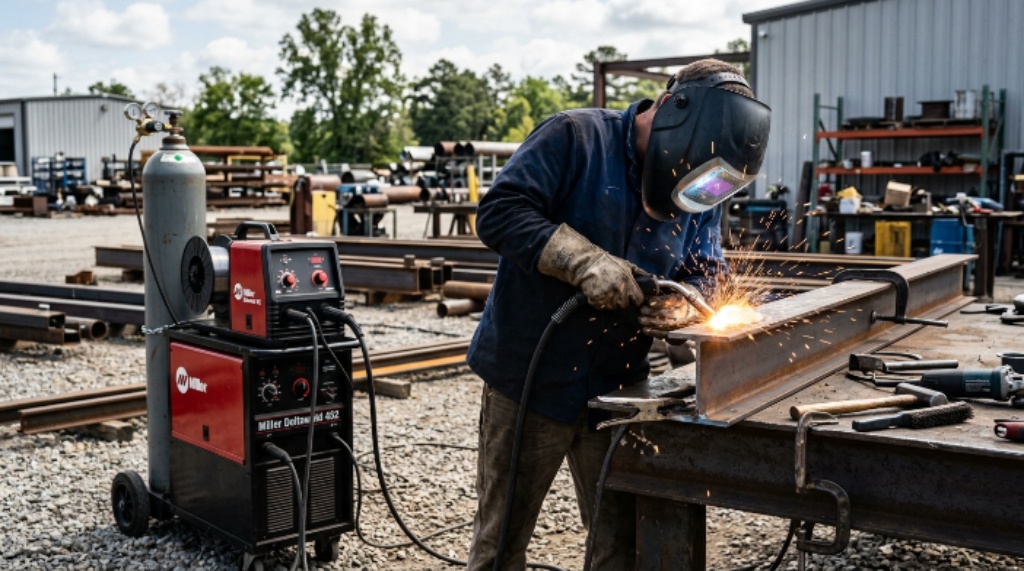
Don’t Just Increase the Gas Flow
This is one of the most common pieces of bad outdoor MIG advice.
It sounds logical: if wind is carrying away the gas, increase the gas flow.
Sometimes adjusting the flow within the manufacturer’s recommended range can help, but more is not automatically better.
Miller notes that gas flow that is too low can cause porosity, while excessive flow can create turbulence and introduce atmospheric contaminants into the weld.
Before changing the flow dramatically, check:
- Is the wind actually reaching the arc?
- Is the gas cylinder valve open properly?
- Is the regulator functioning correctly?
- Are there leaks in the hose or fittings?
- Is the nozzle clogged with spatter?
- Is the nozzle positioned correctly?
- Is your stickout excessive?
- Is the metal clean and dry?
Fix the environmental and equipment problems first.
MIG vs. Flux Core for Outdoor Welding
This is where the choice of process becomes important.
Self-shielded flux-cored arc welding (FCAW-S) uses a tubular wire containing flux. The flux generates shielding gases and forms slag as the weld cools, so the process does not depend on an external shielding-gas cylinder.
AWS describes self-shielded FCAW as particularly useful for outdoor work where wind can disrupt traditional shielding gas. Lincoln Electric likewise markets self-shielded flux-cored wire specifically for outdoor applications where external shielding gas is not required.
Outdoor welding comparison
| Factor | Gas MIG (GMAW) | Self-Shielded Flux Core (FCAW-S) |
| External gas | Required | Not required |
| Wind tolerance | Poor unless sheltered | Much better |
| Slag | Little to none | Yes |
| Cleanup | Easier | More cleanup |
| Spatter | Generally lower | Generally higher |
| Outdoor repairs | Possible with wind control | Often a better choice |
| Gas cylinder | Required | Not required |
| Fumes | Still requires control | Can produce significant fumes |
| Dirty steel tolerance | Limited | Generally more forgiving, but cleaning is still important |
The important point is that flux core is not simply “MIG without gas.” Self-shielded FCAW is a different welding process with different wire, polarity requirements, operating characteristics, cleanup requirements, and parameter settings.
Never assume that changing from solid MIG wire to flux-core wire only requires swapping the spool. Check the wire manufacturer’s specifications and your welder’s instructions for polarity, drive-roll setup, wire diameter, voltage, and wire-feed speed.
When Is Gas MIG Better Outdoors?
Gas MIG can make sense outside when:
- The weather is dry.
- Wind can be effectively controlled.
- You need the cleaner appearance of solid-wire MIG.
- You are working on clean material.
- You can make and inspect test welds.
- The job does not involve a safety-critical structure.
- You can keep the gas cylinder and equipment stable and protected.
For example, welding a small clean-steel fabrication project in a sheltered driveway may be perfectly reasonable.
Welding the same project in an open field during gusty weather is a different situation.
When Should You Switch to Flux Core?
Self-shielded flux core becomes especially attractive when:
- The work is exposed to wind.
- Moving a gas cylinder is inconvenient.
- You are performing outdoor equipment repair.
- The project involves thicker steel.
- You need a portable wire-feed process.
- A temporary wind shelter would be impractical.
AWS notes that FCAW is widely used for outdoor applications and heavy fabrication because of its productivity and adaptability.
The tradeoff is that flux core produces slag and generally requires more cleanup. It can also produce substantial welding fumes, so outdoor work should not be treated as a substitute for proper fume control.
Outdoor MIG Welding Safety: What Matters Most
The outdoor environment introduces several hazards that are easy to underestimate.
1. Fire
Outdoor welding can put you near dry grass, leaves, lumber, fuel, vehicles, insulation, and other combustible materials.
OSHA’s welding standard requires appropriate fire-prevention measures and identifies conditions where a fire watch is required, including situations involving appreciable combustible material within 35 feet of the operation or combustible material that could easily be ignited by sparks.
Clear the work area before striking an arc. Don’t assume that because you’re outside, sparks are harmless.
2. Rain and moisture
Avoid welding in rain or when your electrical setup is exposed to unsafe wet conditions.
Wet gloves, wet clothing, standing water, damp ground, and wet equipment can increase electrical hazards. Moisture on the workpiece can also contribute to contamination and weld-quality problems.
If the metal has been sitting outside, dry it before welding.
3. Welding fumes
Being outside does not automatically make welding fumes harmless.
AWS emphasizes that welding fumes and gases can present significant health hazards and that adequate ventilation, fume control, and appropriate respiratory protection may be necessary depending on the operation and materials involved.
Be particularly careful with galvanized, painted, coated, plated, or unidentified materials.
OSHA has specific requirements for welding materials containing zinc, lead, cadmium, beryllium, and other hazardous substances. Outdoor work does not eliminate those requirements.
If you don’t know what coating is on a piece of metal, don’t assume it is safe to weld.
4. Personal protective equipment
At minimum, outdoor welding requires appropriate eye and face protection, welding gloves, flame-resistant clothing, and suitable footwear. Grinding and surface preparation also require appropriate eye protection.
AWS specifically recommends appropriate protective equipment for welding, including suitable gloves and protective clothing.
A Simple Outdoor MIG Setup Checklist
Before starting, run through this checklist:
- Weather is dry.
- Workpiece is dry and properly cleaned.
- Wind is controlled around the weld.
- Windbreak is fire-safe.
- Combustible materials have been removed or protected.
- Fire extinguisher is immediately available.
- Gas cylinder is secured upright.
- Regulator and hose connections are checked.
- Nozzle is clean.
- Contact tip is in good condition.
- Stickout is appropriate for the process.
- Correct wire and shielding gas are installed.
- Welding polarity matches the wire manufacturer’s instructions.
- PPE is being used correctly.
- Test weld has been made on scrap.
- Test weld has been cleaned and inspected.
If any of those conditions cannot be met, changing welding settings may not solve the real problem.
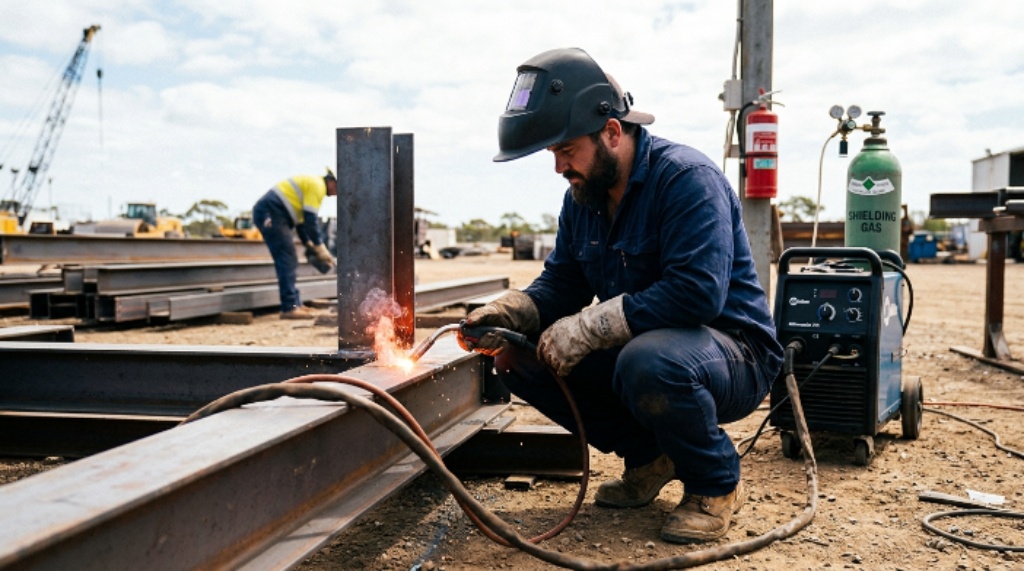
How to Test an Outdoor MIG Weld
Don’t immediately weld the final part.
Use a piece of similar scrap steel and reproduce the conditions you’ll encounter on the actual job.
Make a test bead and inspect:
Appearance: Is the bead consistent?
Arc: Does it sound stable?
Spatter: Is there unusually heavy spatter?
Porosity: Are there visible pinholes?
Fusion: Does the weld properly tie into both sides of the joint?
Consistency: Does the bead remain stable when the wind changes?
For important work, visual inspection alone may not be sufficient. The appropriate inspection method depends on the application, specification, joint, material, and consequences of failure.
Common Outdoor MIG Problems and Fixes
Porosity
Likely causes: Wind, moisture, dirty material, gas leaks, poor nozzle condition, excessive stickout, or improper gas coverage.
First response: Stop welding, inspect the setup, improve shielding, clean the material and nozzle, then make another test weld.
Excessive spatter
Likely causes: Incorrect parameters, contaminated material, unstable shielding, wrong gas, or an unsuitable process.
First response: Verify the machine settings and consumables before simply changing gas flow.
Poor fusion
Likely causes: Incorrect voltage or wire-feed speed, excessive travel speed, poor joint preparation, or insufficient heat input.
First response: Check your parameters and joint preparation rather than assuming the wind is responsible.
Burn-through
Thin sheet can be especially unforgiving outdoors because wind, awkward positioning, and poor visibility can make technique less consistent.
Use the machine manufacturer’s recommended starting parameters and practice on scrap of the same thickness.
Is Outdoor MIG Welding Safe for Beginners?
It can be, but beginners should separate practice welding from structural or safety-critical repairs.
A sheltered outdoor area with clean mild-steel coupons is a reasonable environment for learning once you understand basic welding safety.
However, a beginner should not use an uncertain outdoor weld for a component where failure could injure someone—for example, a critical structural connection, lifting component, pressure-containing part, or safety-related vehicle component.
A weld that “looks good” is not necessarily a weld that is mechanically sound.
Frequently Asked Questions
Can you MIG weld outdoors?
Yes. Gas-shielded MIG can be used outdoors when the weld area is dry, fire-safe, and adequately protected from wind. In exposed conditions, self-shielded flux core is often a more practical choice.
How windy is too windy for MIG welding?
There is no universal wind-speed limit that applies to every MIG setup. The relevant question is whether airflow is disrupting shielding at the weld. If wind reaches the arc and you cannot reliably control it, gas MIG should be moved to a sheltered location or replaced with a more suitable process.
Can I MIG weld outside with 75/25 gas?
Yes. A 75/25 argon/CO₂ mixture can be used outdoors, but the weld still needs effective shielding. The gas mixture does not eliminate the effects of wind.
Is CO₂ better than 75/25 for outdoor MIG?
Not necessarily. CO₂ can be used for MIG welding steel, but it still requires effective shielding at the arc. Outdoor wind can disrupt either gas. Choose shielding gas based on the material, wire, transfer mode, machine, and manufacturer’s recommendations—not simply because you expect one gas to resist wind better.
Should I increase gas flow when welding outside?
Not automatically. Increasing flow beyond the appropriate range can create turbulence and potentially worsen shielding. Miller recommends using wind blocks for outdoor gas-shielded welding and warns that excessive gas flow can introduce atmospheric contamination.
Is flux core better than MIG for outdoor welding?
For many exposed outdoor applications, yes. Self-shielded FCAW does not depend on an external shielding-gas cloud, which makes it much more tolerant of wind. AWS specifically identifies self-shielded FCAW as an outdoor-capable process.
Can I use a cardboard box as a windbreak?
No. A windbreak near an active welding area must not create an additional fire hazard. Use appropriate fire-resistant welding screens or other suitable barriers instead.
Can I weld galvanized steel outdoors?
An outdoor location does not automatically make galvanized welding safe. Heating zinc-containing coatings can generate hazardous fumes, and OSHA has specific requirements addressing zinc and other hazardous materials.
Can I MIG weld in the rain?
You should not weld in unsafe wet conditions. Rain, wet equipment, wet gloves, standing water, and damp work areas can increase electrical hazards and interfere with weld quality.
Bottom Line: MIG Outdoors Is Possible—But Wind Control Is the Deciding Factor
The short answer is yes, you can MIG weld outdoors, but conventional gas-shielded MIG is only a good choice when you can control the environment around the weld.
The biggest issue is not the temperature or the fact that you’re outside. It is shielding-gas control.
If you have a dry, fire-safe area with a properly designed windbreak, clean material, correct consumables, appropriate PPE, and a way to test and inspect your welds, outdoor MIG can produce excellent results.
If you’re fighting unpredictable wind, an exposed worksite, or a job where setting up a gas-shielding shelter is impractical, self-shielded flux core is usually the smarter wire-feed process.
And if the weld is safety-critical, don’t let convenience determine the process. Use the welding procedure, consumables, equipment, inspection requirements, and qualified personnel appropriate for the job.
Outdoor welding rewards preparation. If you control the wind, moisture, fire hazards, fumes, and material condition before you start, you give the welding process a much better chance of doing what it was designed to do.