
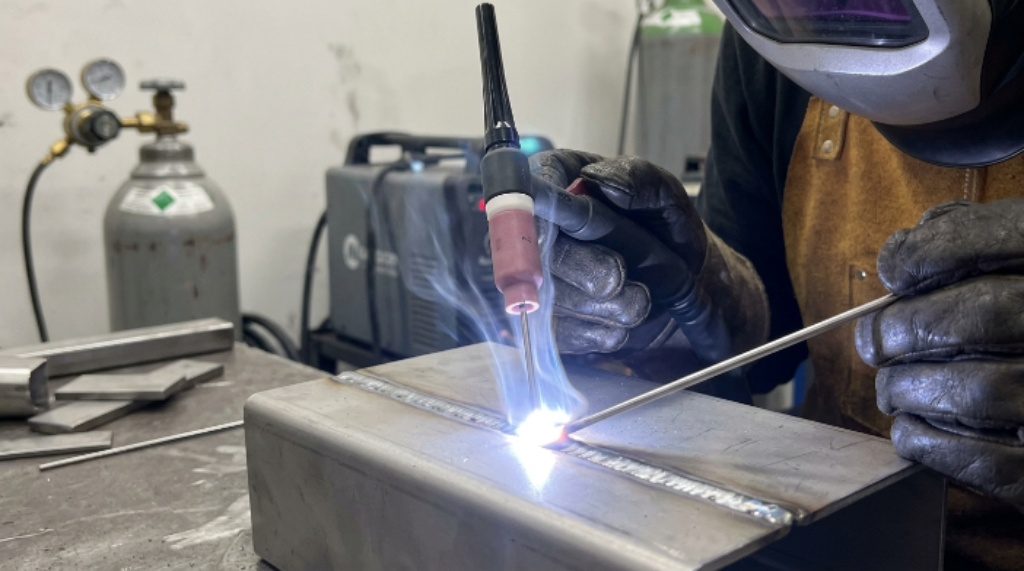

If you’re setting up a TIG welder for the first time, one of the first questions you’ll run into is: What gas do you use for TIG welding? For most TIG welding jobs, the answer is 100% argon. Pure argon is the standard starting point for TIG (GTAW) because it provides a stable arc, reliable arc starts, good shielding, and works across a wide range of common metals. It’s the gas most beginners should use when learning to TIG weld mild steel, stainless steel, and aluminum.
But argon isn’t the only option.
Helium, argon-helium blends, and specialized argon-hydrogen mixtures can improve penetration, heat input, welding speed, or surface characteristics in specific applications. The trick is knowing when those gases actually solve a problem—and when they simply make your setup more expensive and harder to control.
This guide explains the major TIG shielding gases, recommended starting flow rates, gas lenses, back purging, common gas mistakes, and how to choose the right gas for your particular job.
Quick answer: Start with 100% argon for most TIG welding. Use helium or an argon/helium blend when you need additional heat or penetration, particularly on thicker aluminum or copper. Use specialty gas mixtures only when the material, welding procedure, or application calls for them.
Why Does TIG Welding Need Shielding Gas?
TIG welding uses a non-consumable tungsten electrode to create an arc between the tungsten and the workpiece. That arc produces enough heat to melt the base metal and, when necessary, the filler metal.
The problem is that the hot tungsten and molten weld pool are extremely vulnerable to atmospheric contamination.
Oxygen and nitrogen from the surrounding air can cause oxidation, porosity, tungsten contamination, discoloration, and other weld-quality problems. Shielding gas creates a protective envelope around the tungsten, arc, weld pool, and hot filler metal so atmospheric gases don’t reach the welding zone.
AWS describes GTAW as a process that typically uses argon or helium to shield the weld from atmospheric contamination.
That’s why TIG is different from processes such as stick welding. A stick electrode carries its own flux-based shielding system. TIG relies on an external supply of shielding gas.
If the gas supply is interrupted, the weld can become contaminated very quickly.
100% Argon: The Best All-Around TIG Gas
For most welders, 100% argon is the correct answer.
Argon is popular because it combines several useful characteristics:
- Easy, consistent arc starting
- Stable arc behavior
- Good shielding coverage
- Good performance at relatively modest flow rates
- Excellent availability
- Lower cost than helium
- Suitable for a broad range of TIG applications
Miller identifies 100% argon as the best all-around TIG shielding gas and notes its favorable arc-starting characteristics compared with helium.
For a beginner, this simplicity matters.
You don’t want to change five variables at once while you’re learning torch control, arc length, travel speed, filler technique, and amperage. Starting with pure argon removes one unnecessary variable.
What metals can you TIG weld with pure argon?
In common shop applications, 100% argon is used for:
- Mild and carbon steel
- Stainless steel
- Aluminum
- Many nickel alloys
- Titanium and other specialty alloys when specified by the welding procedure
For aluminum, pure argon remains the normal starting point. AWS specifically notes that aluminum TIG does not require 100% helium and that argon is commonly preferred because of its cost, availability, arc characteristics, and cleaning behavior.
Helium: When You Need More Heat
Helium is another inert shielding gas used for TIG welding.
The major reason to choose helium is heat.
Compared with argon, helium can produce a hotter arc and increase heat transfer to the workpiece. That can be valuable when welding thick sections or metals that conduct heat rapidly.
Helium can be particularly useful for:
- Thick aluminum
- Copper
- Certain high-conductivity alloys
- Applications where higher travel speed is desirable
- Jobs where additional penetration is needed
Miller notes that helium’s higher thermal conductivity can produce higher heat input, allowing deeper penetration and faster travel speeds.
There is a trade-off, though.
Helium generally costs more than argon, requires different flow considerations, and has a higher ionization potential. That can make arc starting less consistent, particularly compared with argon.
So don’t switch to helium simply because it sounds like a more powerful gas.
If 100% argon is producing the penetration and productivity you need, there is usually no reason to make the switch.
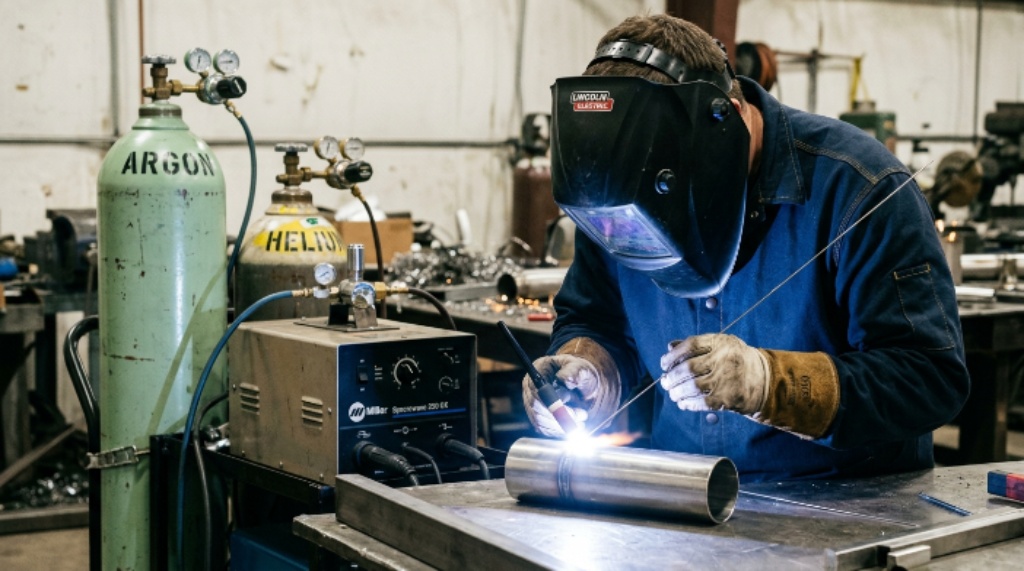
Argon/Helium Blends: A Useful Middle Ground
Argon-helium mixtures combine some of the advantages of both gases.
Argon provides easier arc starting and stable arc behavior, while helium increases heat input.
Commercial blends vary considerably, and Miller notes that common blends can range from roughly 25% to 75% helium. As helium concentration increases, the arc becomes hotter, while arc-starting performance and stability can decrease.
A blend can therefore make sense when:
- Pure argon isn’t providing enough heat
- You’re welding thick aluminum
- You’re working with copper or another highly conductive material
- You want more penetration without going entirely to helium
- Your welding procedure specifies an argon/helium mixture
Hobart Brothers also notes that argon-helium mixtures can increase penetration and reduce porosity in certain aluminum applications, although higher helium content can increase flow requirements and cost.
What About Argon-Hydrogen TIG Gas?
Argon-hydrogen mixtures are a more specialized category.
Small amounts of hydrogen can increase arc energy and improve productivity or surface characteristics in certain applications, particularly some austenitic stainless-steel and nickel-alloy work.
However, this is not a general-purpose beginner gas.
Hydrogen-containing shielding mixtures must be selected according to the material and welding procedure. They are not appropriate for every alloy, and hydrogen-sensitive materials require particular care.
AWS documentation recognizes argon/hydrogen mixtures as GTAW shielding-gas options for certain applications.
If you’re welding ordinary mild steel, stainless, or aluminum in a home shop, don’t start experimenting with hydrogen mixtures. Use the gas specified by the applicable WPS or consumable manufacturer.
Can You Use MIG Gas for TIG Welding?
This is one of the most common mistakes beginners make.
No—don’t assume a MIG shielding gas is suitable for TIG just because it contains argon.
For example, a common MIG steel mixture contains argon and CO₂. CO₂ is chemically active and is not a normal TIG shielding gas because it can cause contamination and damage to the tungsten.
The fact that a cylinder says “argon mix” doesn’t automatically make it appropriate for TIG.
For general TIG work, your safest starting point is:
100% argon.
If a specialized TIG application calls for another mixture, follow the welding procedure or the gas manufacturer’s recommendation.
How Much Argon Do You Need for TIG Welding?
There isn’t one universal TIG gas-flow setting.
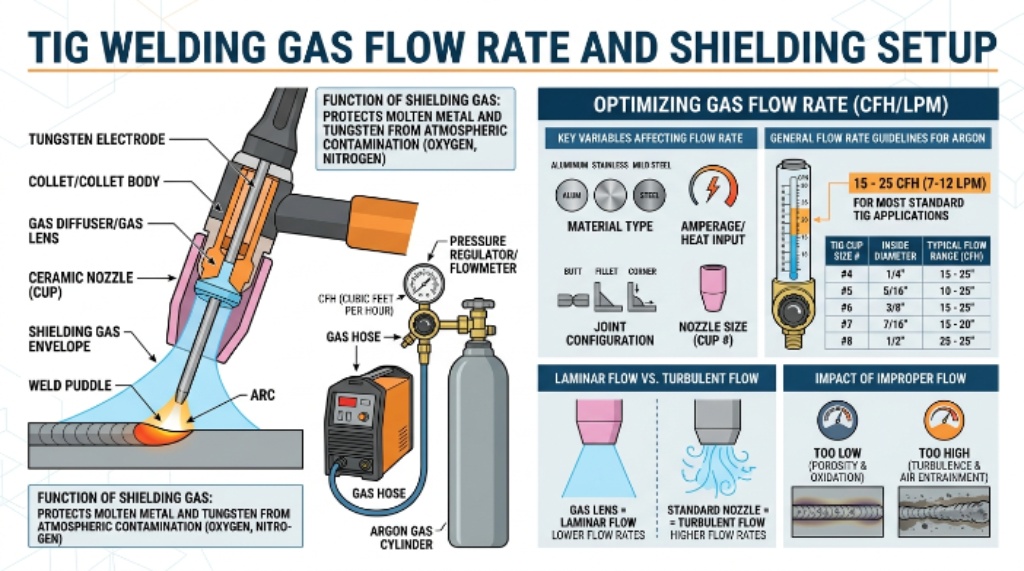
A common starting range is approximately 10 to 35 cubic feet per hour (CFH), according to Miller, but the correct setting depends on the torch, nozzle, gas lens, joint configuration, welding position, and surrounding airflow.
For many everyday TIG jobs, you may find yourself somewhere in the lower-to-middle portion of that range.
The important principle is:
Use enough gas to maintain reliable shielding, but don’t automatically turn the flow higher when the weld looks bad.
More gas is not necessarily better.
Why too much gas can cause problems
Shielding gas should ideally leave the torch in a relatively smooth, laminar column.
If flow becomes excessive, turbulence can develop. That turbulence can pull surrounding air into the shielding envelope—the exact opposite of what you’re trying to accomplish.
Miller specifically warns that excessive flow can increase turbulence and contamination risk.
So if you’re getting porosity, discoloration, or tungsten contamination, don’t automatically turn the regulator up.
Check:
- Gas type
- Gas flow
- Hose and fittings
- Torch assembly
- Cup size
- Gas lens
- Tungsten stickout
- Torch angle
- Drafts and fans
- Material cleanliness
A gas problem is often a shielding-system problem, not simply a “not enough CFH” problem.
Gas Flow Starting Points
The following table is best treated as a practical starting framework—not a substitute for the machine manufacturer’s instructions or a qualified WPS.
| Setup | Practical starting approach |
| Small TIG torch / small cup | Start toward the lower end of the normal range |
| Standard shop TIG | Often around 10–20 CFH |
| Larger cup / greater coverage | May require more flow |
| Gas lens | Often allows efficient, smoother coverage |
| Helium or helium-rich blend | Usually requires higher flow than argon |
| Outdoor/drafty conditions | Fix the draft rather than simply increasing flow |
| Critical weld | Follow the WPS and qualified procedure |
Miller gives a general TIG flow range of 10–35 CFH and recommends using the lowest effective flow that maintains proper shielding.
Gas Lens vs. Standard Collet Body
If you’re struggling with inconsistent shielding, don’t overlook the torch hardware.
A standard TIG collet body directs gas through holes around the torch. Depending on the design and conditions, this can create more turbulent flow.
A gas lens uses screens to straighten and distribute the gas more uniformly.
The benefits can include:
- More consistent shielding
- Reduced turbulence
- Better protection around the tungsten
- Greater allowable tungsten extension
- Improved access to tight joints
- More predictable gas coverage
Miller recommends gas lenses for critical or higher-quality TIG work and explains that their screen structure creates a more uniform, laminar flow.
A gas lens isn’t magic, though.
It won’t compensate for a gas leak, dirty material, severe wind, a contaminated tungsten, or an incorrectly positioned torch.
Don’t Forget Pre-Flow and Post-Flow
Gas management doesn’t stop once the arc starts.
Pre-flow
Pre-flow releases shielding gas before the arc is established. This helps displace atmospheric air around the torch and protects the tungsten during arc initiation.
Miller recommends a minimum pre-flow of 0.2 seconds, although the appropriate setting can depend on the equipment and gas-line configuration.
Post-flow
Post-flow keeps shielding gas around the hot tungsten and weld area after the arc is extinguished.
This is particularly important because hot tungsten can oxidize when exposed to air.
Miller gives a general post-flow formula of approximately:
Welding amperage ÷ 10 = post-flow seconds
It also recommends a minimum of eight seconds in its guidance.
For example, at 120 amps:
120 ÷ 10 = 12 seconds
Your welder’s manual or WPS should take priority over any general rule.
Why Stainless Steel Sometimes Needs Back Purging
Torch-side shielding isn’t always enough.
When TIG welding stainless tubing, pipe, or certain enclosed joints, the back side of the weld can also be exposed to atmospheric oxygen.
That can produce severe oxidation on the root side, commonly called sugaring.
Back purging places shielding gas inside the pipe or joint so the root remains protected while the weld is made.
Miller recommends 100% argon for both shielding and purging in typical stainless-steel GTAW applications.
This is an important distinction:
Torch shielding protects the face of the weld. Back purging protects the root.
For sanitary, pharmaceutical, food-processing, aerospace, and other high-integrity stainless applications, proper purge procedures can be critical.
What Gas Purity Should You Buy?
For casual practice, buying ordinary welding-grade argon from a reputable supplier is generally straightforward.
For critical work, however, the gas specification may be much more demanding.
Depending on the application, a welding procedure can specify:
- Gas purity
- Maximum oxygen content
- Dew point
- Gas mixture percentage
- Shielding-gas flow
- Purge requirements
For example, technical welding guidance for aluminum can specify very high-purity argon, while critical titanium work can impose particularly strict shielding requirements.
The takeaway is simple:
If a WPS specifies the shielding gas, purity, or dew point, follow the WPS—not a generic internet recommendation.
How to Tell If Your TIG Shielding Isn’t Working
A bad-looking TIG weld doesn’t automatically mean you selected the wrong gas.
Look for these symptoms:
- Porosity or pinholes
- Gray or heavily oxidized weld appearance
- Black or sooty contamination
- Discolored tungsten
- Tungsten balls or rapid contamination
- Unstable arc
- Poor arc starts
- Oxidized filler rod
- Excessive discoloration on stainless steel
- Oxidized stainless root during welding
Then troubleshoot systematically.
Check for leaks first. Inspect the torch, gas hose, fittings, regulator, cup, gas lens, and collet assembly.
Next, check for drafts.
A shop fan, open garage door, air conditioner, or outdoor breeze can push shielding gas away from the weld. Increasing flow may actually make the problem worse if it creates turbulence.
TIG Shielding Gas Safety
Argon and helium are inert gases, but inert does not mean harmless.
Both can displace oxygen. Argon is heavier than air and can accumulate in low areas, while helium is lighter and behaves differently in enclosed environments.
AWS safety guidance emphasizes the importance of ventilation and atmospheric testing in confined spaces because oxygen-deficient atmospheres can cause unconsciousness and death without warning.
OSHA also requires appropriate cylinder handling and storage practices, including securing cylinders and keeping them in well-ventilated areas.
At a minimum:
- Secure cylinders upright.
- Protect cylinder valves.
- Keep cylinders away from excessive heat and sparks.
- Use the correct regulator/flowmeter.
- Inspect hoses and connections.
- Don’t weld in an oxygen-deficient environment.
- Provide appropriate ventilation and fume control.
- Follow the cylinder supplier’s handling requirements.
Shielding gas also doesn’t eliminate the other hazards of TIG welding, including UV radiation, electrical shock, hot metal, fire, and welding fumes.
What Is the Best TIG Gas for Different Metals?
Here’s the practical version:
| Material/application | Typical TIG gas choice |
| Mild steel | 100% argon |
| Stainless steel | 100% argon |
| Aluminum | 100% argon |
| Thick aluminum | Argon or argon/helium |
| Copper | Argon or argon/helium depending on thickness/application |
| Titanium | High-purity argon and carefully controlled shielding |
| Stainless pipe root | Argon for torch shielding and typically argon purge |
| Specialized stainless production | Argon/hydrogen may be specified |
| General beginner TIG | 100% argon |
These are general starting points. Material grade, thickness, joint design, welding position, machine capability, and the governing WPS can change the recommendation.
FAQs About TIG Welding Gas
What gas is best for TIG welding?
For most TIG welding, 100% argon is the best all-around choice. It provides stable arc performance, easy starts, good shielding, and works well on common materials such as steel, stainless steel, and aluminum.
Can you TIG weld with helium?
Yes. Helium is used when additional heat, penetration, or welding speed is beneficial. It is especially useful for some thick aluminum and copper applications. However, it costs more and can make arc starting less consistent than argon.
Is 75/25 argon-CO₂ good for TIG?
No. The common 75/25 argon-CO₂ mixture is a MIG shielding gas, not a normal TIG shielding gas. Use 100% argon unless your TIG procedure specifically calls for another gas.
Can you TIG weld aluminum with pure argon?
Yes. Pure argon is the normal starting gas for aluminum TIG welding. Helium or argon/helium can be considered when additional heat or penetration is needed.
What CFH should argon be set at for TIG?
A typical TIG range is about 10–35 CFH, but the correct setting depends on the torch, cup, gas lens, joint, position, and surrounding airflow. Start with the equipment manufacturer’s recommendation and adjust only as needed.
Can too much argon cause TIG problems?
Yes. Excessive gas flow can create turbulence and pull atmospheric air into the shielding envelope. More gas doesn’t necessarily mean better shielding.
Why is my TIG weld dirty even though I’m using argon?
Possible causes include a gas leak, contaminated tungsten, dirty base metal, insufficient or excessive gas flow, drafts, poor torch positioning, excessive tungsten stickout, a damaged hose, or incorrect torch assembly.
Do I need a gas lens for TIG?
Not always. A standard collet body can work perfectly well for many jobs. A gas lens becomes especially useful when you need more consistent shielding, longer tungsten extension, or higher-quality welds.
Does stainless steel TIG welding require a purge?
Not every stainless weld requires back purging, but many pipe, tube, and high-integrity applications do. Purging protects the root side from oxidation and can be essential when root quality and corrosion resistance matter.
The Bottom Line
If you’re standing in a welding-supply store wondering which cylinder to buy for your TIG welder, keep it simple:
Buy 100% argon.
For the vast majority of beginners and general-purpose TIG work, that’s the right place to start.
Once you understand your machine and the behavior of your weld, helium or argon/helium blends can become useful when you need more heat or penetration. Specialty argon-hydrogen mixtures have their place in specific applications, but they should be selected based on the material and welding procedure—not because they’re supposedly “better” than argon.
And remember that shielding gas is only one part of TIG weld quality.
A leak-free system, appropriate flow, clean material, uncontaminated tungsten, correct cup and gas-lens setup, proper torch position, controlled airflow, and adequate pre-flow/post-flow are all part of the equation.
For critical or code work, the final authority should always be the applicable Welding Procedure Specification (WPS), qualified procedure, equipment manufacturer’s instructions, and applicable AWS/industry requirements.
For everyday TIG welding, though, the rule is remarkably simple:
100% argon is the workhorse gas. Start there, get your technique right, and only move to specialty mixtures when the job gives you a specific reason to do so.