
If you’re learning stick welding, one of the first technique questions you’ll run into is simple: Do you drag the electrode or push it? For most conventional stick-welding situations, the beginner-friendly answer is drag. With SMAW (Shielded Metal Arc Welding), the electrode coating produces shielding gas and slag as it burns. A slight drag, or backhand, travel angle generally helps keep the slag behind the molten weld pool instead of allowing it to run into the area you’re trying to fuse.
But there’s an important catch: “Always drag a stick electrode 10–15 degrees” is too simplistic.
The correct travel angle and electrode movement depend on the electrode classification, welding position, joint design, current, polarity, arc length, and the welding procedure being followed. Miller, Lincoln Electric, and Hobart Brothers all provide technique guidance that shows why there isn’t one angle or motion that works for every stick-welding job.
So, if you’re holding a 6010, 6011, 6013, or 7018, don’t assume they should all be run the same way.
The Short Answer: Drag Most Stick Welds
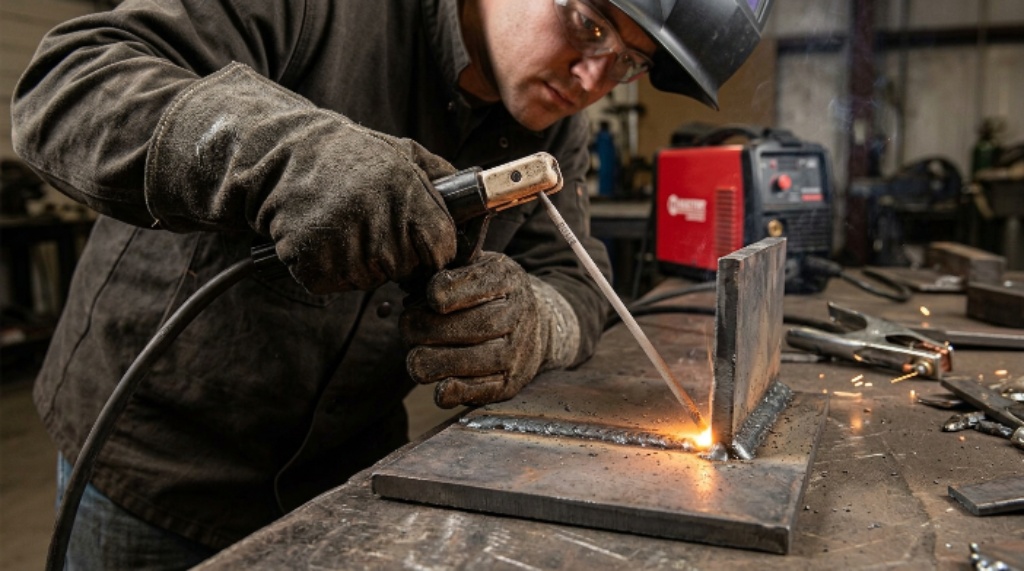
For a typical flat-position SMAW bead, start with a slight drag angle and a short, controlled arc.
Miller’s general stick-welding guidance describes a travel angle of approximately 0–15 degrees toward the direction of travel and identifies this as the drag or backhand technique.
The reason is straightforward. The electrode creates a molten weld pool while its flux coating forms a layer of slag. You generally want that slag to follow the weld pool rather than get pushed ahead of it.
A practical beginner setup looks like this:
| Situation | Good starting approach |
| Flat-position SMAW | Slight drag, short arc |
| Horizontal fillet | Usually slight drag with correct work angle |
| E7018 | Steady drag and tight arc are common |
| E6010/E6011 | Short arc with controlled manipulation; technique varies by application |
| Vertical-up | Position-specific angle and puddle control |
| Overhead | Short arc, controlled puddle and electrode-specific technique |
| Code or production welding | Follow the applicable WPS and electrode manufacturer’s instructions |
The important word is starting. These are not substitutes for a qualified welding procedure.
Why Dragging Usually Works
Stick electrodes are different from solid-wire MIG electrodes because the electrode itself carries the flux needed to shield the weld.
As the electrode burns, the coating produces shielding gases and molten slag. The slag eventually solidifies over the weld bead and must be removed between passes when required.
If you use an inappropriate push angle, you can make it easier for slag to move toward the leading edge of the puddle. That can interfere with visibility and increase the chance of slag becoming trapped in the weld.
Slag inclusion is a real weld discontinuity. It can result from several factors, including poor manipulation, inadequate cleaning between passes, inappropriate travel speed, incorrect current, and poor bead placement.
That means dragging is helpful, but drag angle alone doesn’t prevent slag inclusion.
The puddle still has to wet into both sides of the joint, the arc has to remain controlled, and previous-pass slag must be removed properly.
Drag Angle Is Not the Same as Work Angle
This distinction trips up a lot of beginners.
Travel angle describes how the electrode is angled in the direction you’re moving.
Work angle describes how the electrode is positioned across the joint.
Imagine making a flat fillet weld between a horizontal plate and a vertical plate. Your travel angle controls whether you’re dragging or pushing along the weld. Your work angle determines how the arc is aimed into the corner.
You can have the correct drag angle and still produce a poor fillet weld if your work angle favors one plate too heavily.
The result may be uneven fusion, excessive buildup on one side, or undercut on the other.
A better habit is to think about three things simultaneously:
- Travel angle — drag or push direction.
- Work angle — where the electrode is aimed across the joint.
- Arc length — how far the electrode tip is from the puddle.
All three affect the finished weld.
How Much Should You Drag the Rod?
For general flat-position practice, a small drag angle is a reasonable starting point.
Miller gives a general range of 0–15 degrees for its stick-welding technique guidance.
That does not mean you should automatically hold every electrode at exactly 15 degrees.
Too much angle can create problems of its own. An exaggerated angle can change the arc force, alter bead shape, and make it harder to maintain consistent control.
The best angle is the one that allows the electrode to maintain a stable arc while the molten metal flows into the joint and the slag stays behind the puddle.
In other words, don’t chase a number at the expense of the puddle.
Watch what the weld is doing.
What About 7018? Should You Drag It?
Yes. E7018 is commonly run with a steady drag technique and a relatively tight arc.
Hobart Brothers specifically recommends dragging E7018 along the weld joint. Its guidance also notes that vertical-up welding requires a much more position-specific approach, including a small leading angle and controlled weaving when appropriate.
For a beginner running 7018 on a flat practice bead, focus on:
- A short, stable arc
- Consistent travel speed
- A modest drag angle
- Proper work angle
- A visible, controlled puddle
- Consistent bead width
- Thorough slag removal between passes
Don’t make a huge sweeping motion simply because you’re trying to create visible “stacked dimes.” A good SMAW bead is about fusion and soundness first and appearance second.
One more thing: keep 7018 dry
E7018 is a low-hydrogen electrode, so storage and handling matter.
Hobart’s current guidance explains that E7018 electrodes are supplied in moisture-resistant packaging and should be protected from moisture. Opened electrodes may require controlled holding or reconditioning according to the electrode manufacturer’s recommendations and the applicable code or job requirements.
For critical welding, don’t rely on a generic “put them in the oven” rule. Follow the manufacturer’s instructions and the applicable WPS/code.
What About 6010 and 6011?
This is where the simple “just drag it” advice starts to break down.
E6010 and E6011 are commonly used when you need a penetrating arc and out-of-position capability. They don’t necessarily behave like E7018.
Lincoln’s SMAW guidance specifically describes E6010 and E6011 applications using a short arc and, in certain situations, a quick whip technique with slight circular movement in the crater. Its recommendations also change depending on whether the weld is overhead, whether fit-up is poor, and which electrode classification is being used.
That’s an important distinction.
You may still be traveling generally in a drag direction, but the electrode can be manipulated with a controlled whip-and-pause motion rather than simply being pulled smoothly across the joint.
Don’t copy a 6010 technique onto 7018
A common beginner mistake is learning one rod and assuming every other rod should feel the same.
They don’t.
A 6010 has a different arc character and puddle behavior from a 7018. A 6011 is also commonly selected for applications where its characteristics are advantageous, including situations involving AC power.
The electrode manufacturer’s data sheet should be your first reference when you’re unsure.
Does Pushing a Stick Electrode Ever Work?
It can, depending on the electrode, position, and procedure.
That’s why the statement “never push a stick electrode” isn’t technically precise.
For a beginner asking how to run an ordinary SMAW bead, however, dragging is the safer default rule because it generally supports good slag control.
The more experienced answer is:
Use the travel direction, electrode angle and manipulation specified for the electrode and welding procedure you’re actually using.
That matters even more for pipe welding, vertical welding, overhead welding and code work.
For example, AWS publishes qualified standard welding procedures that specify particular electrode combinations and welding positions. AWS also states that its procedure-qualification framework covers SMAW along with other welding processes.
Flat-Position Stick Welding: The Easiest Place to Learn
If you’re new to SMAW, start in the flat position.
Clean the steel and mark a straight line on the plate. Use one electrode size and classification so you’re changing as few variables as possible.
Strike the arc, establish a short arc length, and begin moving steadily with a slight drag angle.
Watch the leading edge of the puddle, not just the bright arc.
You’re looking for the molten metal to flow into the joint rather than simply piling up on top of the plate.
If you’re making a fillet weld, watch both toes of the weld. The puddle should wash into both sides of the joint.
If the slag starts getting in front of the puddle, stop and figure out why rather than simply increasing the drag angle dramatically.
The cause could be:
- Travel speed
- Arc length
- Current setting
- Electrode angle
- Work angle
- Electrode classification
- Joint preparation
Changing five things at once makes troubleshooting almost impossible.
How Arc Length Changes the Result
A good drag angle won’t compensate for a bad arc length.
A long arc can make SMAW more difficult to control. It can increase spatter, make the arc wander, and change the shape of the weld pool.
This is particularly important with electrodes such as 7018, where a tight, controlled arc is a major part of getting predictable results.
If your electrode keeps sticking, don’t automatically solve the problem by pulling the rod farther away from the work.
Check the basics first:
- Is the amperage appropriate?
- Is the electrode the right size?
- Is the polarity correct?
- Is the base metal clean?
- Is the electrode in good condition?
- Are you maintaining the recommended arc length?
The electrode manufacturer’s operating range should take priority over a generic internet setting.
Travel Speed Matters, Too
Imagine you’re dragging the rod at the correct angle but moving much too quickly.
You can still end up with a narrow bead and inadequate fusion.
Move too slowly, and you can deposit excessive metal, overheat the workpiece,e or allow the puddle to become difficult to control.
The goal is a consistent travel speed that produces the bead size and penetration required by the joint and procedure.
Don’t judge your speed solely by how fast the rod disappears. Watch the puddle.
That’s one of the biggest transitions between simply “burning rods” and actually learning to weld.
Vertical and Overhead Stick Welding Are Different
The flat-position drag rule should not be blindly transferred to vertical and overhead welding.
Gravity changes puddle behavior, and different electrode classifications have different operating characteristics.
For vertical-up work, you may need a controlled progression, shorter arc, and carefully managed puddle. E7018, for example, has specific vertical-up technique recommendations from filler-metal manufacturers.
E6010 and E6011 may use different manipulation techniques, particularly for pipe and out-of-position work. Lincoln’s guidance includes short-arc and whip techniques for these electrodes.
Overhead welding requires even more attention to puddle size and control.
If molten metal is falling away from the joint, don’t try to “muscle through” the weld. Stop, let the work cool as appropriate, reassess your settings and technique, and practice on scrap.
Common Signs Your Technique Needs Adjustment
After the weld cools, remove the slag and inspect the bead.
Watch for:
- Slag trapped along the toes
- A tall, narrow or rope-like bead
- Undercut
- Excessive spatter
- Poor fusion at one side of a fillet
- Uneven bead width
- Porosity
- Slag that repeatedly becomes difficult to remove
- An unstable or excessively harsh arc
Don’t immediately blame the travel angle.
For example, undercut can be associated with excessive current, excessive travel speed, long arc length, or electrode positioning. Slag inclusion can also have multiple causes besides travel direction.
Good welding troubleshooting means changing one variable at a time whenever possible.
A Simple Practice Exercise
Here’s a useful drill for beginners.
Take a piece of clean mild-steel plate and run three short beads with the same electrode.
For the first bead, use a modest drag angle.
For the second, exaggerate the drag angle.
And for the third, use a mild push angle only as a controlled learning exercise on scrap.
Keep your current electrode size and travel speed as consistent as possible.
After the plate cools, remove the slag and compare the results.
Look at:
- Bead width
- Tie-in at the toes
- Slag coverage
- Slag removal
- Spatter
- Undercut
- Surface profile
This teaches something a diagram cannot: the angle you hold in your hand changes what happens in the puddle.
Keep notes on the electrode classification, diameter, amperage,e and technique. Over time, you’ll build a practical reference for how different rods behave on your particular machine and material.
The Most Important Rule for Professional Welding
If you’re welding a bracket in your garage, general technique guidance is useful.
If you’re welding structural steel, pressure equipment, piping, bridges, lifting equipment,nt or another safety-critical component, the question isn’t simply “drag or push?”
The question becomes:
What does the applicable welding procedure require?
A qualified WPS can establish variables such as electrode classification, welding position, current, polarity, joint design, preheat, interpass requirements and technique. AWS’s B2.1/B2.1M:2026 specifically addresses qualification of welding procedures and personnel, including SMAW.
In code work, follow the governing WPS and applicable code rather than substituting a generic rule from a welding blog.
Stick Welding Safety Still Comes First
SMAW produces intense ultraviolet and infrared radiation, hot slag, sparks, fumes and electrical hazards.
OSHA requires appropriate protection for arc welding and addresses eye protection, protective clothing, ventilation, fire prevention and confined-space precautions.
At minimum, use appropriate welding PPE and make sure your work area is suitable for hot work. Protect nearby workers from arc radiation, keep combustible materials away from sparks and slag, and provide adequate ventilation or appropriate fume control.
Never weld on a container that may have held flammable or hazardous material unless it has been properly prepared and determined safe.
And don’t assume outdoor welding automatically eliminates fume hazards. Welding fumes still need to be controlled so you aren’t breathing the plume.
FAQs
Should you drag or push when stick welding?
For most conventional SMAW work, especially beginner flat-position welding, dragging is the normal starting technique. It helps keep the slag behind the molten weld pool.
What is the best stick-welding angle?
There is no single angle that works for every electrode and position. A modest drag angle is a good starting point for many flat-position applications. Miller gives a general 0–15° travel-angle range, but electrode and position-specific instructions should take priority.
Do you drag a 7018 electrode?
Generally, yes. E7018 is commonly run with a steady drag and tight arc. Vertical-up and other positions require their own technique.
Do you drag a 6010?
E6010 is commonly run with a short arc and may use controlled whip-and-pause or related manipulation depending on the application. Follow the electrode manufacturer’s recommendations and the applicable welding procedure.
Why does my stick weld have slag trapped in it?
Slag inclusion can have several causes, including poor manipulation, incorrect travel speed, inadequate cleaning between passes, unsuitable current, poor bead placement, or an electrode angle that allows slag to interfere with the puddle.
Why is my stick weld tall and narrow?
Possible causes include excessive travel speed, insufficient heat, incorrect electrode angle, or an arc that isn’t being controlled properly. Don’t change the travel angle alone without checking current, arc length and travel speed.
Why does my 7018 electrode keep sticking?
Check the amperage, polarity, electrode condition,n and arc length against the manufacturer’s recommendations. A long arc is not a reliable solution for a rod that keeps sticking.
Can you push a stick weld?
Some SMAW applications can use different travel directions or manipulation techniques, so “never push” is too absolute. For ordinary beginner stick welding, however, a slight drag is the best starting point.
Is dragging the same as keeping the electrode touching the steel?
No. Dragging describes the direction and travel angle. Your arc still needs to be maintained according to the electrode’s recommended operating technique. Some electrodes are designed for very close contact, while others require a controlled arc gap.
Does rod type change the correct technique?
Absolutely. E6010, E6011, E6013, E7018 and other electrodes have different arc characteristics and operating recommendations. The electrode classification and manufacturer’s data should guide your technique.
Bottom Line
If you’re just getting started with stick welding, remember this:
Start by dragging, not pushing. Keep the angle modest, maintain a controlled arc, watch the puddle, le and let the slag follow behind the weld.
But don’t turn that into another rigid welding rule.
A good SMAW technique is the combination of electrode selection, travel angle, work angle, arc length, amperage, polarity, travel speed, welding position and joint preparation.
For a simple flat-position practice bead, a slight drag is usually the right place to start. For 6010/6011 pipe work, vertical welding, overhead welding or code work, the technique becomes more specific. And for professional welding, the qualified WPS and electrode manufacturer’s instructions ultimately take precedence.
That’s the difference between memorizing “drag the rod” and actually understanding why you’re doing it.